



 79 / 308

79
International Students and Students’ Exchange
Students’ Exchange
TUM students are offered several possibilities for spend-
ing some part of their studies abroad – varying in region,
duration and educational goal. Within the framework of
the European ERASMUS+ program and TUM’s worldwide
TUMexchange program, students have the possibility
to study one or two semesters at one of TUM’s more
than 450 partner universities. Moreover TUM has signed
about 35 double degree agreements worldwide, targeting
students with excellent academic performance who are
interested in doing an additional degree.
Tuition fees are waived for double degree students as
well as for students going abroad for an exchange. Help
regarding administrative issues and housing is usually pro-
vided by TUM and/or the partner institution. ERASMUS+
and double degree students at EU-partner universities
automatically get the ERASMUS+ grant whereas TUMex-
change and double degree students studying overseas
may apply for scholarships.
Apart from offering the exchange options mentioned,
self-organized internships within Europe and research
projects overseas can be financially supported by TUM.
Information about suitable scholarships is provided by
TUM and the department.
The ERASMUS+ student mobility as well as the double
degree program is by and large organized on departmen-
tal level whereas TUM’s International Center is in charge
of the TUMexchange program. A recently issued brochure
aims at the promotion of double degree programs among
the department’s students.
Incoming Exchange Students
In addition to recruiting an increasing number of inter-
national full-time students, the department successfully
attracts an increasing number of international exchange
students – both from within Europe and worldwide. In win-
ter 2017/18, 151 exchange students from 27 nations are
studying at the Department of Mechanical Engineering.
3
During the winter term 2017/18 more than 16% of the
incoming exchange students of TUM have been enrolled
at the Department of Mechanical Engineering and another
43 students have been registered as full-time M.Sc.
students within the framework of the TIME double
degree programs.
4
Outgoing Exchange Students
The Department of Mechanical Engineering not only aims
at increasing its international student body, but also pur-
sues its goal to increase the mobility of its own students.
With the objective of being able to offer every student
the opportunity to spend at least one semester abroad,
the department has signed 70 ERASMUS+ agreements
with 87 universities in 21 European countries. Most of the
department’s partner institutions are in France (12), Spain
(12), Italy (8), Sweden (6) and the UK (5).
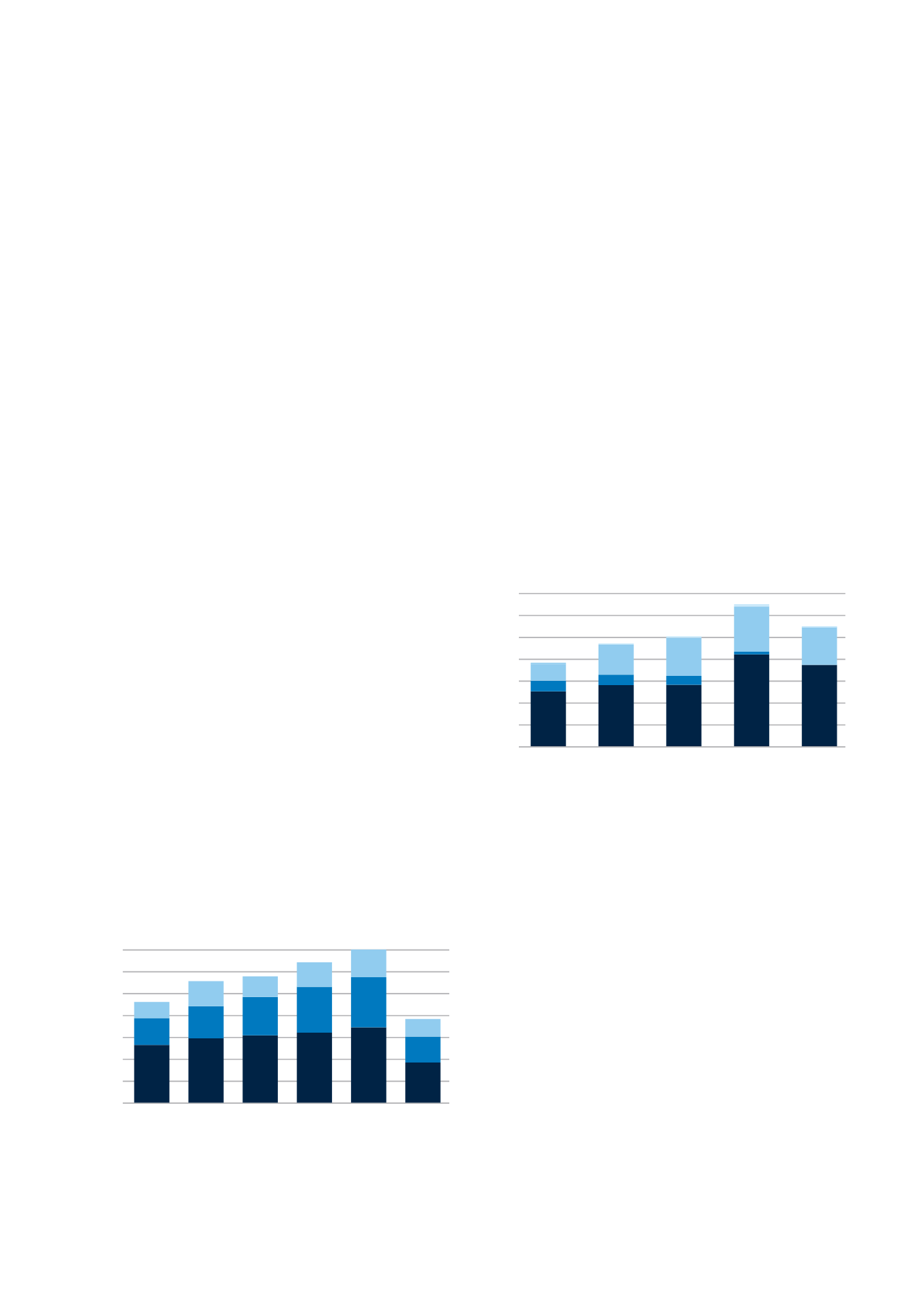
In 2017/18 the number of students going abroad has
slightly declined for the first time since 2013/14, yet it
nevertheless seems to have stabilized at a level of around
300 outgoing students per year.
350
300
250
200
150
100
50
0
Number of students
n
ERASMUS
n
TUMexchange
n
Time DD
2012-13 2013-14 2014-15 2015-16 2016-17 2017-18*
350
300
250
200
150
100
50
0
Number of students
2014-15
2015-16
2016-17
2017-18
n
ERASMUS SMS
n
ERASMUS SMP
n
TUMexchange
n
Time DD
2013-14
3 Sources: International Center (TUM): Online database ‘Moveon’;
Students
’
Services Department of Mechanical Engineering (TUM)
4 See footnote 3
Development of the number of mechanical engineering students going abroad
Development of the number of international exchange and double degree
students (*winter term 2017/18 only)
In addition, the centrally organized TUMexchange
program enables selected students of the department to
study overseas at one of more 120 partner universities.
Moreover a joint degree B.Sc. program ‘Engineering
Science’ and a joint M.Sc. program ‘Material Science’
with Paris Lodron Universität Salzburg have been signed
and ten TIME double degree agreements in Brazil,
France, Italy, Sweden, Switzerland and Spain have been
concluded with renowned associate universities such
as Groupe Ecoles Centrales, KTH Stockholm and Ecole
Polytechnique Fédérale de Lausanne (EPFL).