



 40 / 308

40
NANOSHOCK* – Manufacturing Shock Interactions
for Innovative Nanoscale Processes
Funded by the European Research Council (ERC) under
the European Union’s Horizon 2020 research and innova-
tion program with an Advanced Grant for Prof. Adams, in
this project we are developing numerical methods that are
capable of predicting multi-phase shock wave interactions
and are continuously optimizing our software framework
for the latest high-performance computing architectures.
Our mission is to improve the understanding of complex
physical phenomena with the help of numerical tools. As
an example, we investigate the underlying mechanisms
of applications such as kidney-stone lithotripsy, which
ultimately is the fundamental problem of gas-bubble
collapse impact on interfaces and biomaterials. With a
detailed knowledge of the physics, we aim to help to
improve treatments in cancer therapy or drug delivery
by harnessing the enormous potential of shock wave-
induced interactions someday.
We continuously develop and improve our numerical
methods and computer capabilities and offer our simula-
tion framework to the public. Our research code ‘ALPACA’
is available under open-source license
(www.aer.mw.tum.de/abteilungen/nanoshock). Interestingly, solving the
inviscid and per se unstable Euler equations using spatial
schemes with increasingly high order is subject to new
challenges. Due to the fact that numerical dissipation no
longer suppresses the effect of floating-point inaccura-
cies, symmetric test cases like an implosion problem or
the Rayleigh-Taylor instability tend to lose symmetry. We
have improved our numerical algorithms and actual imple-
mentations to ensure perfect symmetry of low-dissipative
test problems.
* This project has received funding from the European Research Council
(ERC) under the European Union’s Horizon 2020 research and innovation
programme (grant agreement No 667483).
The ‘Nanoshock’ group at the Institute of Aerodynamics
and Fluid Mechanics (Prof. Adams) investigates the highly
complex flow physics of shock interactions with inter-
faces. Shock waves are discontinuities in the macroscopic
fluid state that can lead to extreme temperatures, pres-
sures and concentrations of energy. A classic example of
the generation of shock waves is the supersonic boom
of an aircraft or the pressure wave originating from an
explosion.
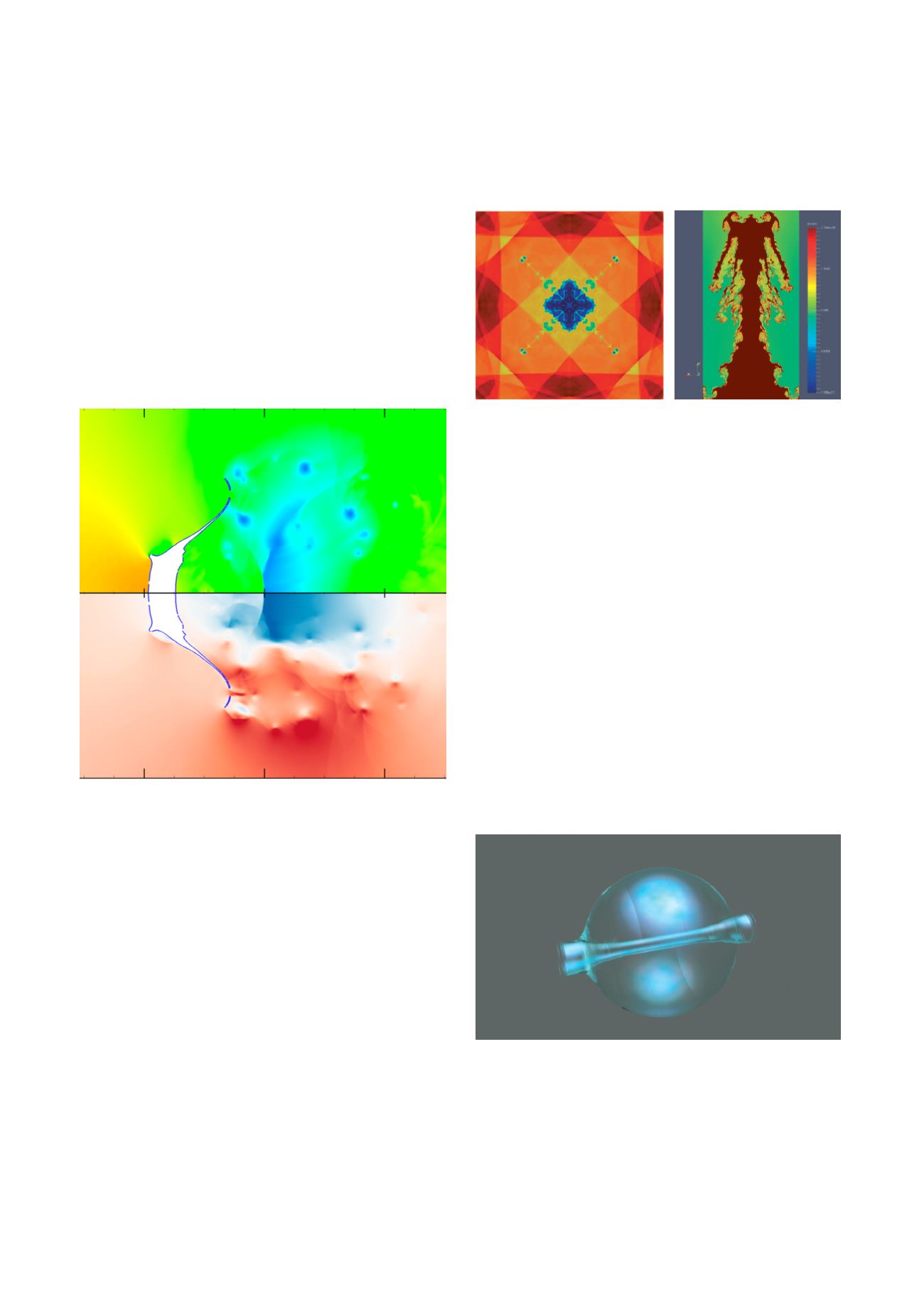
Interface visualization (blue line) with pressure (upper half) and normalized
streamwise velocity component (lower half) of a water drop after interaction
with a shock of Mach number MS=1.47.
Snapshots of highly-resolved two-dimensional test simulations: implosion
test case (left) and Rayleigh-Taylor instability (right). Note the exact symme-
try of the simulation result.
Volume-rendered interface visualization of the liquid drop shortly after
exposure to highly-focused energy deposition from a laser pulse
Members of the research group are V. Bogdanov, N. Fleisch-
mann, N. Hoppe, N. Hosseini, J. Kaiser, A. Lunkov, T. Paula,
J. Winter, Dr.-Ing. S. Adami, Prof. Dr.-Ing. N. A. Adams.
Selected Highlights 2017