



 42 / 308

42
Selected Highlights 2017
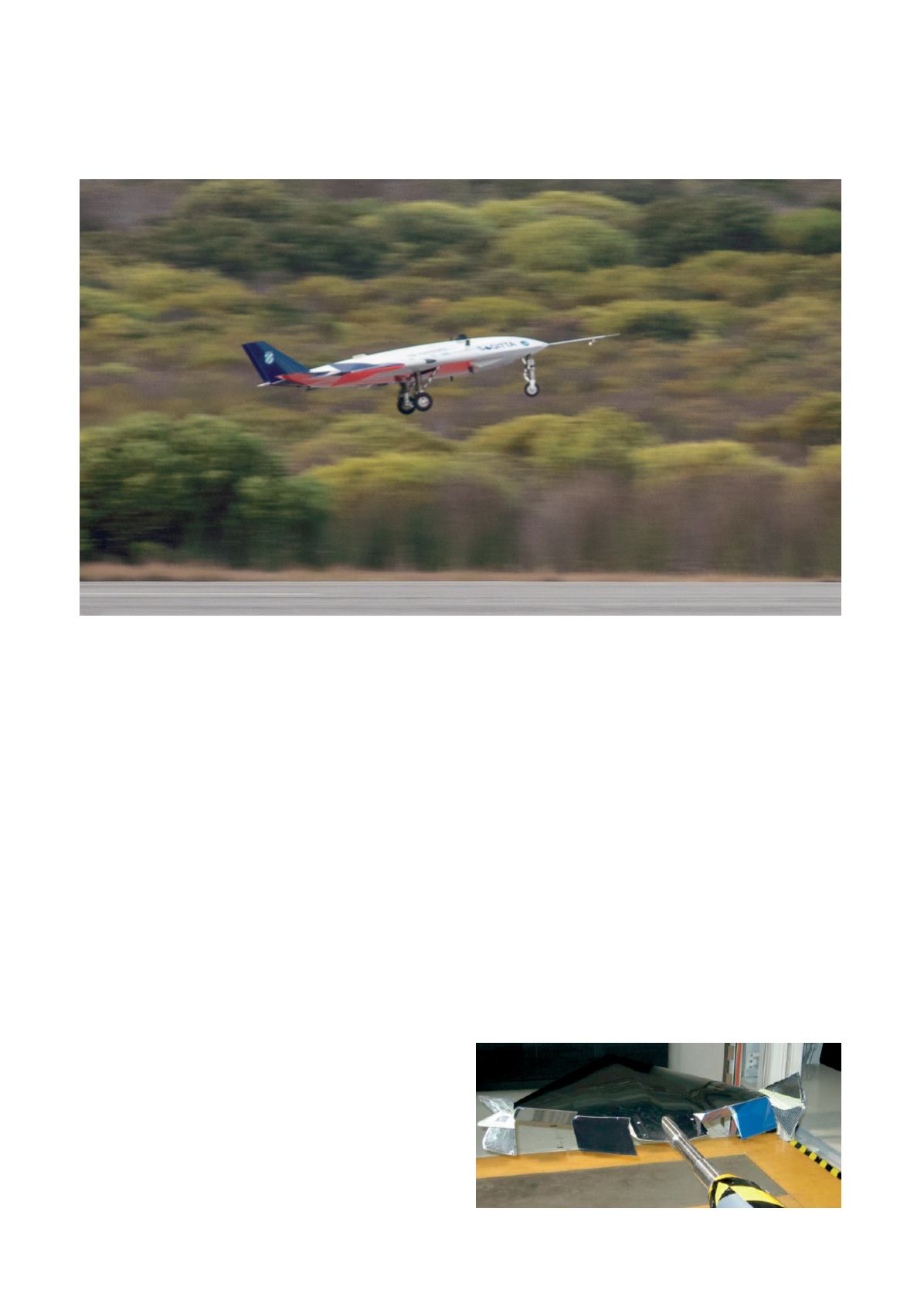
In 2017 TUM researchers, jointly with their project partners
from industry and academia, successfully conducted the
first flight campaign of the SAGITTA technology demon-
strator. During two flights in South Africa the flying testbed
showed its safe operation in flight. Multiple technologies
of five TUM institutes were on board this aircraft.
The aircraft manufacturer Airbus Defence & Space
initiated its open innovation initiative SAGITTA in 2010.
Sagitta, meaning arrow in latin, signifies the target air
vehicle configuration, which was designed exactly like the
tip of an arrow (diamond wing). In very close cooperation
between industry and multiple research institues, from
DLR, the University of the German Armed Forces, the
Technische Hochschule Ingolstadt as well as the Technical
Universities of Chemnitz and Munich, are jointly develop-
ing technologies for future unmanned air vehicles (UAV).
As part of the project the individual technologies were
integrated and tested for their applicability on the flying
testbed. Within TUM four institutes and one TUM-IAS
Focus Group contributed to the project:
Institute of Aircraft Design
Besides the overall aircraft design of novel UAVs with
low wing span, novel flight control devices as well as
novel propulsion integration and control concepts were
in the focus of research. New means of controlling the
air vehicle, such as thrust vectoring techniques, as well
as novel active flap systems, are key enablers for such
diamond-shaped aircraft. In close cooperation with the
Institute for Aerodynamics and Fluid Mechanics a radical
new split flap system for the wing tip has been developed,
promising increased efficiencies and better performance.
This flap system has already been tested during the first
flights of Sagitta.
Institute of Aerodynamics and Fluid Mechanics
Diamond shape wings with a high leading edge sweep
show specific flow phenomena, such as separated leading
edge vortices for example. A better understanding of such
flow characteristics as well as methods to actively effect
those flow conditions were in the focus of research at the
institute. For the flying testbed the institute was respon-
sible for all aerodynamic data and windtunnel measure-
ments, amounting to more than 15.000 datapoints for
multiple variants of the configuration.
First Flight of the SAGITTA Technology Demonstrator