



 203 / 308

203
Nuclear Engineering
The safe and economic operation of nuclear reactors
depends to a large extent on the behavior of the nuclear
fuel. We carry out research in this topic through a series
of projects on model development and the simulations
of fuel rod and fuel assembly behavior for a large range
of operating and transient conditions. The use of thorium
fuel-cycle in future reactors is becoming a hot topic
around the world because of its better performance in
terms of nuclear waste compared to the current ura-
nium cycle. During 2017, a project was completed that
expanded the capabilities of the fuel analysis code TRAN-
SURANUS, in collaboration with the Institute for Tran-
suranic Elements (ITU) in Karlsruhe, to the simulation of
thorium-based fuels ((Th,Pu)O
2
and (Th,U)O
2
) by including
models for fission gas release, thermal properties, burn-up
and fracture dynamics models with very good results.
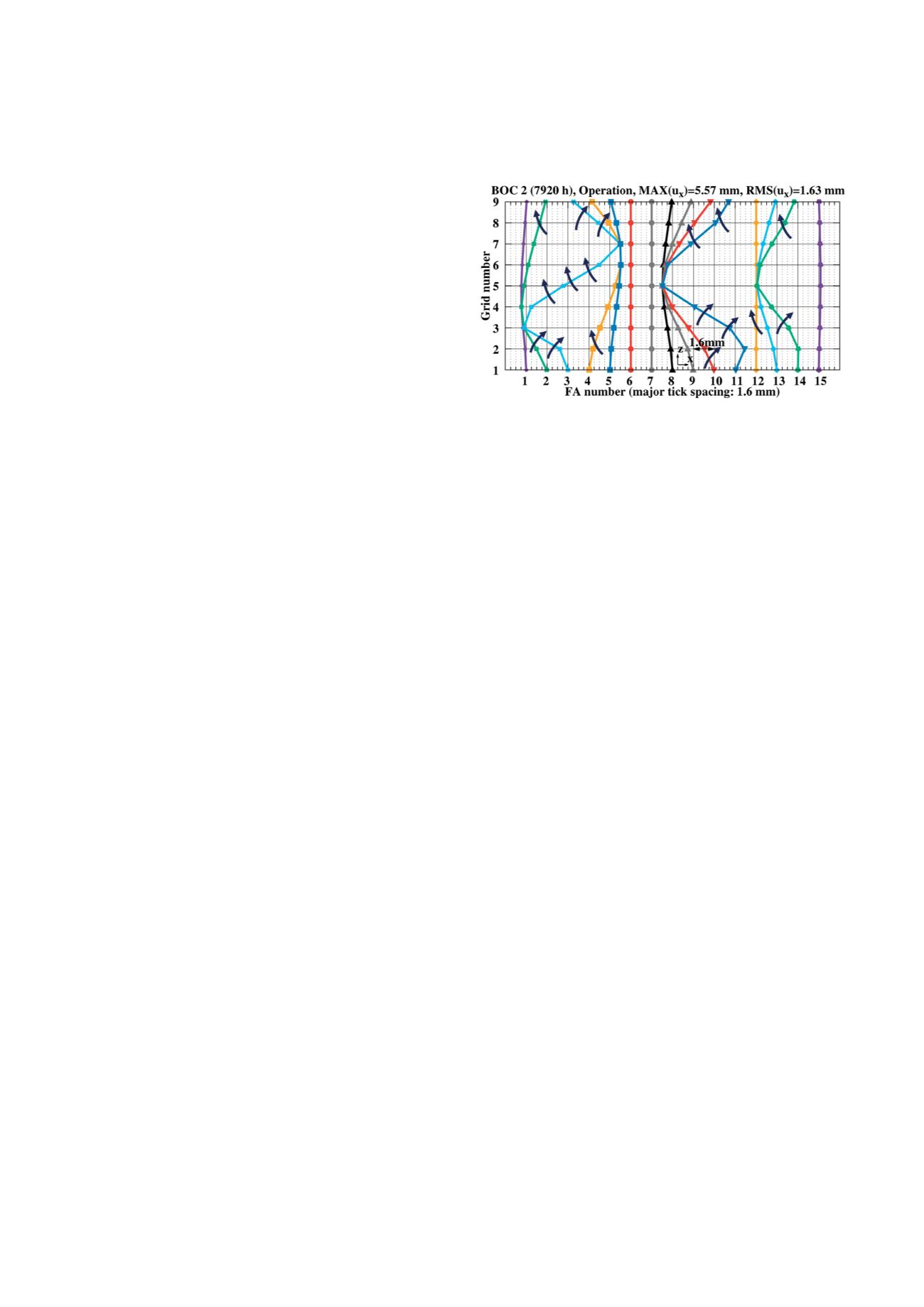
Another on-going project looks into the long-term creep
deformation of PWR (pressurized water reactor) fuel
assemblies (FA), also known as FA bow. A sophisticated
mechanical model has been developed with ANSYS
that also contains fuel structure interactions. Such a
development makes it possible to carry out studies of
fuel assembly displacements and full core mechanical
oscillations. Finally, a collaboration with the CEA and
E.On Kernkraft (today PreusserElektra) on the behavior of
Fuel assembly bowing and forces caused by fluid-structure interactions in
the core of a PWR (A. Wanninger, Ph.D. Work)
Material and Mechanical Fuel Behavior Analysis
new fuel materials in LWRs has produced very interesting
insights into their properties and open the possibility of
using them in the future.
Projects
■■
Development of models for the prediction of thorium-
based fuel (E.On Kernkraft)
■■
Experimental and analytical analysis of the performance
of nuclear fuel under LOCA conditions (E.On Kernkraft)
■■
Mechanical analysis of bowing in PWR fuel assemblies
(E.On Kernkraft)