



 207 / 308

207
Vibroacoustics of Vehicles and Machines
Experimental Test Facility
In 2017, the Chair of Vibroacoustics of Vehicles and
Machines purchased two major scientific measurement
systems, namely a PSV500 3D-scanning-laser-Doppler
vibrometer (LDV) from Polytec and a 56-multi-channal
acquisition system from Brüel & Kjaer. The following
measurements and analysis methods can be conducted
using both systems:
■■
Contact-free excitation and three dimensional meas-
urements of structural dynamics of large structures at
virtually an infinite number of measurement points
■■
Operational and experimental modal analysis (excita-
tion force of modal shaker between 1N and 600N)
■■
Measurement and visualization of operational deflection
shapes (ODS)
■■
Measurement of high frequency Lamb wave propaga-
tion up to 10Mhz
■■
Sound source localization with the help of an acoustic
camera and/or a sound intensity probe
■■
Long time field measurements of various physical
quantities such as sound pressure level (SPL), sound
intensity, structural velocity and acceleration, rotational
speed, dynamic forces
■■
Bi-naural sound measurements for psycho acoustic
analysis
■■
Measurement of room acoustic parameters such as
SPL, reverberation time, speech intelligibility
■■
Sound wave visualization through refractor vibrometry
Furthermore, the chair received two new laboratory
rooms both of which will be equipped with large vibration
isolated tables for measurements with high scientific
precision and quality.
Interactive Acoustic Apps in Research and Teaching
In lectures or exercises physical problems can be clearly
demonstrated with experiments. Depending on the exper-
iment, special laboratory conditions may be necessary or
the set up and tidying requires a considerable amount of
time. Using modern simulation tools, however, numerous
phenomena of acoustics and vibration theory can be
demonstrated clearly and with little effort. In the form of
interactive apps in the web browser, the chair develops
a range of freely-accessible applications for teaching in
school and further education, which can help visualize
acoustic phenomena without further ado in the lecture
or subsequently on the computer or on the touch screen
of a tablet computer or smartphone for understanding
and trial. Among the applications already developed are
apps for the acoustics of musical instruments, vehicles in
the wind channel, vibrations of bells and glasses and the
effect of acoustical grating).
Humboldt Fellow
Due to the long-term collaboration with Associate Profes-
sor Vasant Matsagar from the Indian Institute of Technol-
ogy in Delhi, his Humboldt application was accepted as a
research fellow in the early 2017. He has attended a Ger-
man course in Munich and will be working from the end of
October to end of February 2018 at the Chair. In addition
to his professional background in structural dynamics, he
will focus on the field of vibration reduction and modeling
uincertainties together during his stay at the Chair.
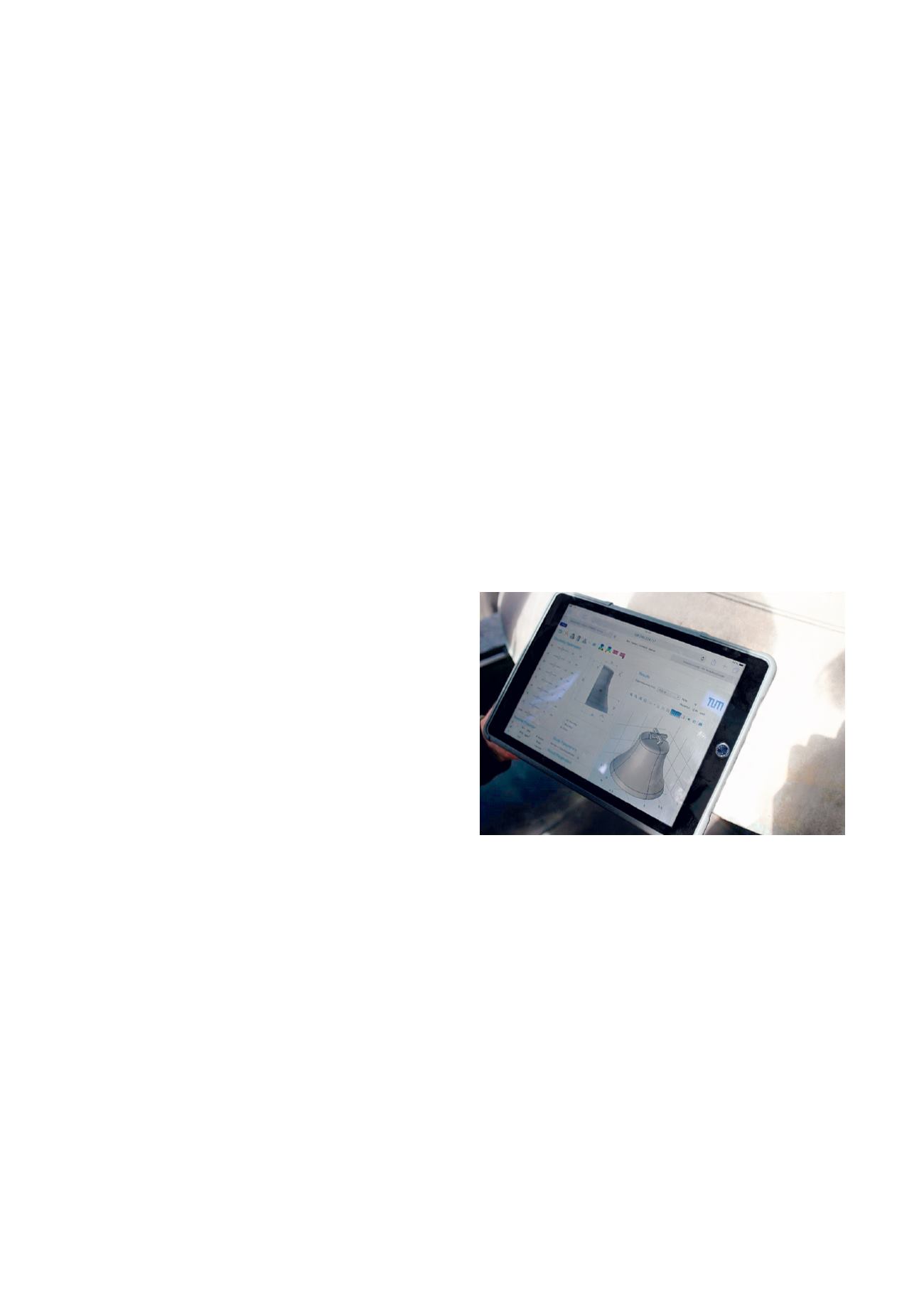
Using an application for vibrations of bells on a tablet computer in a bell
tower during a student tutorial