




 198 / 308

198
Medical Materials and Medical Implant Design
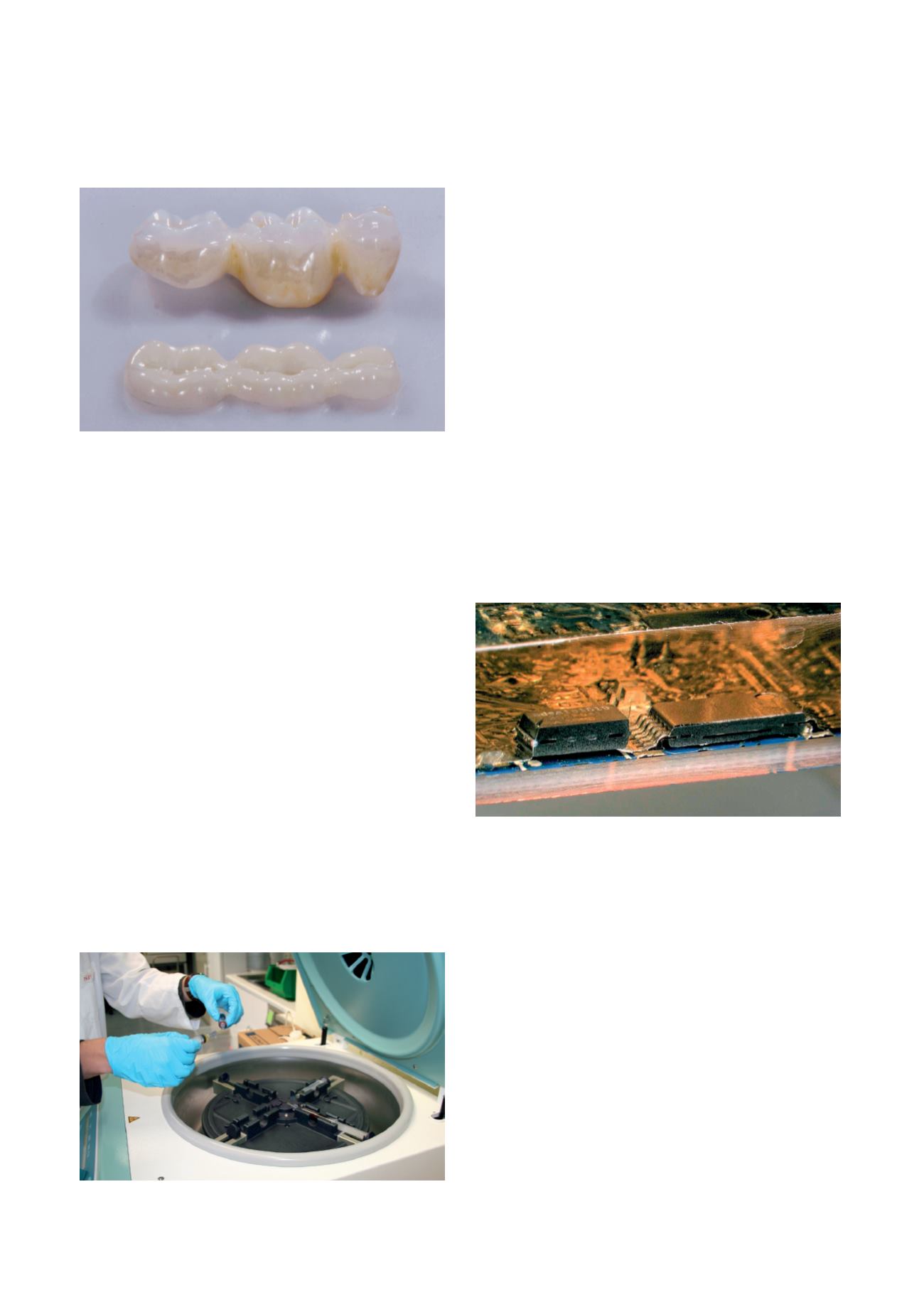
The high priority of functioning, aesthetically pleasing
teeth motivates the continuous optimization of dental
prostheses and the materials used for them. As an
alternative to currently used ceramics, thermoplasts or
combinations of a ceramic framework and a polymeric
veneer are being used increasingly. In order to exploit the
advantages of thermoplasts and at the same time to meet
the mechanical and optical requirements of dentures, the
TheverTech project in cooperation with the Poliklinik für
Zahnärztliche Prothetik of LMU Munich has developed a
new method for veneering ceramic crowns and bridges
with high-performance thermoplasts (e.g. PEEK).
Ceramic bridge (top) with thermoplastic veneer (bottom)
Dental Technology – Novel Dental Veneers Made of Thermoplasts
The research group ‘IoT & Polymers’ systematically
investigates the interaction between plastics and their pro-
cessing on the one hand and IoT electronics on the other.
Use in the medical environment places special demands
on IoT-augmented plastic parts. These include strains
from sterilization or disinfection processes as well as the
use in the organism’s aqueous environment with a risk of
short-circuit and corrosion. Research focuses on inte-
gration strategies with coatings and casting compounds
for cushioning mechanical forces in the injection molding
process, surface technologies for optimizing composite
materials with regard to conformal integration, and the
investigation of the influence of plastics on electromag-
netic waves. Suitable materials for the realization of
plastic-electronic composites are identified with regard to
Smart Technology – Integration of IoT Electronics into Medical Plastic Parts
Bioprotective conformal polymeric encapsulation of IoT electronics
their biocompatibility and bioprotective effect (prevention
of the release of toxic and allergenic substances).
Platelet rich plasma (PRP) is generated from a patient’s
own blood by centrifugation. Platelets contain growth fac-
tors, which guide tissue regeneration and enhance heal-
ing. Thus, PRP can be therapeutically applied to wound
sites to support the body’s healing process. However, in
current systems numerous manual steps in the manufac-
turing processes lead to reduced reproducibility of the
quality of this patient’s own therapeutic agent. Therefore,
a centrifugation system enabling fully automated pro-
duction of PRP has been developed and is now being
launched on the market. Optimization and expansion of
the system to produce various blood products offering a
broad therapeutic field is currently under investigation.
Automated system for production of patient’s own blood products for
therapeutic use
Regenerative Medicine – Automated Production
of Patient’s Own Therapeutic Blood Products