



 112 / 308

112
Ergonomics
the shared space. The adequate design of movement
strategies thus fosters the achievement of both individual
and shared goals. In general, acceptance and trust of the
human operator have to be considered in addition to the
interpretation of human movements. Concerning auto-
mated vehicles, similar mechanisms apply to the design
of driving behavior. To ensure smooth procedures, driving
strategies must be unambiguous and easily recogniz
able to other traffic participants such as human drivers,
cyclists, and pedestrians. Accordingly, methods have to
be defined for the design and evaluation of unequivocal
and safe trajectories.
Telepresence System for Wizard-of-Oz Studies
Automated and autonomously moving
robotic systems are increasingly
merging in human dominated areas
and therefore will have to interact and
coordinate with pedestrians in public
and private spaces. The Human-Ro-
bot Interaction group (part of Coop-
erative Systems and Automation)
at the Chair of Ergonomics applies
a commercially available robotic
telepresence system to investigate
social interactions in Wizard-of-Oz
experiments. The robot is controlled
via keyboard, mouse or gamepad
and hotkeys are programmed to
enable repeatable robot movement
behavior, initiated by the wizard.
Present research activities target the
identification and quantification of
implicit (non-verbal) communication
via movement cues of mobile robot
systems. Based on the concept
of legibility (behavior that leads to
understanding the robot’s intentions)
and predictability (behavior that
meets the human observer’s expec-
tations and lets the user anticipate
future states), robotic movements
are investigated and evaluated in
quantitative (e.g. motion and eye
tracking, physiological measures)
and qualitative (e.g. questionnaires,
interviews, video feed rating) studies
with participants. For more information please do not hesi-
tate to contact Jakob Reinhardt
(Jakob.reinhardt@tum.de)
or Jonas Schmidtler
(jonas.schmidtler@tum.de).
IMAGinE
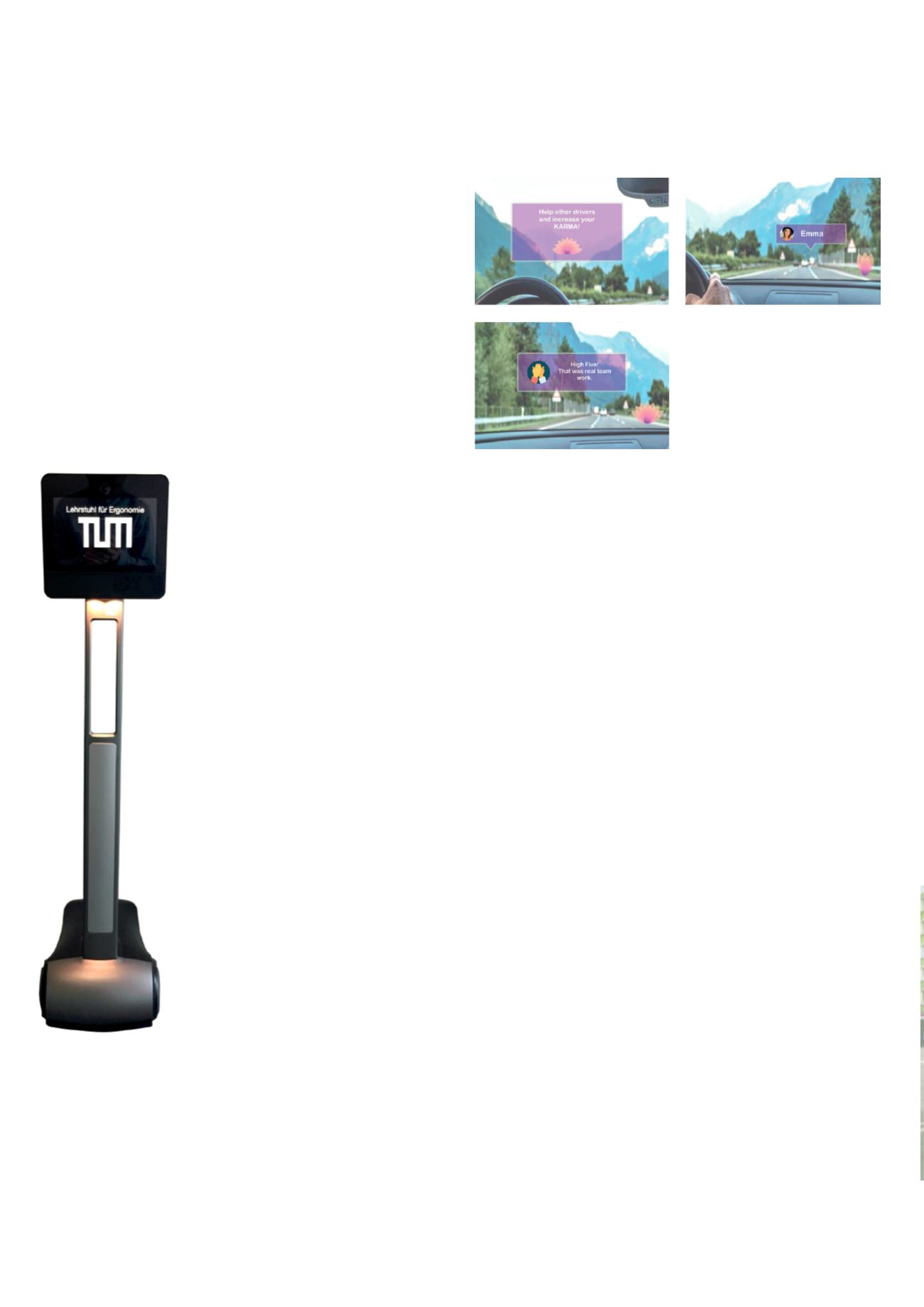
The BEAM telepres-
ence system
(Reference: Jonas
Schmidtler, TUM, 2017)
Illustration of head up display
elements in a gamified driver
assistance system to motivate
and facilitate cooperation
(Reference: Sandra Zollner,
TUM, 2017)
The collaborative research project IMAGinE (Intelligent
maneuver automation – cooperative hazard avoidance
in real time) will develop new and innovative assistance
systems which will support the cooperative driving of the
future.
To realize the potential for cooperation between vehicles
and between vehicles and the infrastructure major tech-
nological challenges need to be solved. IMAGinE will take
on these challenges by – for the first time – implementing
communication protocols for automated information
exchange in real time as well as the alignment and the
decision-making processes between intelligent systems
and drivers. The human factors aspect in this project
targets questions regarding the driver’s motivation to
cooperate with other drivers and the driver’s acceptance
of assistance systems that facilitate cooperative maneu-
vers.
While the research project is organized (vertically) into six
sub-projects its contribution to current and future research
endeavors in the field of connected and assisted driving
becomes visible (horizontally) through five core innova-
tions:
■■
Cooperative functions
■■
Shared environment perception model
■■
Communication mechanism for cooperative behavior
■■
Simulation environment for cooperative driving
maneuvers
■■
Human-machine interaction
The project will run for four years – beginning on Sep-
tember 1, 2016. First results are available. The IMAGinE
consortium is formed by twelve renowned companies and
research institutions in Germany: Adam Opel AG (project
coordinator), BMW AG, Continental Teves AG & Co. oHG,
Daimler AG, Hessen Mobil – Straßen- und Verkehrs-
management, IPG Automotive GmbH, MAN Truck & Bus