



 110 / 308

110
Ergonomics
road users (e.g. pedestrian and bus) and to design the
interior and exterior of an autonomous bus.
The Chair of Ergonomics will work on this project together
with the German Aerospace Center (DLR, Institute for
Transport Research, Institute for Vehicle Concepts, and
Institute for Traffic System Technology), the Hochschule
Esslingen, the Berlin Transport Company (BVG), the Asso-
ciation of German Transport Companies (VDV) and the
Berlin Senate Department for the Environment, Transport
and Climate Protection.
Truck 5.0 – Concepts of Truck Cabins
for Future Vehicles
In this day and age, the automobile industry has to
manage a huge challenge: on the one hand, traffic and
transport volume is increasing more and more; on the
other hand fuel consumption has its limits. This trade-off is
well known, but the problem it presents has not yet been
solved. Particularly trucks with their high drag coefficient
are not exactly known to be environmentally friendly. To
improve the environmental footprint of the trucks, the legal
length regulations will be changed so that the cabs have a
more aerodynamic shape. An aerodynamic exterior design
has a natural effect on the interior of the vehicle and
consequently on the driver’s workplace.
Against this background and in the context of the
three-year research project “Concepts of Truck Cabins
for Future Vehicles” funded by MAN Truck & Bus AG,
fundamental investigations into future drivers’ workplaces
will be carried out. This fundamental investigation can
be summarised in three main aspects; view and seating
position, roominess and cabin layout, and ingress and
egress motion. The subtopic ‘view and seating position’
focuses on the effects of the lateral and vertical movement
of the seating position on the direct view of a truck driver.
The work package ‘roominess and cabin layout’ deals
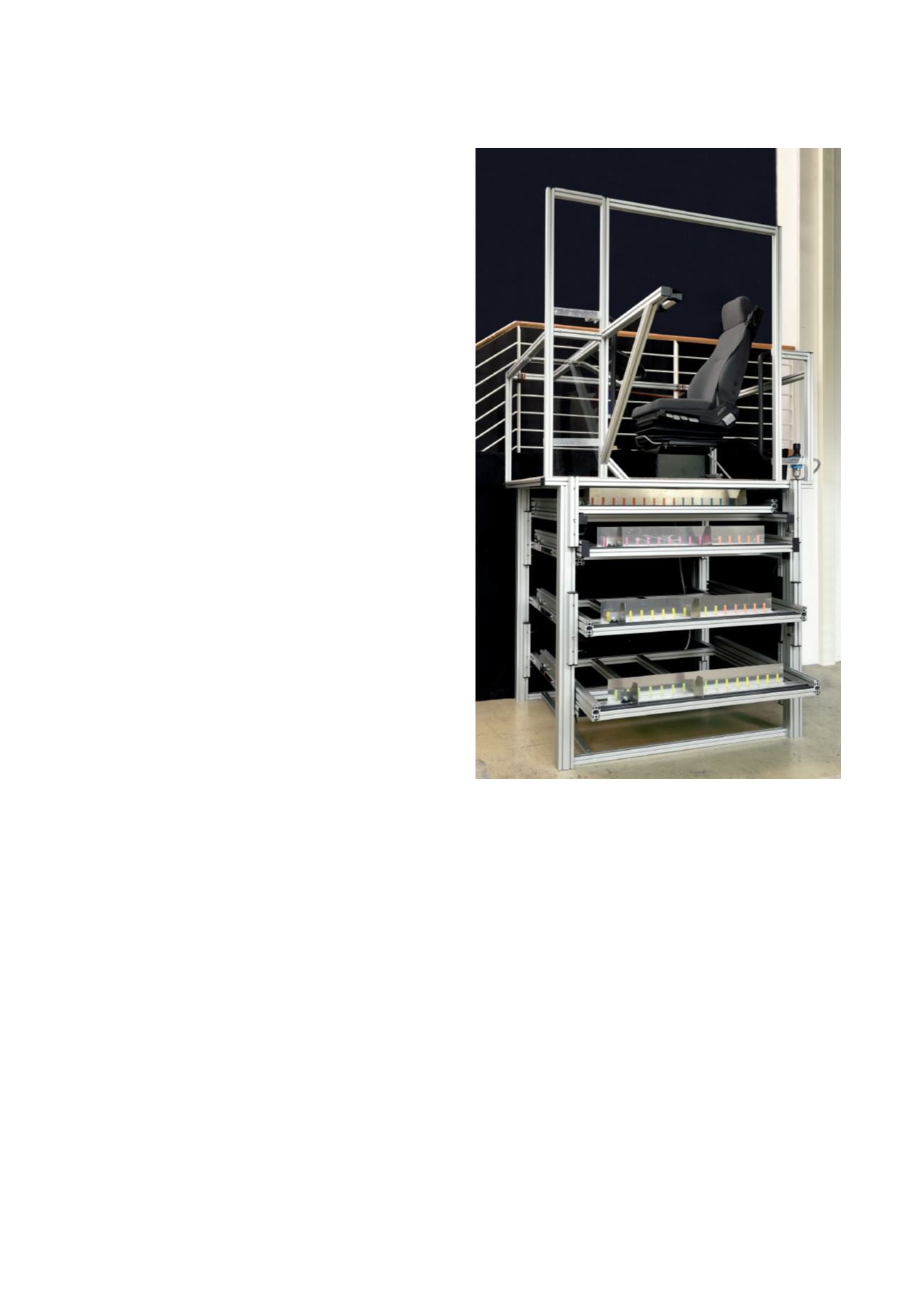
Truck ingress model (Reference: Tobias Hase, TUM, 2017)
with new cabin layouts and their impact on the driver’s
feeling of roominess. Finally the truck ingress will be
investigated in terms of motion strategies and the desired
entering geometry.
2. Automated Driving
Next to the advances in sensor and actuator technologies,
the human factors aspect of automated driving keeps
on contributing towards the goal of self-driving cars. The
Chair of Ergonomics has had its share so far in adding to
the research base that will one day allow fully autonomous
systems to be built.
Complying with the international known SAE J3016
standard definition most research concentrated on Level 3
– conditionally automated driving, in which an automated
system controls the vehicle in both lateral and longitudinal
direction under normal circumstances. The challenge of
successfully handing back the driving task to a human
driver in case such a system reaches its functional limit
has been and continues to be a complex endeavor.
Multiple influences, like distraction through secondary
tasks, basic trust in such systems and the danger of
sleepiness through an insufficiently challenged human
driver, have been the focus of research on highway roads.
Pushing forward new environments, like urban areas as
well as the interaction with a wider range of different traffic
participants, pose new challenges for the development of
automated cars.