




 148 / 308

148
Space Propulsion
The group applied a modified global rainbow refractome-
try to investigate the cryogenic propellants spray droplets
(i.e. liquid oxygen, liquid methane and, for comparison
reasons, liquid nitrogen). The refractive index and the
probability distribution of the droplet sizes are retrieved
from the global rainbow pattern with the inversion meth-
ods using the complex angular momentum scattering the-
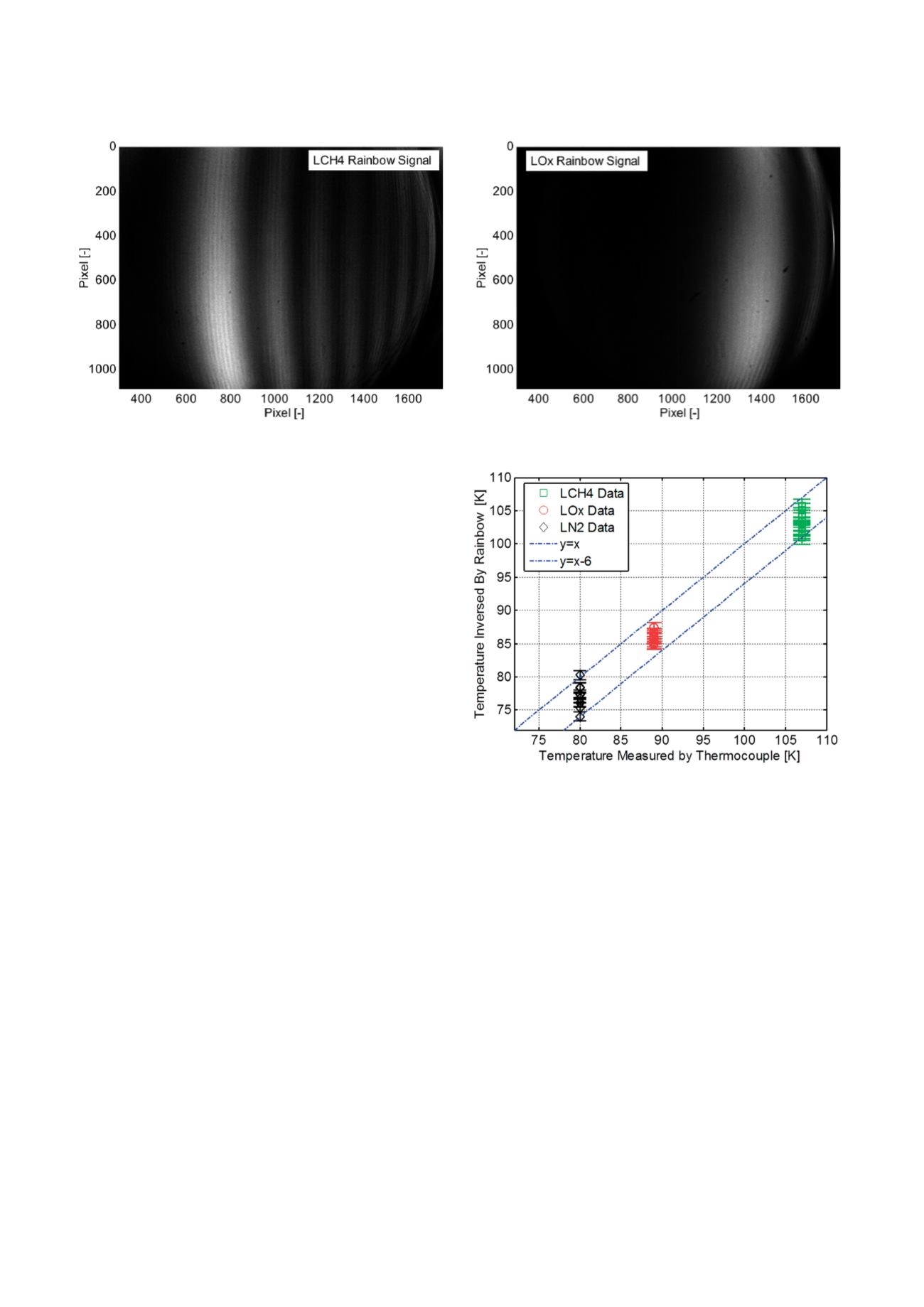
ory, see Fig. 8 which shows the measured rainbow signal
of a liquid methane and liquid oxygen spray, respectively.
A detailed evaluation of the results shows that the
deduced temperatures from the rainbow signal agree well
with the temperatures measured by thermocouples, with
discrepancies less than 7.5% for the tested sprays at
temperatures ranging from 80K to 110K. The temperature
measurement uncertainties are analyzed to be within
±1.0K. Applying Saengkaew’s methods, the inversed
droplets size distribution shows bimodal or even multi-
modal characteristics in the measurement probe volume,
see Fig. 9.
Interestingly, the flashing experiments revealed the forma-
tion of solid nitrogen and methane but not of solid oxygen,
a behavior which can be easily attributed to the differ-
ences in thermos-physical properties of these molecules.
Figure 9: Comparison of measured thermocouple and rainbow
temperatures
Figure 8: Scattering fringe pattern of liquid methane (left) and liquid oxygen (right)