



 152 / 308

152
Helicopter Technology
Material from Renewable Resources in Aerospace Applications
Hybrid structures combining carbon and flax fibers should
be applied in replacing a conventional carbon composite
structure for a helicopter cockpit door. Besides advan-
tages in structural damping, benefits in crash behavior
can be expected. First specimen tests showed promising
results.
The project is funded by LUFO V2; the associated
partners are the Department of Lightweight Structures and
Polymer Technology at the Technical University Chemnitz
and the Institute for Bioplastics and Biocomposites at the
University of Applied Sciences and Arts in Hannover.
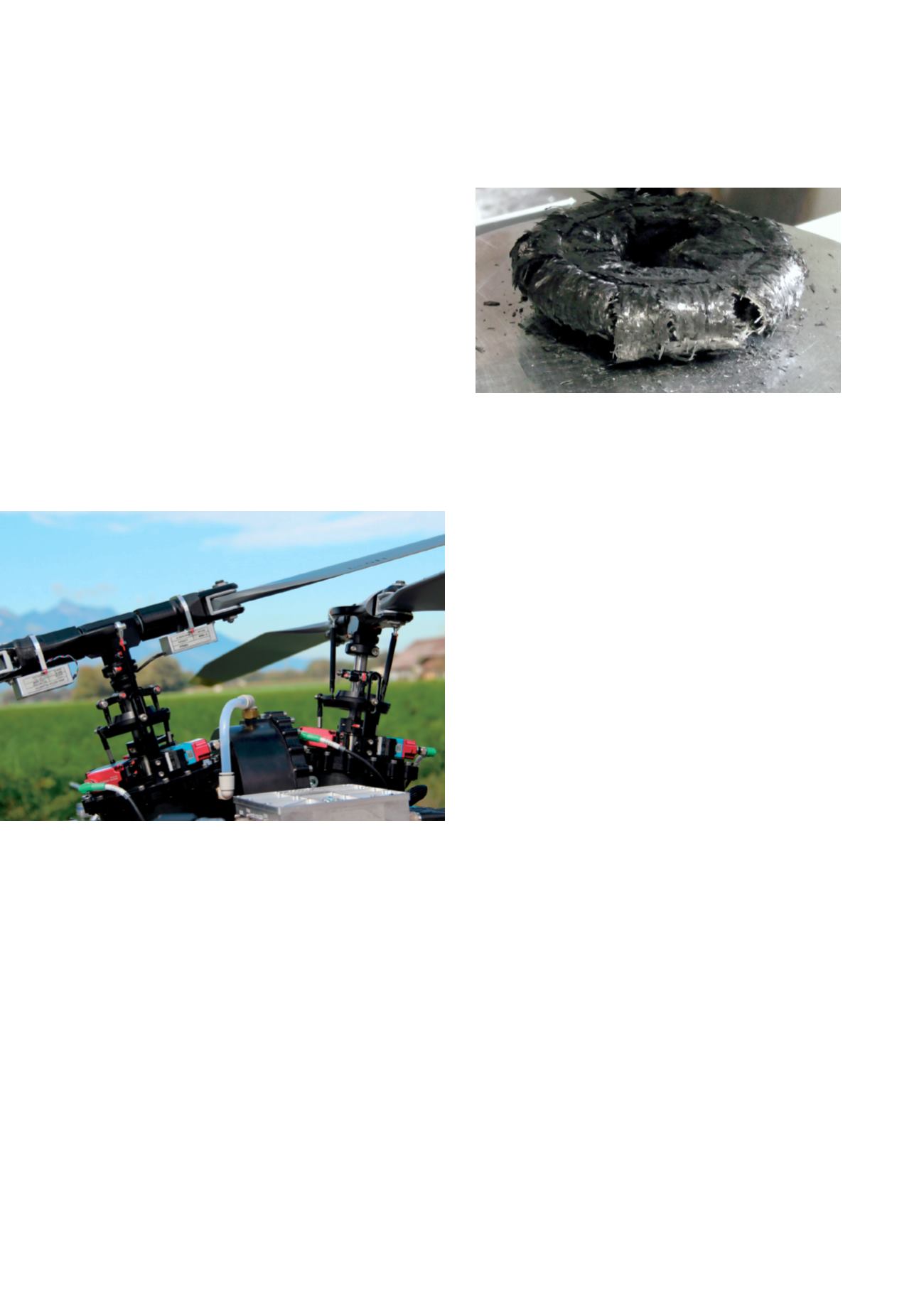
Carbon-flax specimen after crushing
AREA – Autonomous Rotorcraft for Extreme Altitudes
Our partnership with DLR has the aim to bring an autono-
mous rotorcraft up to altitudes of 9000m. Now, the project
has reached an important milestone with successful test
flights in Switzerland. The all-electric drone, with a take-off
weight of 36 kg and its unique flying qualities, has shown
the desired response to a newly developed controller.
Since the successful first flight took place in August 2016,
more than 100 starts have been performed, accumulating
a total of 4 flight hours. The flight dynamics model repre-
sents the aircraft’s behavior with a high fidelity and could
thus be used for the controller development. All systems
are working as expected and the performance parameters
correspond with predictions – necessary preconditions for
the high attitude flight trials in 2018.
As a last formal step, the flight clearance for test flights in
Argentina was received in early December.
Area rotor heads with flight test instrumentation