



 210 / 308

210
Plasma Material Interaction
Tungsten Heavy Alloys as First Wall Material in Fusion Devices
Tungsten (W) is currently the most promising candi-
date as armour material of the first wall in a future
fusion power plant. Since 2014, the Garching fusion
experiment ASDEX Upgrade (AUG) operated by the
Max-Planck-Institute for Plasma Physics has been using
bulk tungsten tiles at its most loaded area, the divertor,
receiving up to 20 MW/m² of heat load. Since the base
operating temperature of AUG is room temperature,
where bulk tungsten behaves mostly brittlely, cracks in
most of the tiles were observed after only a few hundred
plasma discharges. A possible option could be the
use of more ductile W heavy alloys (W-HA) as they are
produced commercially by several companies. W-HAs
consist of up to 97 weight % W and Ni/Fe admixtures.
In comparison to bulk W, these materials are consid-
erably cheaper due to the facilitated sintering process
and they show improved machinability and ductility at
room temperature. Their major drawbacks, in view of
the application in fusion experiments, are the rather
low melting temperature (~1500 °C) and their magnetic
properties. In order to explore their feasibility, W-HAs
from two suppliers (Plansee Composite Materials GmbH
(D185) and HC Starck Hermsdorf GmbH (HPM 1850))
were investigated concerning their thermal and magnetic
properties and subjected to screening tests and cyclic
loading in the high heat flux test facility GLADIS.
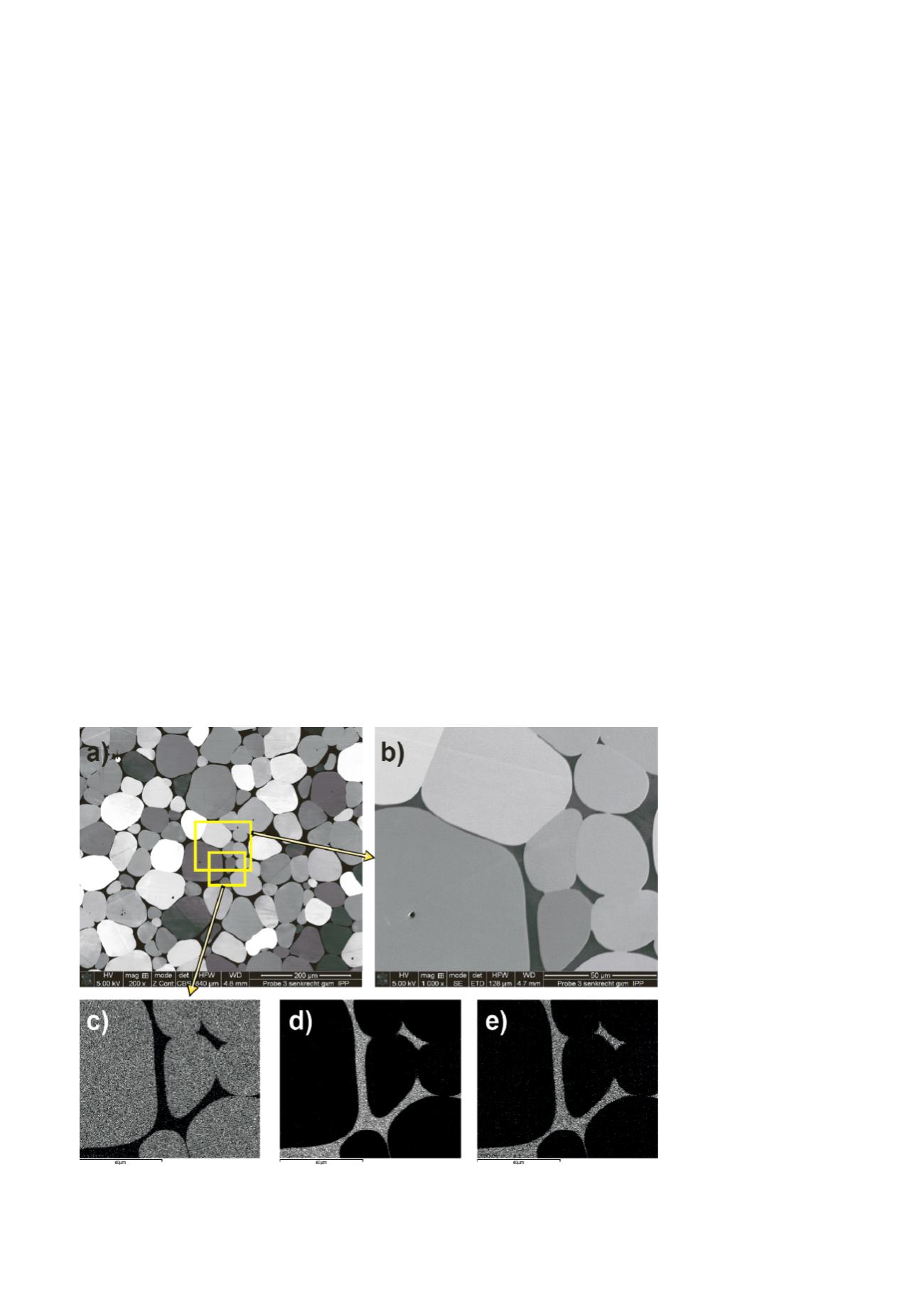
Fig. X2 a) and b): Scanning electron micrograph with orientation contrast of W heavy alloy (HPM 1850, 2% Ni, 1% Fe).
The yellow squares mark the regions with higher magnification; c), d), e) EDX maps showing the distribution of W, Ni
and Fe, respectively.
The magnetisation of these materials is moderate
(~2Am²/kg)) and saturates already at low magnetic field
(~2000 Oe). The thermal conductivity at room temperature
is a factor of two smaller than that of pure W (80W/(mK)),
but in contrast to W it increases with temperature leading
to a similar thermal performance above 700 °C. High heat
flux tests with power loads of up to 20 MW/m² and sur-
face temperatures of up to 2200 °C were performed. As
expected, a surface modification was observed when the
melting temperature of the binder phase was exceeded.
However, the failure behaviour under overload is very
benign: segregation of Ni/Fe in the topmost micrometres,
but the bulk structure was not affected under the condi-
tions tested here. Long term exposure of one W-HA tile
in AUG (with the so-called ‘Divertor-Manipulator’ – see
Annual Report 2014) under the highest possible power
and energy injection confirmed the rather positive results
of the GLADIS HHF tests. It was therefore decided to
equip the divertor with 28 W-HA tiles, preferentially at
locations where the mechanical load (due to electro-
magnetic forces) is expected to be highest. First results
revealed the expected positive properties. Depending on
ongoing investigation on their hydrogen retention and their
behaviour under neutron irradiation W-HAs could even
qualify as armour material in a future fusion reactor at
locations with intermediate heat load.