




 213 / 308

213
Thermo-Fluid Dynamics
Uncertainty quantification
Thermoacoustic instabilities are highly unpredictable,
because they respond in a very sensitive manner to slight
changes in operating or boundary conditions. As a result
instabilities are detected often only at the later stages of
development in full combustor tests, resulting in signifi-
cant overruns of development cost or time. It is essential
to deploy robust and reliable simulation methodologies
that include strategies to quantify the uncertainty of model
predictions and their sensitivity to parameter changes.
The TFD group has developed and applied successfully
a variety of strategies for uncertainty quantification in
thermoacoustics, such as non-intrusive polynomial chaos
expansion, or active subspace. The development of
surrogate models by analytical means, or by exploiting
adjoint numerical solutions, has played an important role
in these efforts.
Project
■■
CSC Scholarship, AG Turbo COOREFLEX
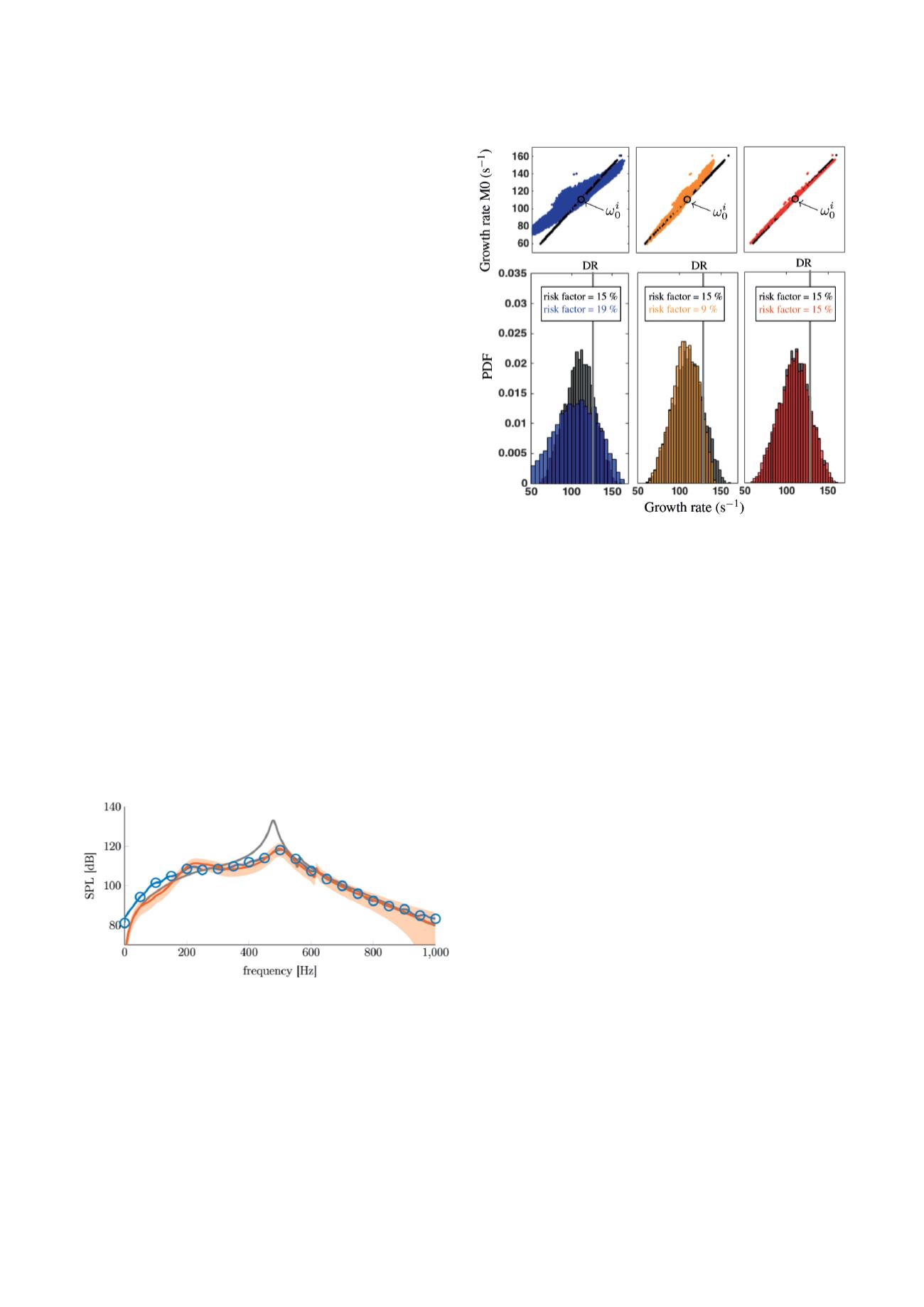
Uncertainty of growth rates and risk factor of thermoacoustic instability,
predicted with adjoint-based surrogate models of increasing order (from
Silva et al, JGTP, 2017).
Combustion noise
In the past year, the TFD group has developed charac-
teristic-based, state-space boundary conditions, which
allow to impose non-trivial acoustic impedances at the
computational domain boundaries in a robust and flexible
manner. Furthermore, advanced techniques for system
identification were introduced, which estimate noise
Power spectral distribution of pressure fluctuations generated by an
enclosed turbulent swirl burner. Measurements (O) vs. modelling with
one-way (
—
) and two-way coupling (
—
). Shading indicates the 95%
confidence interval of results.
(Merk et al, submitted to Proc. Combust. Inst.)
models as well as confidence intervals from time series
data generated by high-fidelity simulations. Combining
these techniques with large eddy simulation of turbulent
combustion makes possible the accurate and efficient
prediction of combustion noise. Furthermore, eigenmode
analysis of the spectral distribution of pressure fluctua-
tions elucidates the interplay between combustion noise
generation, flame dynamics and thermoacoustic reso-
nances. The results emphasize the necessity of including
full two-way coupling in simulations of flow-flame-acous-
tic interactions.
Project
■■
DFG/ANR NoiseDyn