



 244 / 308

244
Machine Elements
to 160 kph. Two identical permanent magnet synchronous
machines drive the axle gear with up to 30,000 rpm.
The electric motors operate with separate optimized
AC/DC converters, which are supplied by a direct current
voltage source. Hence, the car’s battery system was not
part of this project.
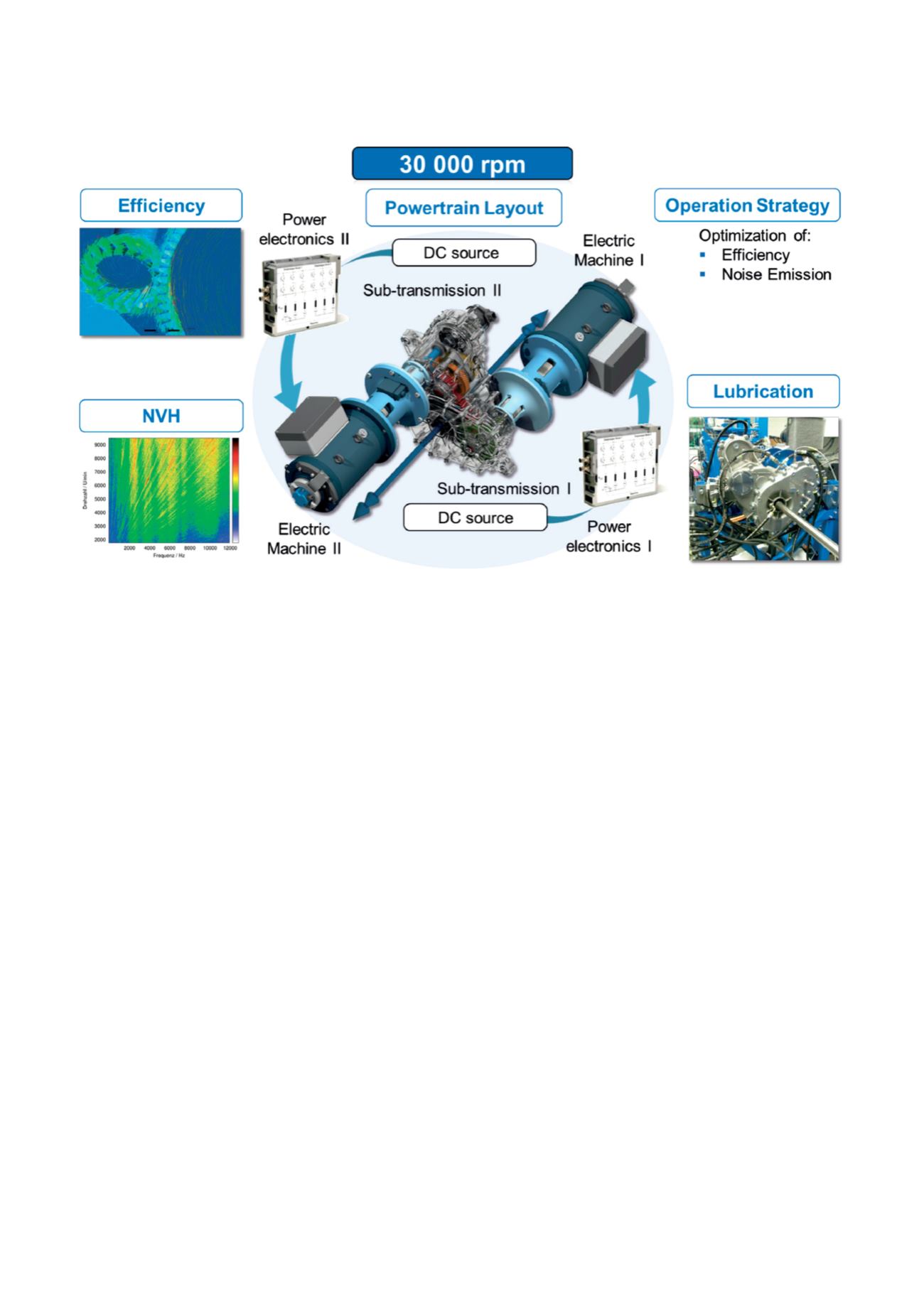
The powertrain’s gearbox consists of two separate
sub-transmissions, which are mechanically connected
via a common final drive. Sub-transmission I consists of
a two-stage cylindrical gear drive with a gear ratio of 21,
reaching the desired vehicle velocity of 160 kph at the
maximum speed of the electric machine. To investigate
the impact of the extremely high input speeds on acoustic
behavior and efficiency, different types of gears were
applied to the high-speed stage of sub-transmission I.
Sub-transmission II consists of three stages and features
two speeds: a high run-up gear ratio of 32 and an over-
drive gear ratio of 15 for high efficiency at high vehicle
velocity.
The flexible distribution of power supply to both sub-
transmissions is used to provide operating strategies
with reduced energy consumption or noise emissions.
It also enables seamless shifting using dog clutches
with an optimized electric synchronization. This requires
an operational strategy, which influences the shifting of
sub-transmission II and therefore the power distribution
between both electric motors and sub-transmissions.
The whole powertrain was installed and tested at FZG.
Within the scope of the experimental investigations, both
efficiency as well as NVH performance was optimized. In
order to reduce load dependent power losses, a low-
loss test gear set was developed and tested, showing a
significant increase in efficiency. By adjusting the oper-
ation strategy, the overall energy consumption within a
given driving cycle decreased even more. Using another
test gear set enabled investigations beyond the gear’s
resonance frequency and showed huge potential for high-
speed applications.
In the follow-up BMWi joint research project ‘Speed4E’,
the input speed will be increased above 30,000 rpm and
a newly developed powertrain will be installed in a car.
Hence, the vehicle integration of the high-speed power-
train will be an important part of the follow-up project ,
starting in 2018.
Powertrain layout of Speed2E and resulting design challenges