



 250 / 308

250
Automation and Information Systems
Self-X Cyber-Physical Production Systems
Methods to establish and improve
the design of self-x (e.g., self-organ-
izing, self-learning and self-adapting)
automation software in automated
production systems were evaluated
e.g. in intralogistics. Research in the
domain of intralogistics was focused on
reducing the effort for new development
and extension of existing Material Flow
Systems (MFSs). Generally, the hardware
modules, which are combined to form a
MFS, are reused frequently (an example
for such a hardware module is a roller
conveyor). The project aComA (BFS
Project) transferred this reuse into the
control software of MFSs and introduced
a modular, model-based development
procedure for intralogistics systems.
Based on a meta model, which allows
the formal description of the frequently
reused hardware modules, the program-
mable logic controller (PLC) control code
for these modules is generated automatically. The gener-
ated code was successfully used to control the industry
size self-X material flow demonstrator. Furthermore, the
model-based description is used to automatically analyze
and adapt the interfaces of hardware modules to imple-
ment a backward compatibility of newer modules with an
existing MFS. To increase the flexibility of MFSs and allow
an easy adaption of the system layout to requirements
arising during the operation phase of a MFS, the project
iSiKon (DFG Project) introduced a decentralized, agent-
based control approach for MFSs. Therefore, an MFS is
divided into hardware modules, which are each equipped
with a PLC and represented by a module agent. The
use of a multi-agent system allows adding or removing
modules to or from a MFS without the need to change the
control program of the MFS’s other modules. Additionally,
an approach for self-healing was implemented based on
a state control according to the OMAC State Machine
Standard. This approach enables a plant to independently
react to a failure and take measures to attempt to resolve
an occurring error state before the plant operator has to
intervene.
Projects
■■
DFG Project – Increased flexibility in heterogonous
material flow systems based on intelligent software in
self-configuring modules
■■
DFG Project – Model-Driven Evolution Management for
Microscopic Changes in Automation Systems
■■
DFG Project – Self-Maintenance of Mechatronic
Modules
■■
BFS Project – Automatische Codegenerierung für
modulare Anlagen
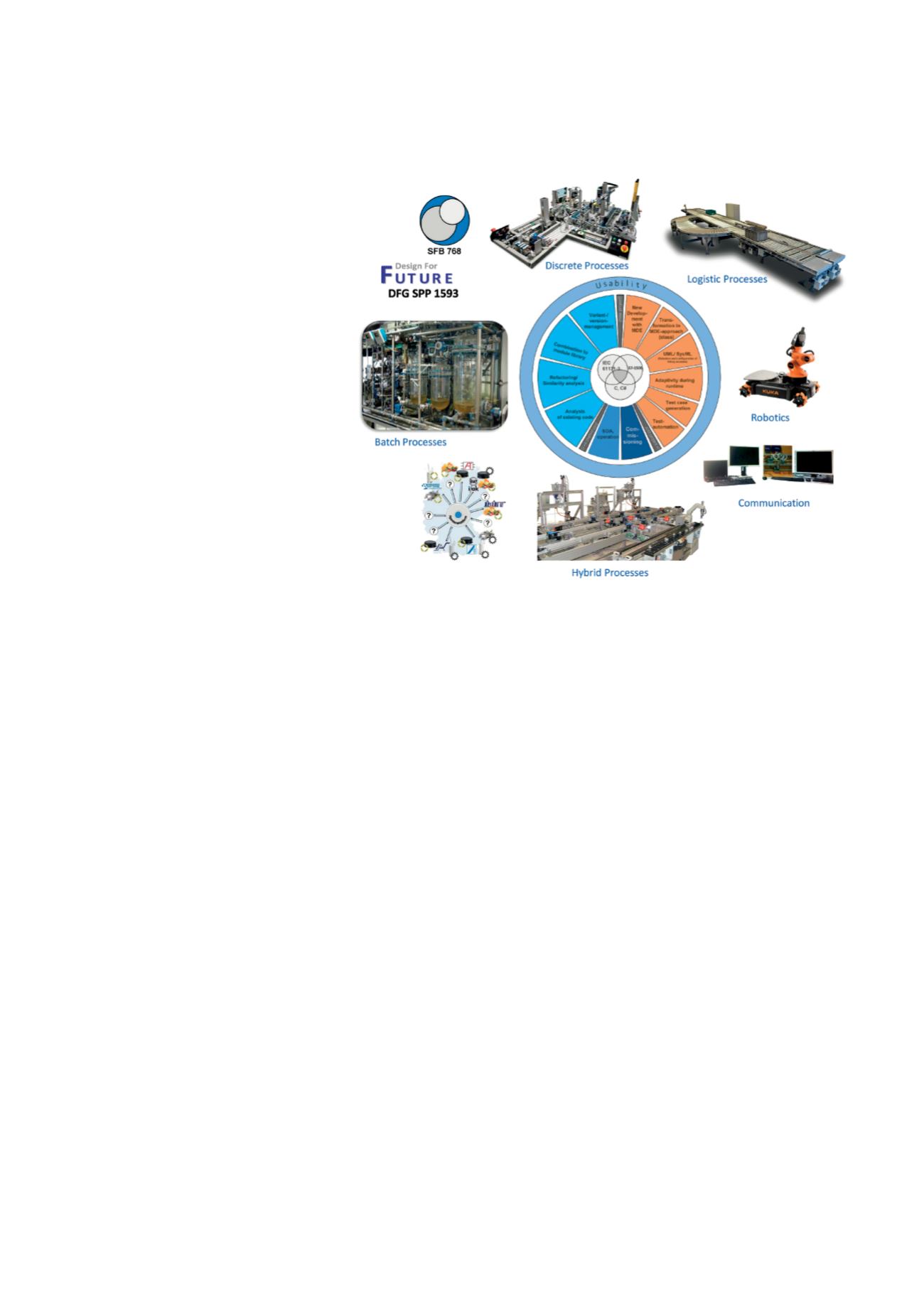
Demonstrators at the AIS from discrete event to batch processes
Model-Based Development
To handle the increasing complexity of mechatronics
systems model-based approaches are most appropri-
ate but still need research to handle cross-disciplinary
development. The question of interest is how different
domain-specific models could be connected, how the
information flow between models could be automated and
how inconsistencies between models should be managed.
Therefore, dependencies between models were investi-
gated, intra-model change impacts explored and methods
like standardized model-interfaces defined using meta
modeling and model-coupling as well as ontologies for
inconsistency management. A special focus is put on the
human and organization as an essential part of an inter-
disciplinary CPPS in the Collaborative Research Center
(CRC) 768. Different modeling languages are investigated
and adapted for the different domains of mechatronics