



 245 / 308

245
Machine Elements
Optimized Lubrication and Energy Efficiency of Geared Power Transmissions
The development of energy- and resource-efficient geared
transmissions has become a major concern in industry.
This is mainly driven by environmental requirements
and resource scarcity. Geared power transmissions
require lubrication in order to reduce friction in loaded
rolling elements and to dissipate frictional heat. Several
research projects at FZG address the lubrication and
energy efficiency of geared power transmissions. Besides
experimental investigations, focus is put on the physical
understanding of mechanisms by support of numerical
modelling.
As the lubrication of geared transmissions is difficult
to predict at the design stage, the DFG project STA
1198/14-1 in cooperation with Prof. Adams from AER/
TUM aims at developing efficient CFD (computational fluid
dynamics) simulation models to predict the oil flow and
no-load gear losses. Various operating conditions includ-
ing kinematic, geometrical and oil-specific parameters
are investigated. Consequent validation is performed at a
no-load power loss test rig by measuring the loss torque
and the oil flow with a high-speed camera. The results
contribute to an optimized lubrication and efficient design
of geared transmissions. On the one hand, lubrication has
to be sufficient to avoid any damage to machine elements.
On the other hand, the lubricant volume has to be as small
as possible to reduce the no-load power loss, which is
due to hydraulic losses and ventilation.
Load-dependent gear losses are caused by friction
between loaded gear flanks in relative motion. Its reduc-
tion by use of DLC (diamond-like carbon) coatings is
addressed in the IGF project 18490 N (FVA 585/II). The
potential of DLC coatings to improve load capacity and to
reduce friction is well known. However, the thermophys-
ical mechanisms of friction reduction in elastohydrody-
namically lubricated (EHL) gear contacts with separated
surfaces is largely unexplored. Experimental investigations
at the model and gear test rigs show significant reduction
of friction and load-dependent gear loss by up to 40%.
Thermal EHL simulations indicate that this is mainly due
to the low thermal inertia of DLC resulting in a thermal
insulation and low effective viscosity in EHL gear contacts.
The potential of pure and reinforced thermoplastic gears
for application in geared power transmissions is inves
tigated in the IGF project 18414 N (FVA 785/I). Thermo-
plastic EHL contacts are completely different to steel
EHL contacts and not well understood. Investigations are
performed experimentally at model and gear test rigs as
well as theoretically by means of thermal EHL simulations.
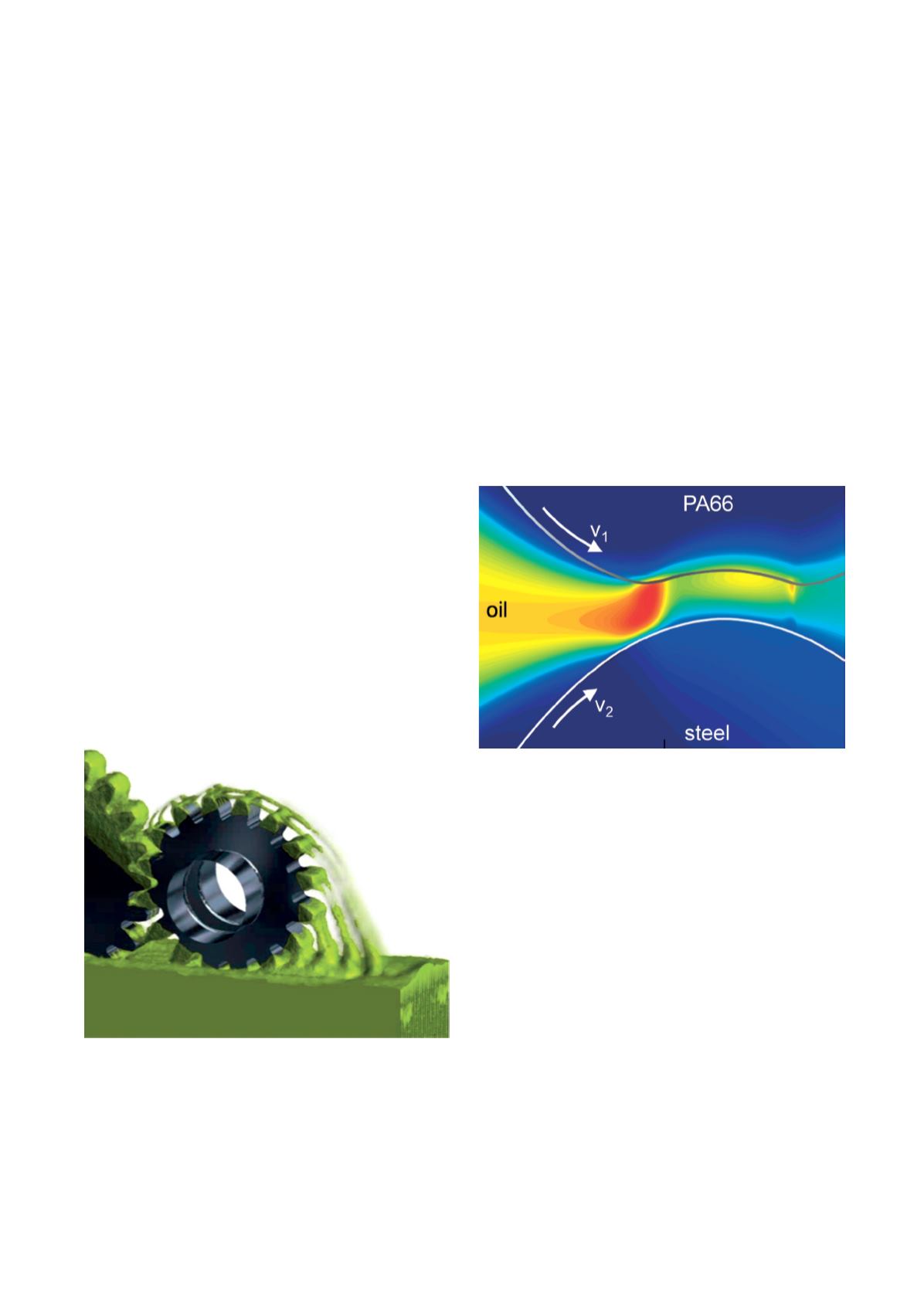
The figure above illustrates exemplarily the deformation
and temperature distribution of a hybrid EHL contact of
steel and polyamide 6.6 (PA66). The high surface con-
formity leads to low hydrodynamic pressure compared to
steel contacts for the same load applied and thus very low
friction. The low thermal inertia of thermoplastic material
affects the local contact temperature and its tribological
performance. The appropriate usage of optimized thermo-
plastic gears in geared power transmissions can push its
limits of energy and resource efficiency.