



 252 / 308

252
Automation and Information Systems
Human Machine Interaction
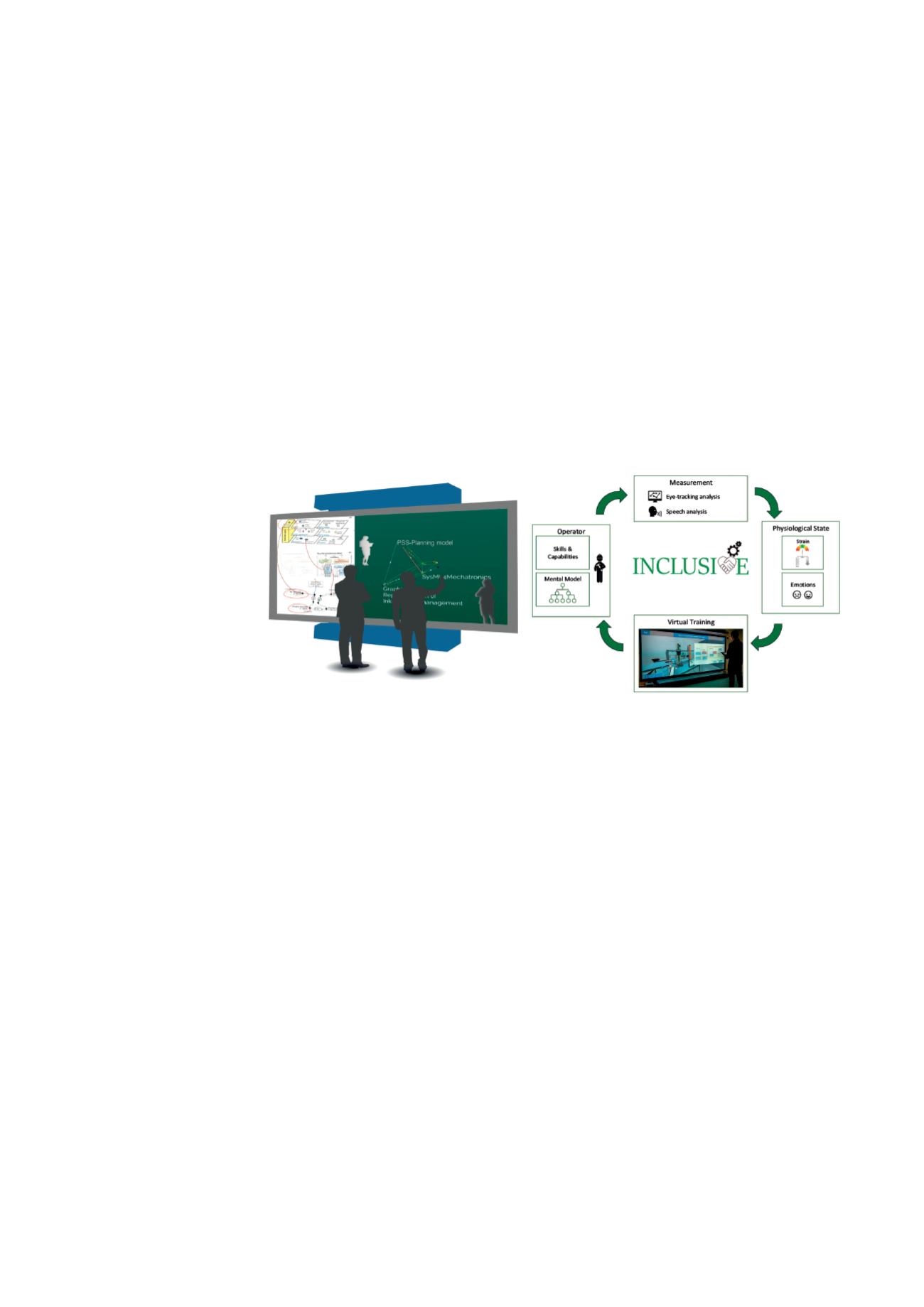
Interdisciplinary team working at
the visual computing laboratory,
discussing model dependencies
This field of research addresses the design and evaluation
of human-machine interfaces (HMI) for operators as well as
engineering support systems. The increasing capabilities of
production systems and the availability of big data require
intuitive user interfaces and visualization techniques.
New challenges for the design of industrial HMI arise from
the increasing diversification of the workforce driven by
the demographic change. The EU project INCLUSIVE
targets the development of automation systems that
adapt to the capabilities of human operators. A part of
the approach are virtual training systems that allow the
initial training of manufacturing and changeover proce-
dures using virtual reality technologies. User profiles that
describe age, education, and the mental model of the
trainees are used to adapt the training system and the
style of information presentation to the capabilities of the
user. Multimodal training systems (e.g., using haptic or
speech-based interaction) allow more effective training
that can be adapted to the capabilities of elderly or
disabled users. The state of the users is tracked in real-
time using emotional speech analysis and eye-tracking
to detect stressful situations and errors in mental models.
Support during the work process is provided by multi-
modal assistance systems that guide operators during
procedures using speech and visual instructions.
To support the cycle-oriented design of innovation
processes for product service systems, the goal of sub-
project D2 of the CRC 768 is to develop an appropriate
interaction and visualization approaches. For this pur-
pose, a method for the interactive visualization of model
dependencies, which arise during the innovation process,
is developed. Such a visualization approach can increase
the cross-discipline understanding of the actors involved
in the innovation process by linking their mental models.
Furthermore, resolving inconsistencies in the model
dependencies is simplified by the visualization of possible
recommendations for action.
Projects
■■
EU Project – Smart and Adaptive Interfaces for Inclu-
sive Work Environment (INCLUSIVE)
■■
EU Project – Innovative Modelling Approaches for
Production Systems to Raise Validatable Efficiency
(IMPROVE)
■■
DFG Project – Interactive Visualization and Navigation
in Heterogeneous Models (CRC 768, subproject D2)
■■
DFG Project – Regression Verification in a User-Cen-
tered Software Development Process for Evolving
Automated Production Systems (SPP 1593, project
IMPROVE APS)
(modification of the well known neuronal nets) are exam-
ined and adapted to serve as classification methods for
operation phases. Once the preprocessing is completed,
an intelligent combination of various approaches can be
used to analyze data for patterns indicating upcoming
malfunctions, necessary maintenance and shortcomings
in product quality. Machine learning methods like neuronal
nets and Markov chains as well as statistical approaches
like regression are use to predict machine faults or
product quality. Thereby the signals are considered in
time-domain as well as frequency-domain. All above
approaches require a balanced combination of big data
methods, process understanding and input of plant
specialist knowledge. The Chair of AIS is experienced in
applying these to a great variety of different industries.
The above experience makes the chair of AIS a reliable
and experienced research institute and partner to trans-
form industrial big data into smart data, including sensor,
actuator and alarm data.
Projects
■■
EU Project – Innovative Modelling Approaches for
Production Systems to Raise Validatable Efficiency
(IMPROVE)
■■
BMWi Project – Skalierbares Integrationskonzept zur
Datenaggregation, -analyse, -aufbereitung von großen
Datenmengen in der Prozessindustrie (SIDAP)