



 289 / 308

289
Product Development and Lightweight Design
Rotating CFRP Disks for Neutron Spectroscopy
Carbon fiber reinforced plastic disks with a diameter of up
to 1000 mm and rotational speeds in vacuum aimed for
up to 500 Hz (30.000 rpm) are studied for their vibration
behavior at the Laboratory of Lightweight Structures.
One specific application of such disks is the neutron
time-of-flight spectroscopy. These disks have one or more
cut-outs, which causes stress peaks in the structure.
The strength and the vibration behavior of such disks
are researched in detail, and proper design and material
selections are made.
The interaction between the disk and the hub on which
the disk is mounted, as well as the structural dynamics of
the whole system, are considered. In particular, the effect
of the membrane stiffening of the disk, which is caused
by the centrifugal forces during rotation, is quantified.
An improved design is generated by numerical design
optimization methods, which also take strength and
manufacturing constraints into account.
The computed results are validated by experimental
testing.
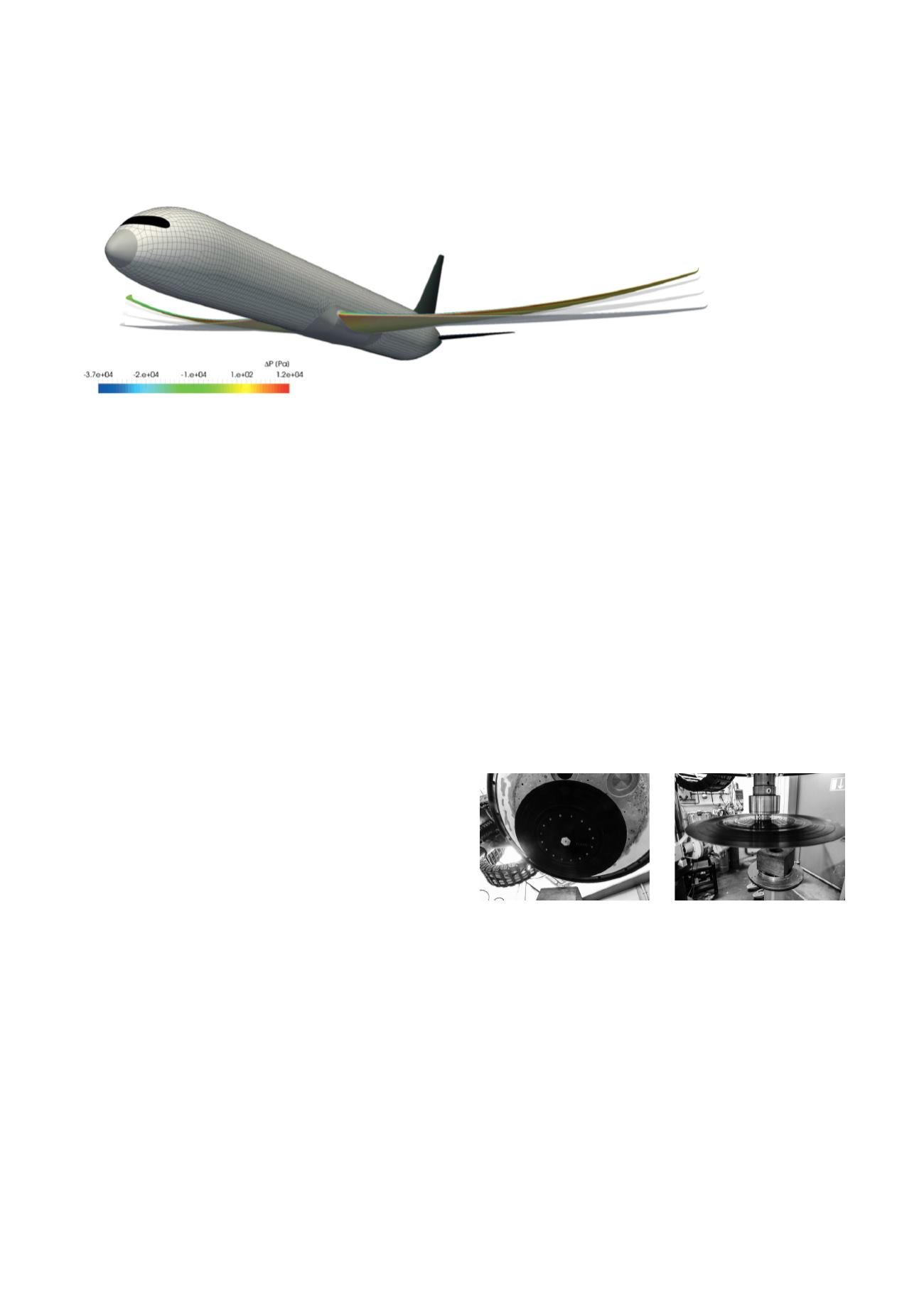
CFRP disk mounted on a spin test stand
Highly Flexible Aircraft
Therefore, staggered fluid-structure-interaction methods in
combination with a trim algorithm is developed.
Furthermore, dynamic flight manoeuvres on a reduced
order model are performed to investigate the dynamic
behaviour. Within the investigated methods, the number
of degrees of freedoms are typically reduced from millions
to some hundreds, without loss of the most important
dynamic aircraft properties. The method enables to
investigate wing instabilities due to gusts or flutter in an
early aircraft design stage with high accuracy.
Project
■■
Vitam-Flex (by Prof. Hornung)
Model of highly flexible wing structures
Future airliner wings have an increased aspect ratio for
lowering drag and the structure is extensively optimised in
the direction of lightweight design. Therefore the next gen-
eration of wings are inherently highly flexible and implicate
further challenges in the aeroelastic design.
The idea of a virtual aircraft model, which allows virtual
flight tests to predict aircraft loads and performance, is
part of the research project VitAM. The combination of
structural and aerodynamic models with an application
background on highly flexible wing structures to a unified
coupled aeroelastic aircraft model is in research focus.
High fidelity coupled CSM-CFD methods are used for
highly accurate load and aerodynamic drag prediction.