



 290 / 308

290
Product Development and Lightweight Design
Satellite Antenna
The thermoelastic deformation behavior of a satellite
antenna is investigated in the project H2KAR, which is a
collaborative project with the space supplier companies
INVENT GmbH and HPS GmbH, funded by the German
Federal Ministery of Economic Affairs and Energy (BMWi).
Thermoelastic deformations occur during orbiting of the
satellite in space, which causes temperature changes of
up to +150°C and -150°C.
The deformations are investigated by heating the antenna
and measuring the deformations by photogrammetry and
temperatures with infrared thermos-grammetry. A concept
for measuring temperatures and strains on the reflector
surface with a fiber-optical sensor was developed, evalu-
ated and qualified for use in orbit.
A Rayleigh-backscattering fiber optical sensor can meas-
ure temperatures or strain continuously over the whole
length of the fiber, in contrast to classical fiber optical
measurement methods. The fiber was bonded on the
reflector backsurface with a new high precision bonding
process. The sensor was finally tested in an environmental
test campaign consisting of vibration-, acoustic- and
thermal vacuum tests, which simulate the conditions of
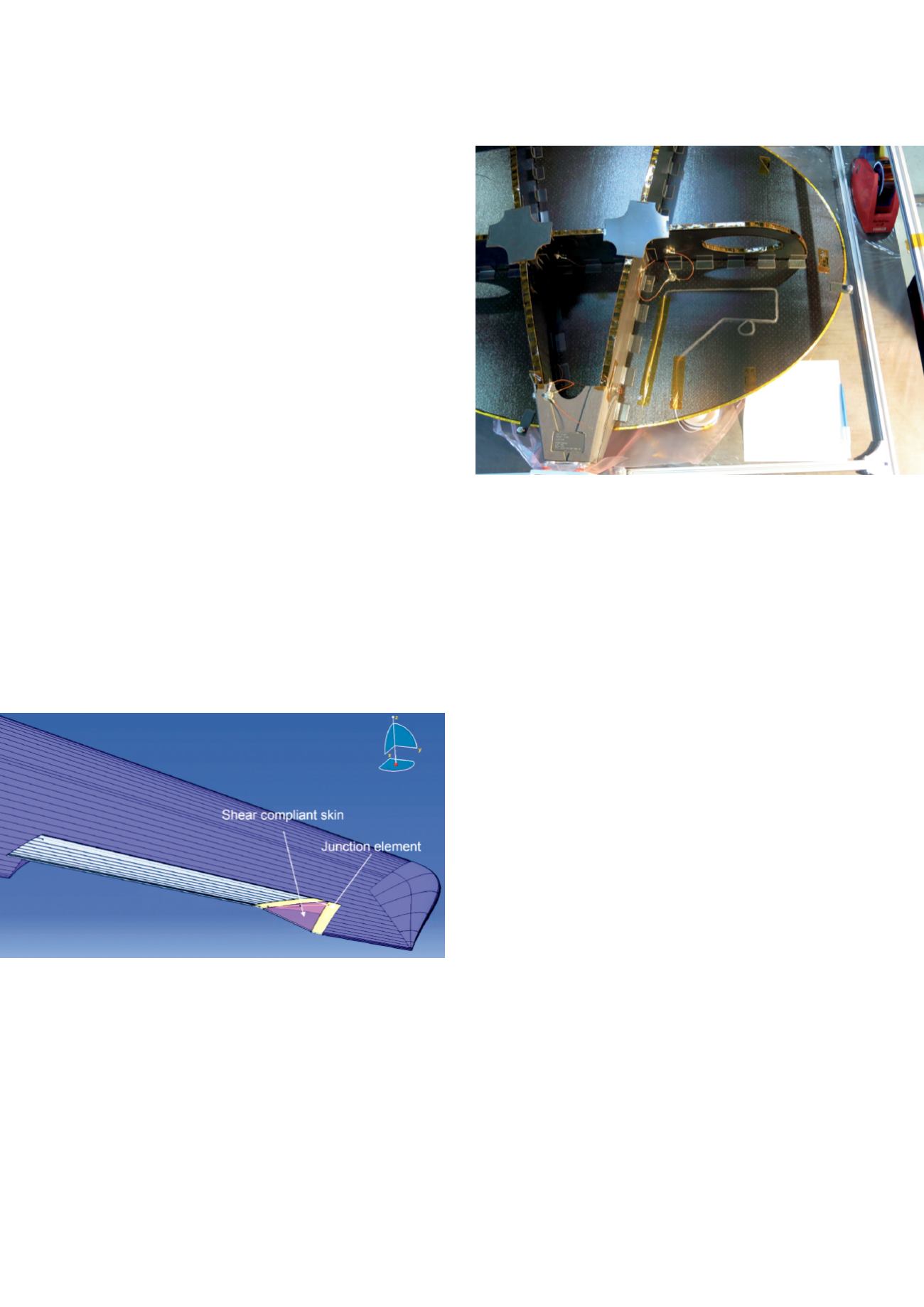
Fiber-optical sensor array bonded on antenna
the launch and in orbit. First results show that the sensor
withstands the applied environmental loads.
Project
■■
H2Kar (by Prof. Hornung)
Flexible Flap Gap Cover
Aircraft wing with flexible flap gap cover
The use of fiber reinforced elastomeric materials for an
elastic flap gap cover for a passenger aircraft wing is
investigated in the project FlexMat, in collaboration of
the German Aerospace Center (DLR), Invent GmbH and
TUM, with funding from the German Federal Ministery
of Economic Affairs and Energy (BMWi). The elastomer
material EPDM serves as matrix material, which is
reinforced by unidirectional carbon fiber reinforced epoxy.
The elastomeric material makes the composite shear
compliant, which can be used for morphing purposes. A
new manufacturing process for thin fiber reinforced elas-
tomeric composites has been developed and evaluated.
Homogenization-based simulation methods were used for
prediction of the material behavior.
Project
■■
FlexMat (by Prof. Hornung).