




 63 / 308

63
Aerospace
Thermoplastic CFRP-Module for a Sounding Rocket with Integrated Fiber Optic Sensors
Coordinator
Prof. Dr.-Ing. Mirko Hornung,
Institute of Aircraft Design
Phone +49.89.289.15981
mirko.hornung@tum.de www.lls.mw.tum.deMembers
Prof. Dr. Nikolaus Adams,
Institute of Aerodynamics and
Fluid Mechanics
www.aer.mw.tum.deProf. Dr. Carlo Bottasso,
Institute of Wind Energy
www.wind.mw.tum.deProf. Dr.-Ing. Klaus Drechsler,
Institute of Carbon Composites
www.lcc.mw.tum.deProf. Dr.-Ing.Volker Gümmer,
Institute of Turbomachinery
and Flight Propulsion
www.lfa.mw.tum.deProf. Dr.-Ing. Oskar Haidn,
Space Propulsion Group
www.lfa.mw.tum.deProf. Dr.-Ing. Manfred Hajek,
Institute of Helicopter
Technology
www.ht.mw.tum.deProf. Dr.-Ing. Florian Holzapfel,
Institute of Flight System
Dynamics
www.fsd.mw.tum.deProf. Dr.-Ing. Hans-Jakob
Kaltenbach, Flow Control and
Aeroacoustics Group
www.aer.mw.tum.deProf. Dr.-Ing. Ulrich Walter,
Institute of Astronautics
www.lrt.mw.tum.deProf. Dr.-Ing. Markus
Zimmermann, Institute of
Product Development and
Lightweight Design
www.pl.mw.tum.deContact
The Chair of Carbon Composites (LCC) developed and
implemented a manufacturing concept for a carbon
fiber reinforced module of a sounding rocket in coop-
eration with the German Aerospace Center (DLR). The
CFRP-module was qualified for flight as part of a REXUS
sounding rocket mission and is now ready for the launch
in March 2018.
To increase the performance of the rockets LCC devel-
oped and implemented a manufacturing concept for
a thermoplastic CFRP-module with integrated fiber
optic sensors as an alternative to the existing aluminum
modules.
A module consists of a thin cylindrical shell with bulky
load input rings on both ends as bolting interface to the
neighboring structures. The rings were manufactured by
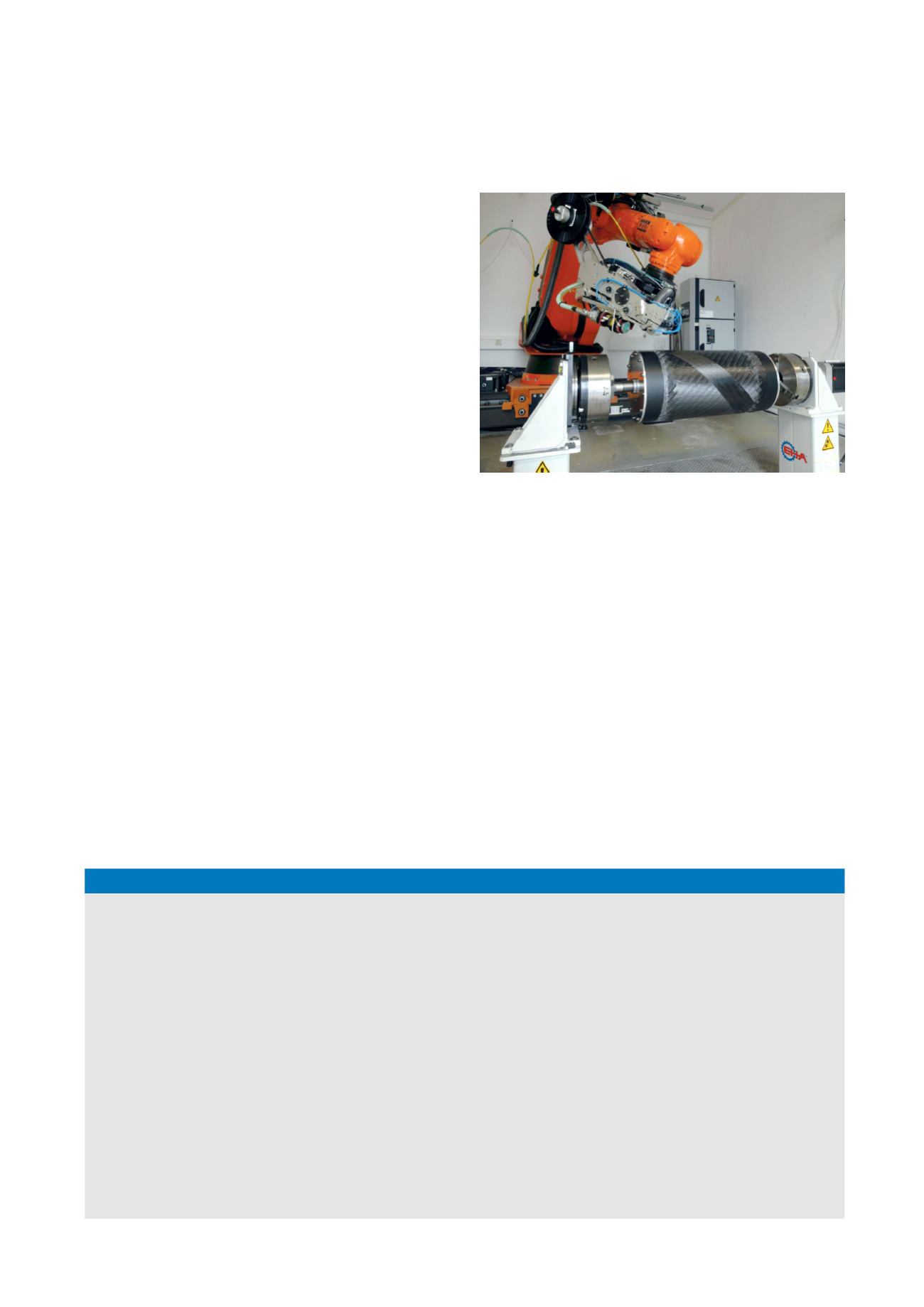
pressforming long fiber thermoplastic material (LFT), the
shell structure by thermoplastic automated fiber place-
ment (TP-AFP). TP-AFP allows an in-situ consolidation
of the shell on the previously manufactured rings without
additional adhesive, mechanical fasteners or a subse-
quent autoclave consolidation.
Polyetheretherketone (PEEK) was used as matrix polymer
due to the high mechanical and thermal loads.
Tests were performed on coupon-, subcomponent- and
full-scale level at room- and service-temperature.
Capsuled fiber Bragg grating (FBG) sensors were inte-
grated in the TP-AFP laminate during manufacturing at
different positions. A measurement system was installed
inside the module to operate the sensors and handle the
data. This will allow temperature measurements within the
laminate during flight.
Manufacturing of the cylindrical shell of the module with in-situ consoli-
dated TP-AFP tapes
The CFRP-module with integrated sensors and measure-
ment system is part of REXUS mission XXIII with a sched-
uled launch window in mid-March in Kiruna, Sweden.
The project was funded by the Federal Ministry for Eco-
nomic Affairs and Energy and partly funded by the REXUS
mission. REXUS is realized as a bilateral agreement
between DLR and the Swedish National Space Board
and gives universities all over Europe the opportunity to
perform experiments on sounding rockets.
www.lcc.mw.tum.de