



 67 / 308

67
Materials
Coordinator
Prof. Dr. Ewald Werner,
Materials Science and
Mechanics of Materials
Phone +49.89.289.15247
post@wkm.mw.tum.de www.wkm.mw.tum.deMembers
Prof. Dr.-Ing. Mirko
Hornung (interim),
Lightweight Structures
www.lls.mw.tum.deProf. Dr. Klaus Drechsler,
Carbon Composites
www.lcc.mw.tum.deProf. Phaedon-Stelios
Koutsourelakis,
Continuum Mechanics
www.contmech.mw.tum.deProf. Dr. Tim Lüth (interim),
Medical Materials and
Medical Implant Design
www.medtech.mw.tum.deProf. Dr. Rudolf Neu,
Plasma Material Interaction
www.pmw.mw.tum.deProf. Dr.-Ing. Veit Senner,
Sport Equipment and
Materials
www.spgm.mw.tum.deContact
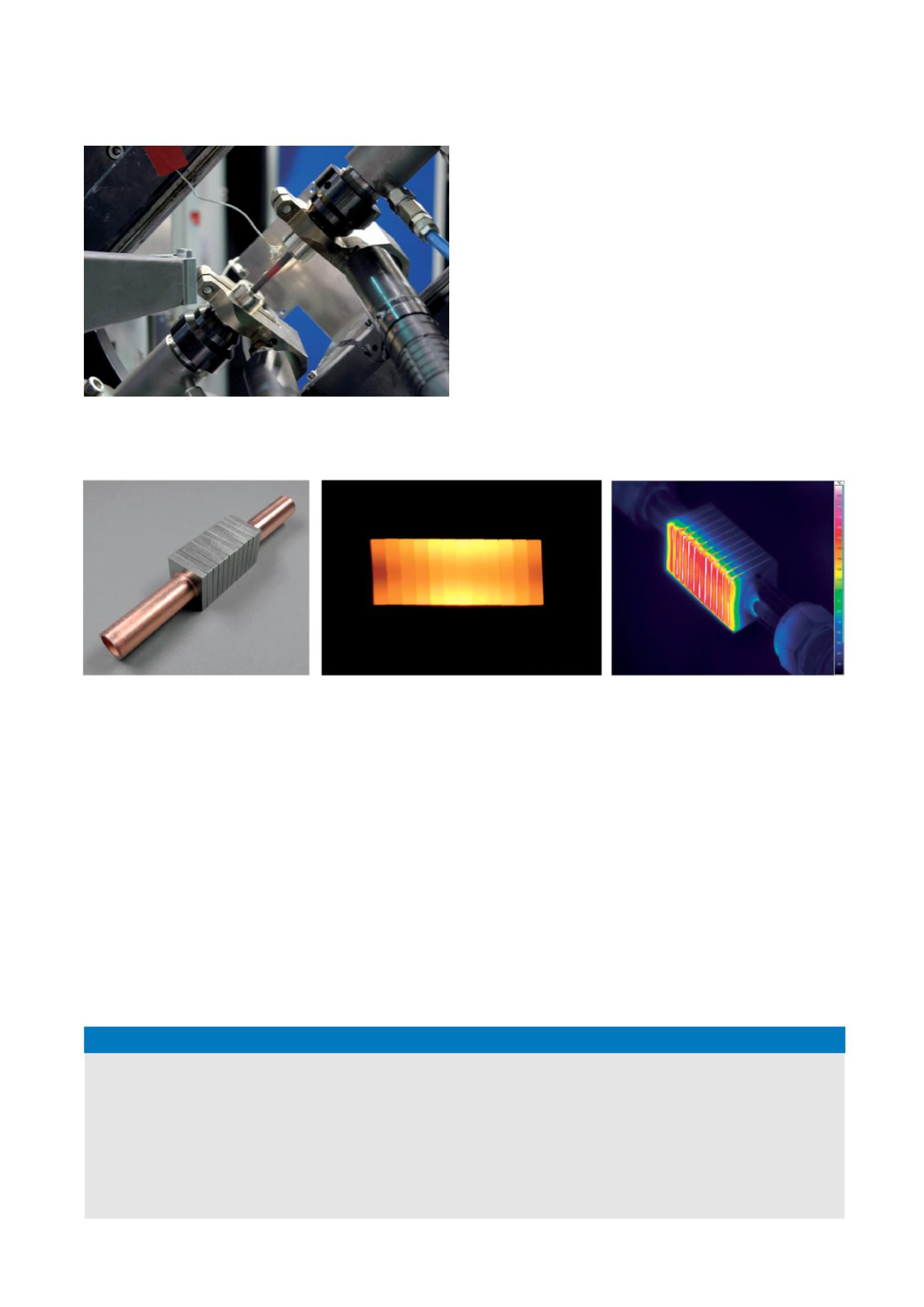
Thermally and mechanically loaded tensile specimen clamped in the
Eulerian tensile testing machine mounted on the neutron diffractometer
STRESS-SPEC. This setup allows to study of the evolution of intergranular
and interphase micro-strains during macroscopic plastic deformation at
elevated temperatures up to 800 °C. (Source: FRM II)
High Heat Flux Components for Future Fusion Reactors
In magnetically confined fusion plasmas, the hot plasma
core is largely separated from the first wall. Nevertheless
high-energy particles can escape from the confined
plasma and collide with the surrounding wall. Additionally,
electromagnetic radiation from the plasma reaches the
wall material depositing substantial power. In the case of
burning fusion plasma, the neutrons produced enter the
wall material and alter its characteristics through lattice
distortion and transmutation.
The research of the Plasma Materials Interaction Group is
carried out at the Max Planck Institute for Plasma Phys-
ics. The group develops metal matrix composites and
prepares mock-ups for plasma facing components for a
future fusion reactor together with other European fusion
laboratories. They are tested in the group’s high heat flux
neutral beam facility with reactor relevant heat loads.
Supported by EUROfusion
www.euro-fusion.orgHigh heat flux component with tungsten fibre reinforced copper tube as cooling channel and tungsten armour (left). The actively water-cooled component
was subjected to cyclic high heat flux tests surviving 300 pulses at 20 MW/m² for 10 s under conditions relevant to a future fusion reactor. During testing
(centre: photograph taken in the visible spectral range) the component reaches thermal equilibrium after 5 s at surface temperatures of 1500 °C (right).
phases, in-situ neutron diffraction is the method of choice.
An accompanying rigorous characterization of microstruc-
tural aspects on different length scales is accomplished by
light- and electronmicroscopy (SEM/ TEM), 3D-atomprobe
tomography, small angle neutron scattering, as well as
X-ray diffraction.