




 121 / 308

121
Wind Energy
Control of Wind Turbines and Wind Farms
Control technology holds much promise for improving the
way wind turbines and wind farms are operated, and may
contribute significantly to reducing the cost of energy from
wind. In fact, as sensors become cheaper and more capa-
ble, digital controls can make existing and future assets
‘smarter’, optimizing the way turbines and farms respond
to complex inputs and behave in challenging operational
scenarios. These are some of the most interesting and
pressing scientific questions we are working on:
■■
How can we improve the way wind turbines are
controlled, to increase power capture and/or decrease
loading to extend life?
■■
Can we move away from the greedy control approach
used today on board wind turbines, where each turbine
is operated individually with little or no consideration of
what neighboring machines are doing?
■■
What can be gained by using cooperative control
strategies of wind turbines within a farm? By the use
of cooperative control, can we mitigate wake losses
or reduce loading? Does the use of smart cooperative
control lead to new ways of designing future wind
farms? And, by using cooperative control, can we also
improve the way existing wind farms operate today?
■■
Can we operate wind farms in a way more similar to
what is done for other conventional energy sources,
and can this help in the integration of a higher share of
wind in the grid?
■■
What knowledge on the wind and the system response
is necessary to enable smart control approaches for
turbines and farms? And what sensors can provide
such information at a low cost, high availability and
moderate complexity?
Projects
■■
EU H2020 project ‘CL-WINDCON – Closed Loop Wind
Farm Control’
■■
BMWi project CompactWind ‘Erhöhung des Flächen
energieertrags in Windparks durch avancierte Anlagen-
und Parkregelung’
■■
Industrial project ‘Wind Farm Control’
■■
Industrial project ‘Development and Testing of Scaled
Offshore Wind Turbine Models’
■■
Industrial Ph.D. ‘LiDAR-Assisted Control of Wind
Turbines’
■■
One Ph.D. position (Chinese Scholarship Council)
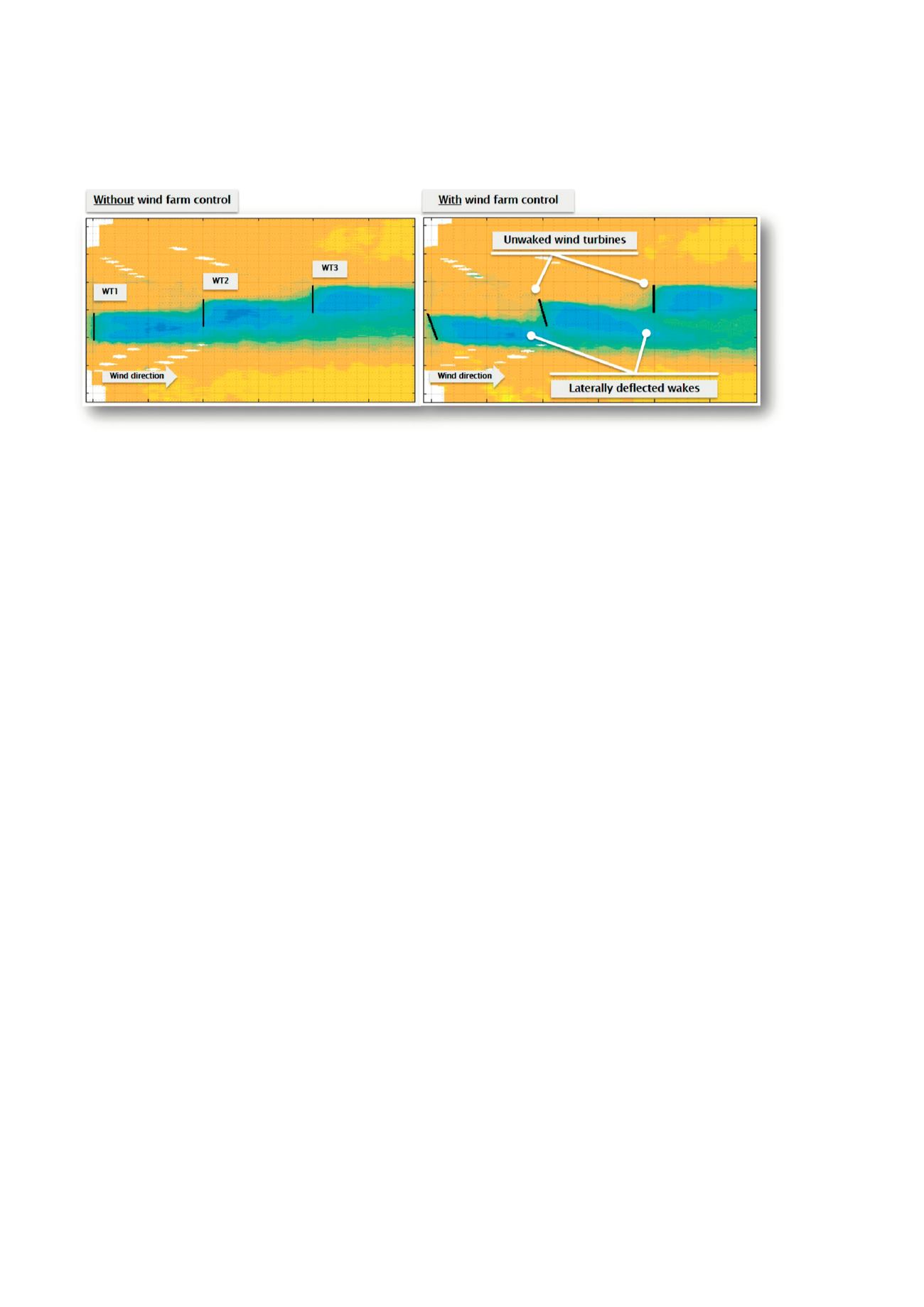
Wind farm control by wake steering, tested in a boundary layer wind tunnel. The front turbines yaw slightly away from the wind, and ‘clean’
the downstream machines by laterally deflecting their wakes. For the cluster of turbines in the figure, this strategy leads to a gain in power
output of 15%. (Flow visualization by DTU scanning LiDARS)