



 124 / 308

124
Carbon Composites
Process Technology for Matrix Systems
The Group ‘Process Technology for Matrix Systems’
addresses the robust and efficient processing of matrix
systems for the production of continuous fiber reinforced
composite parts.
On the one hand, the basic understanding of matrix
systems, the characterization of impregnation properties
of the fiber material for optimized processing, and process
engineering are central for the group. On the other hand,
associated issues such as tool technology, surface seal-
ing, and process integration are key activities of the group.
Team Processes and Production Systems
The Chair of Carbon Composites is represented in the
steering committee of the Competence Cluster for
Additive Manufacturing of the Department of Mechanical
Engineering to address composite materials for high
temperature applications. The investigations are focused
on the processing method called fused filament fabrica-
tion (FFF). The main target has to be to change the part
design approach to maximize the benefit of the increased
freedom of design and potential of additive processing.
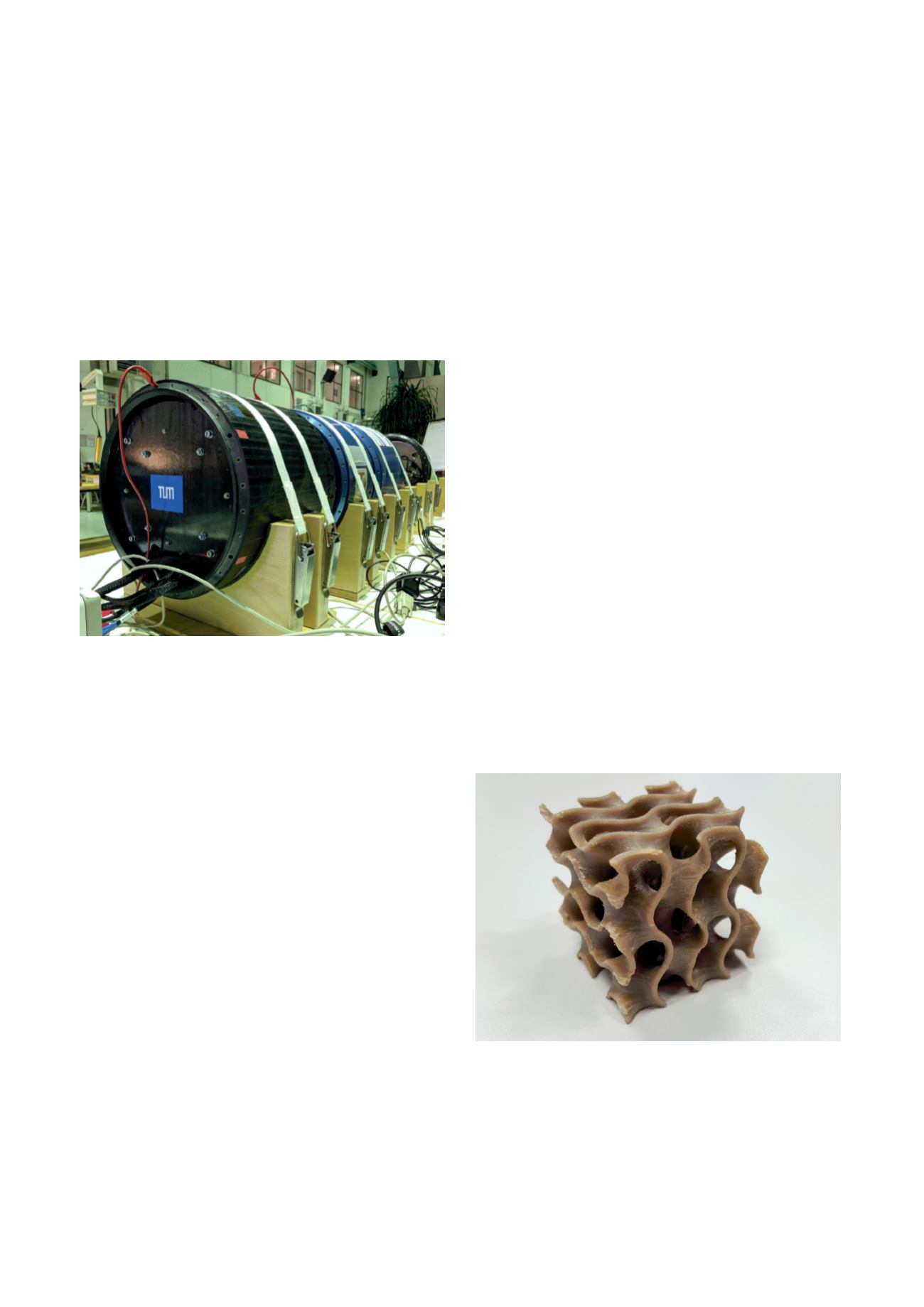
Constructions like ‘gyroids’ for example can combine
features like heat exchange with mechanical load to multi
functionalize the structure (see figure). These construc-
tions show the new freedom of design, without limitations
for tool access, for printed parts to address new business
Gyroid Structure printed out of PEEK (printed on an Apium Printer)
Reducing the structural weight of a rocket allows higher
payloads, higher apogees or reduced fuel consumption.
DLR operates sounding rockets to perform experiments
during its sub-orbital flight. The modular structures of
these rockets are typically made out of aluminum. To
increase the performance of the rockets TUM has devel-
oped and implemented a manufacturing concept for a
thermoplastic CFRP-module with integrated fiber optic
sensors as part of a project funded by the Federal Ministry
for Economic Affairs and Energy.
A module consists of a thin cylindrical shell with bulky
load input rings on both ends as a bolting interface to the
neighboring modules. The manufacturing was split into
separate steps for the load input rings and the cylindrical
shell. The rings were manufactured by pressforming of
long fiber reinforced thermoplastic granules (LFT). Ther-
moplastic automated fiber placement (TP-AFP) was used
for the manufacturing of the shell structure. The closed
loop control of the TP-AFP process parameters allows an
in situ consolidation of tapes on the substrate and on the
previously manufactured load input rings. This way there
is no need for a subsequent consolidation in an autoclave.
Polyetheretherketone (PEEK) was used as a matrix poly-
mer due to the high mechanical and thermal loads.
Public Funded Projects
■■
AIF project ‘FullCycle’
■■
AIF project ‘Accurat 3’
■■
BMBF project ‘MAIsandwich’
■■
BMBF project ‘InSensoFlecht’
■■
BMWi project ‘AirCarbon2’
■■
BMWi project ‘TELOS’
■■
BFS project ‘ISP’
■■
DFG project ‘DR 204/10-1’
■■
EU project ‘INSCAPE’
Test Set-up with integrated CFRP-module representing a major milestone
in the REXUS mission XXIII