




 120 / 308

120
Wind Energy
used for studying wakes, turbulent flows within wind
farms and wind plant control, as well as for the planning of
future experiments.
Experimental activities at WEI are not limited to scaled
testing. In fact, within a joint project with the research
cluster WindForS (Windenergie-Forschungscluster),
we are working on the development of an experimental
test site in complex terrain. The test facility, funded by
the German Federal Ministry for Economic Affairs and
located in Baden-Württemberg, will include two highly-
instrumented 750 kW wind turbines, as well as extensive
instrumentation for the measurement of wind conditions.
Once operational, the test site will enable new, exciting
and unique testing capabilities, paving the way for an
improved understanding of wind conditions and the opti-
mization of wind turbines for complex terrain applications.
Projects
■■
BMWi project ‘WINSENT – Wind Science and Engineer-
ing in Complex Terrains’
■■
EU H2020 project ‘CL-WINDCON – Closed Loop Wind
Farm Control’
■■
Industrial project ‘Wind Farm Control’
■■
Industrial project ‘Development and Testing of Scaled
Offshore Wind Turbine Models’
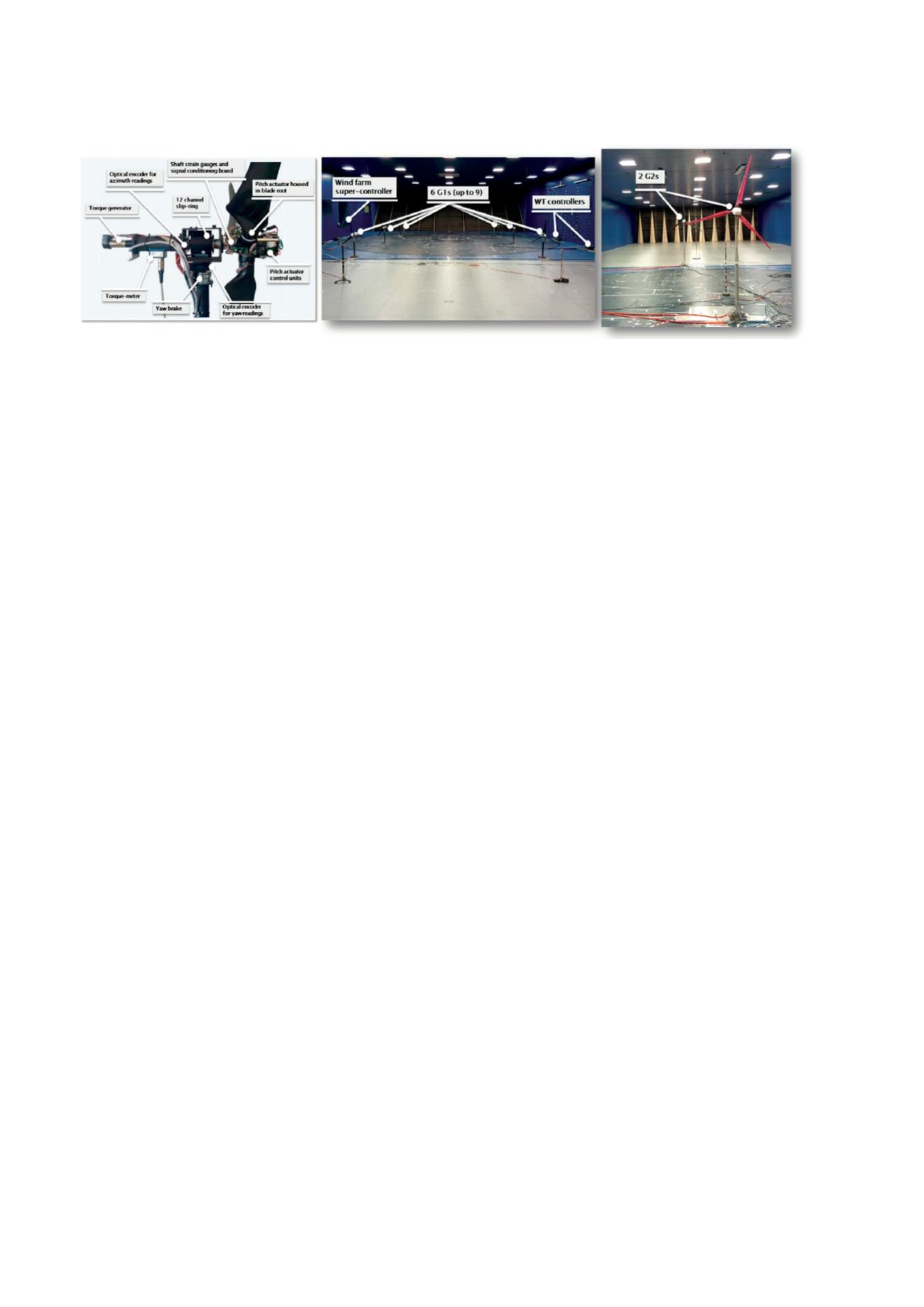
From the left: view of the nacelle-rotor system of the G1; 6 G1s in a 2 x 3 array; 2 G2s in partial wake overlap, looking upstream towards the wind
tunnel inlet (notice turbulence-shear-generating spires).
■■
Can we go beyond the matching of purely aerodynamic
effects, replicating at scale also the aeroservoelastic
behavior of wind turbines?
■■
Can closed-loop control methods for wind turbines and
farms be tested at scale? If so, what do we capture
with good precision, and what are the limits of these
scaled models with respect to full-scale reality?
Our scaled models are miniaturized wind turbines and,
exactly as full-scale machines, they are governed by
closed-loop pitch, torque and yaw controllers. Optionally,
a super-controller can be used for the collective control
of clusters of wind turbine models, enabling the study of
wind farm control techniques. Our family of wind turbines
includes at present three different sizes: the largest
models (termed G2, with a 2 meter rotor diameter) can be
optionally equipped with aeroelastically scaled blades,
while the smaller ones (G1 and G0.6, respectively of 1
and 0.6 meters of diameter) are used for modeling wind
turbines clusters, studying wake interactions and complex
terrain effects. A high-fidelity digital copy of the models
and the wind tunnel has been developed by WEI research-
ers, using state of the art CFD techniques coupled with
aeroelastic wind turbine models. The experimental results
are used to validate the digital models, which in turn are