




 119 / 308

119
Wind Energy
Wind Sensing Technology
At present, wind turbines are largely unaware of the wind
blowing on their rotor: they are equipped with anemom-
eters and wind vanes installed on the nacelle, which only
measure wind speed and direction at that point in space.
Therefore, wind turbines are essentially operating in the
dark: they have only a very primitive knowledge of the
atmospheric conditions, and they ignore whether or not
they are shaded by other machines. This lack of aware-
ness clearly hinders the way they are operated.
We are working on changing this situation, developing
new technology that can measure the wind conditions
at the rotor disk. This is achieved in a radically new way:
turning the whole rotor in a large wind sensor, a novel
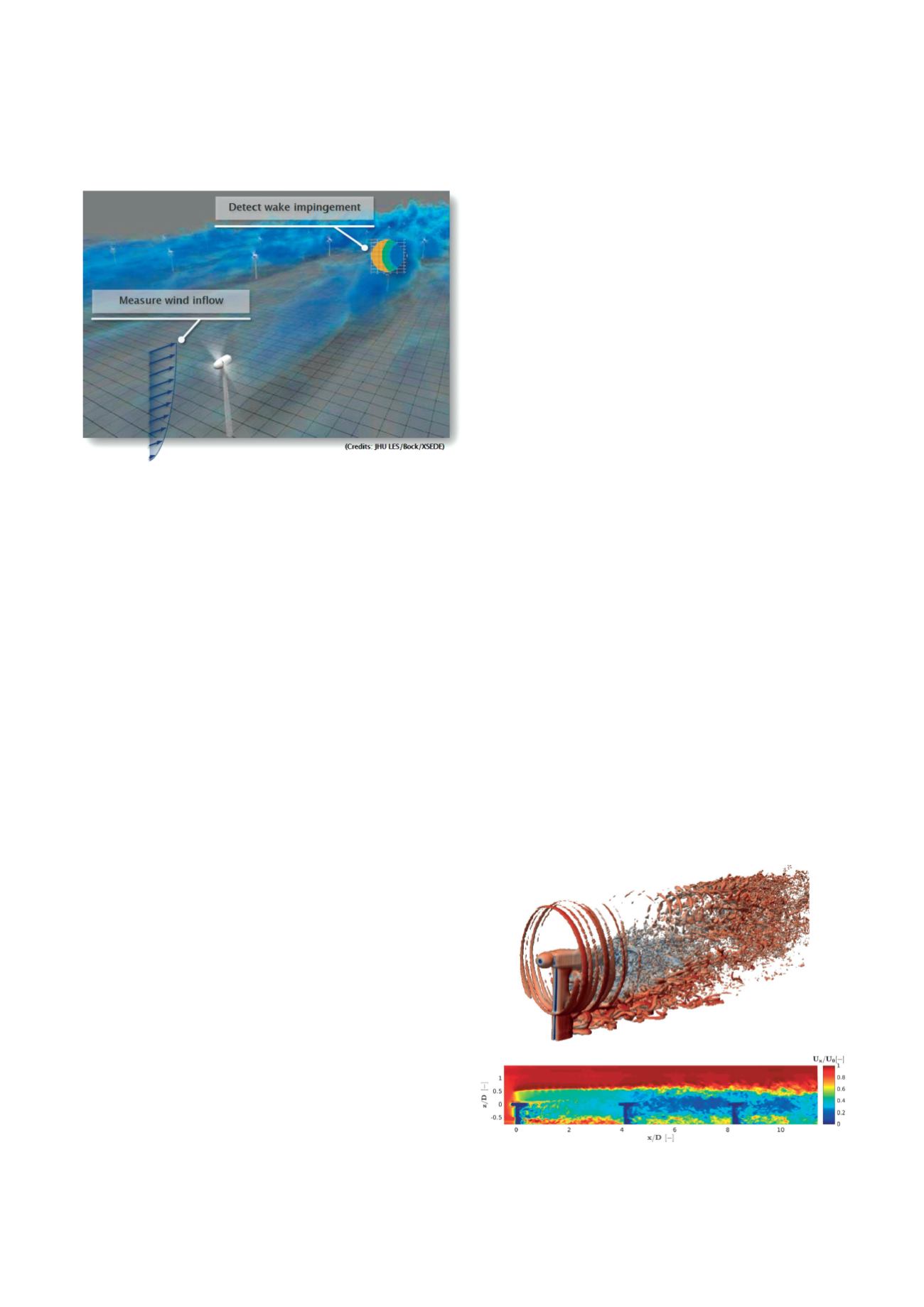
Wind sensing technology in action. Wind turbines detect in real-time the
wind inflow conditions, including the possible presence of an impinging
wake.
approach that we have termed ‘wind sensing’. By the
use of wind turbine response data, as provided by strain
gages or accelerometers installed on the blades or the
nacelle, wind sensing technology computes in real-time
the wind conditions at each machine. In turn, better
knowledge of the wind is used for improved operation of
each wind turbine or the whole wind farm by smart control
strategies.
These are some of the key scientific questions we are
working on:
■■
What wind characteristics can we measure and with
what precision?
■■
What is the minimum set of sensors that are necessary
for measuring the wind inflow?
■■
What is the use that can be made of detailed wind
information at the rotor disk?
■■
What new control approaches can be developed based
on wind sensing technology? How can wind sensing
improve the way a wind turbine is controlled? And how
does wind sensing enable smart wind farm control
methods?
Projects
■■
Industrial project ‘Wind Estimation from Rotor Loads’
■■
Industrial project ‘Vertical Wind Shear Estimation from
Rotor Loads’
■■
H2020 ETN Project AWESOME ‘Wind Energy Operation
and Maintenance’
■■
EU H2020 project ‘CL-WINDCON – Closed Loop Wind
Farm Control’
Experimental Testing
Experimental testing is crucial for verifying and validating
the results of all our research efforts, including mathemat-
ical models, simulation tools, control strategies or new
technologies. Testing in the field on production machines
is however very challenging, possibly expensive and often
altogether impossible. To address some of the limits of
full scale testing, WEI has developed new technology
for scaled model testing in boundary layer wind tunnels.
These are some of the most important research questions
that WEI researchers are trying to answer:
■■
Can we replicate in the controlled environment of a
wind tunnel some of the key physical aspects of the
energy conversion process from wind? How should
scaled models be designed in order to match as many
of the relevant physical parameters as possible?
■■
Can we faithfully replicate wake behavior, wake interac-
tions, and complex terrain effects?
Top: LES simulation of a single G1 wind turbine; bottom: wake interactions
for three aligned G1 wind turbines.