




 180 / 308

180
Biomechanics
Material Properties of Bacterial Biofilms
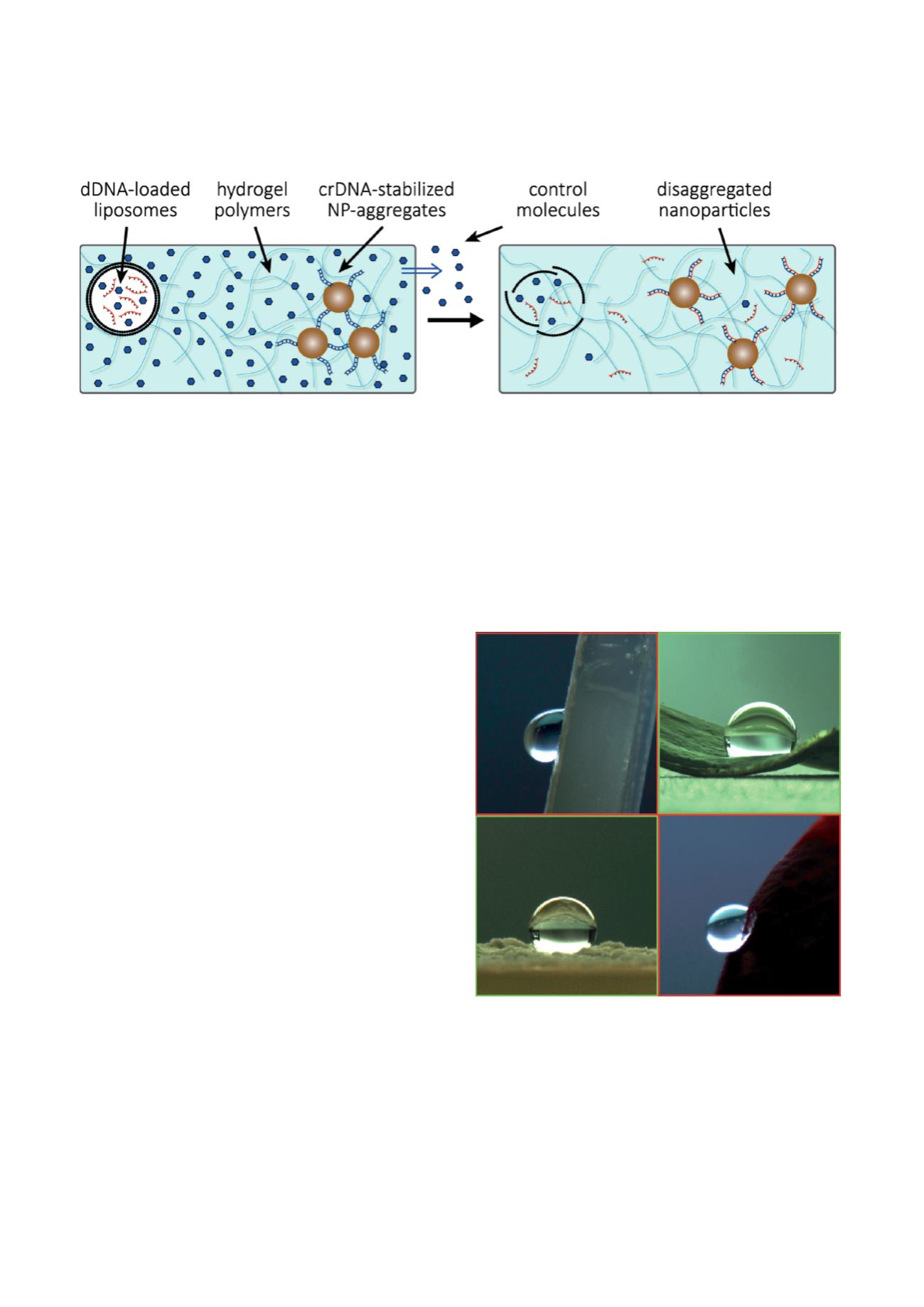
Water drops on biofilms (left column) and plant leaves (right column).
Rose-like behavior is indicated by red boxes whereas lotus-like behavior
is depicted by green boxes.
(Bio-)Hybrid-Materials
A combination of osmotic pressure and synthetic DNA constructs allows for the temporally controlled release of nanoparticles from a hydrogel matrix.
Bacteria secrete a broad range of biopolymers, that form a
protective matrix around the prokaryotes. This community
of biopolymers and bacteria is referred to as a biofilm.
Bacterial biofilms can grow on a broad variety of surfaces
and constitute a severe issue in industry and medicine.
We aim at quantifying the mechanical and water-repellent
properties of bacterial biofilms. We are also interested in
how different chemical environments affect those material
properties. By doing so, we hope to develop new strate-
gies for the removal of biofilms from surfaces.
Project
■■
SFB 863: Mechanics of bacterial biofilms
Many biomolecules offer outstanding properties but
cannot be used in medical/technical applications on their
own. Thus, we develop hybrid materials where we either
mix biological molecules in new combinations or add
biological components to inorganic/synthetic materials.
Examples for such hybrid materials are hydrogels with
programmable drug release kinetics.
Project
■■
Triggered nanoparticle release from hydrogels