



 184 / 308

184
Automotive Technology
two wheels and stabilizing itself, Scube is able to operate
with a very small footprint. Driven autonomously, Scube
features an active tilting system to keep the passenger
free from sheering forces and ensure a comfortable ride.
To travel longer distances, the team proposes the novel
bus system ‘Scube-Trans’. Scubes can attach themselves
to this bus system, which travels above the traffic
and therefore never needs to stop.
Entry Mobility for India
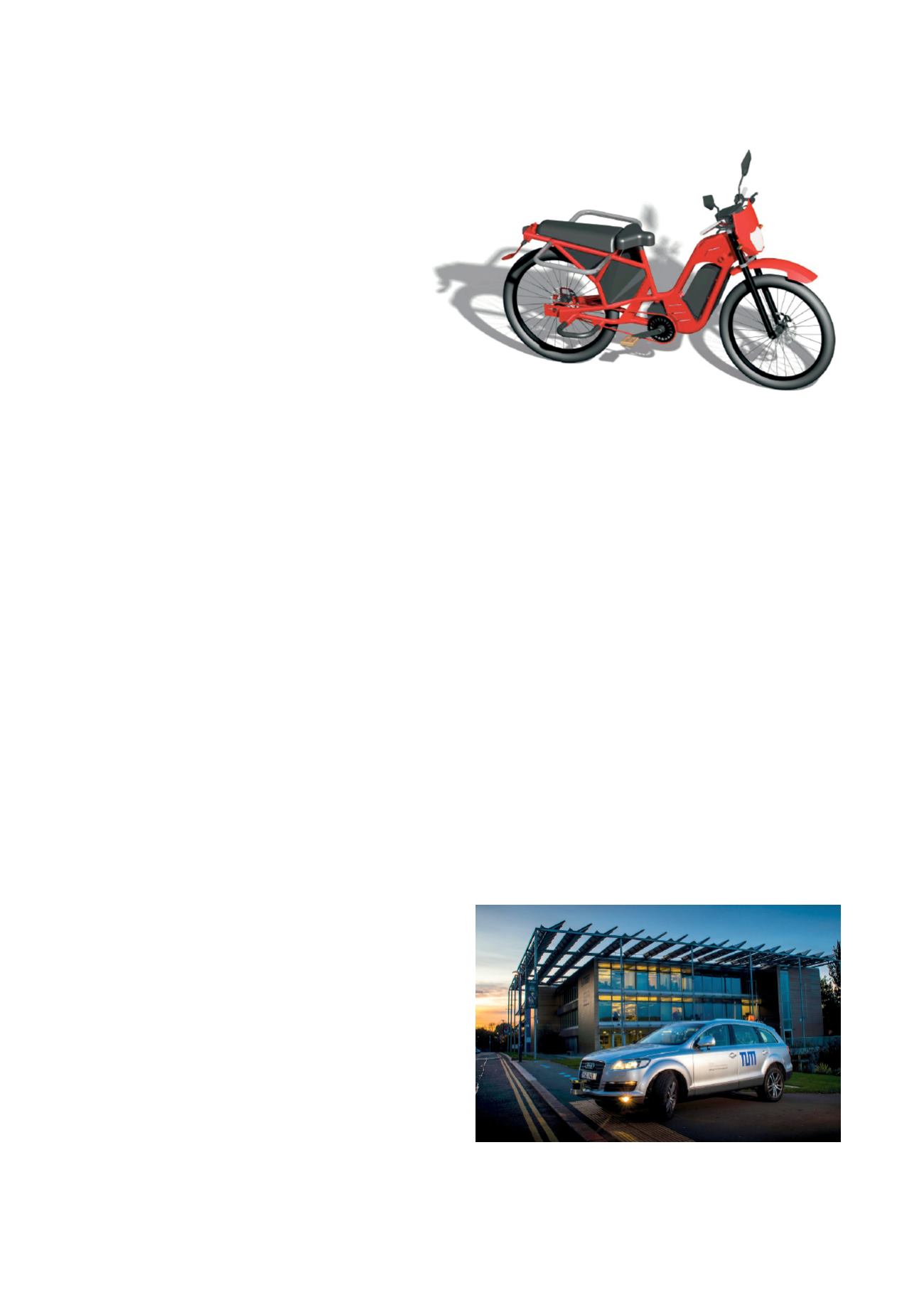
The concept consists of a modular bike with a multifunc-
tional frame and a separate electric propulsion unit, which
can also be attached to any other existing bike. This
enables the customers who own a bike already to only
purchase the propulsion unit and retrofit with a major cost
advantage compared to the whole system. If the customer
later on feels the need for more features, like better design
or increased payload, he or she can simply upgrade by
purchasing the frame at a later point in time. But the whole
system is offered with a cost advantage compared to
separate purchase.
The propulsion consists of a compact mid-mounted
electric motor. It can be attached to almost any kind of
bike just by replacing the bottom bracket and cranks.
The separate detachable portable battery module can
be mounted to the down tube or on the rack of the bike.
To make the vehicle more attractive and increase perfor-
mance, the propulsion unit includes a hand throttle so
that the driver can use his bike without even the need to
pedal. However, pedals can then still be used to extend
the range of the vehicle and in case recharging is not
possible. With this setup, a potential customer is able to
carry passengers or goods more comfortably and extend
his or her mobility radius.
The design of the vehicle is more motorcycle-like to
create a more appealing and sportier image compared to
fragile-looking standard bike frames. A bigger set of tires
are available to take over suspension functionality and
hence provide more comfort, especially on bad roads.
The wheelbase is longer to provide more space and the
frame has a low step-through to also ensure that female
riders wearing a traditional Indian Sari do not encounter
problems.
Beside the ‘typical’ vehicle features, the concept also
offers extra features due to its modular design. The frame
comes with special mounting holes for different add-ons.
They can be footboards, a rack or a lateral tube structure
that, together with a net, serves as a lightweight but
high-bearing cargo space.
In addition to the modular frame, the concept also
includes a second-life option for the frame. If parts of the
vehicle are broken and it needs to be disposed of entirely,
the frame can still be reused and easily converted into a
bike trailer, a wheelbarrow or even a simple three-wheeler.
Because of the special design of the frame with lateral
holes, two frames with their respective back wheels can
easily be combined with a few crossbars. The new vehicle
which results can be used as a transportable marketplace
or a trailer for several passengers.
Tele-Operated Driving
It was the first time in Europe that 5G-enabled tele-
operated driving was used to control a consumer vehicle
remotely – in this demonstration, the vehicle was located
at Surrey University (5GIC) and was controlled from
the MBB Forum venue, London ExCel. The end-to-end
network latency was less than 10 milliseconds and air
interface latency was less than 1 milliseconds, which
enabled the driver to control a vehicle remotely from 50
kilometers away, with only 24 cm braking deviation when
it was driven at approximately 90 km/h.
The Institute of Automotive Technology has been
researching into controlling a vehicle remotely since 2009.
From projects like the EU-Project PROMOTHEUS or the
London, UK, 15th November 2017: At 8th Global Mobile Broadband
Forum, the Institute of Automotive Technology demonstrated 5G tele-
operated driving with Huawei, Vodafone and the 5G Innovation Centre
(5GIC) of Surrey University.