



 185 / 308

185
Automotive Technology
New Projects
Vehicle Dynamics and Control Systems
■■
Optimal body movement for highly automated driving
■■
Development of a methodology to support strategy
decisions in motorsports
■■
Compensation of modified suspension parameters
using steering control
Driver Assistance and Safety
■■
Safety assessment of highly automated vehicles
■■
Intelligent maneuver automation – cooperative risk
prevention in real time
■■
Classification of damage risk under the influence of
advanced driver assistance systems
Vehicle Concepts
■■
ACAR – Vehicle concept for sub-Saharan Africa
■■
SIM2GETHER – Collaboration platform for interdiscipli-
nary simulation
■■
Topology optimization of electric drive trains for four-
wheel drive vehicles
Electric Vehicle Components
■■
The rapid aging characterization of battery systems
■■
Lifetime analysis and prediction for battery-powered
products
■■
Second-life of lithium-ion vehicle batteries
Smart Mobility
■■
Hydrogen mobility concept
■■
WATE – Web-based analysis tool electro mobility
■■
QOSTREET – Classification of road surface quality with
big data
GlobalDrive
■■
Fusion of high-precision map data in the automotive
industry
■■
Intelligent travel features in public transport of the
future
■■
‘Pimp my Twizy’ – Increasing the performance and
range of an electric vehicle through optimized thermal
management
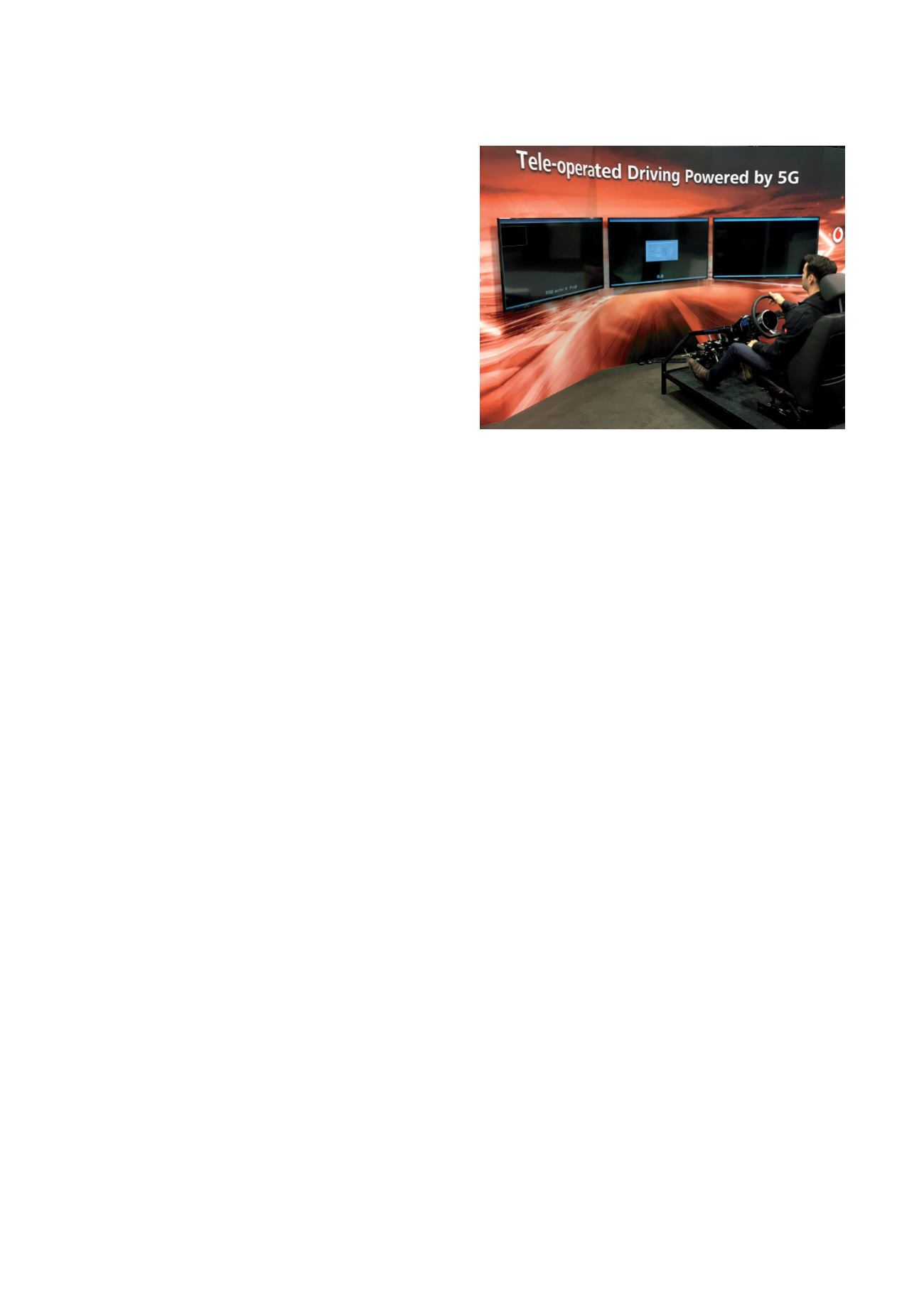
The Institute of Automotive Technology demonstrates Europe’s first
tele-operated driving with 5G.
competitions of the U.S. Department of Defense (DARPA
Challenges), it can be stated that today autonomous
driving is only possible in certain less complex scenarios.
Especially in the field of urban traffic with many different
road users and confusing road topology autonomous cars
will not be able to perform like a human in the next couple
of years.
Therefore, a viable approach is to bring back a human
driver into the control loop in order to deal with the com-
plexity of the situation. A wireless data transmission (5G at
the demo) connects the human driver with the vehicle. A
server handles communication and can perform compu-
tationally intensive tasks or provide additional information
from the internet. Further, a Car2Server communication
is being developed simultaneously, which apart from the
tele-operation, is able to provide information to the driver,
like road situations lying ahead.