



 237 / 308

237
Sport Equipment and Materials
Understanding the Interaction between Athlete, Equipment and Environment
Psycho-physics has pervasive and significant practical
applications in different fields such as neuroscience,
robotics but also for sports engineering. The meaning
for sports engineering becomes clear if we look at the
factor ‘(dis)comfort’. This variable is considered as one
of the important criteria for athletes selecting and tuning
their sport equipment. It may also have an impact on
sport injuries and performance. One related question is
whether there is a relationship between objective bio-
mechanical parameters (i.e. plantar pressure distribution
or joint angles) and the perceived ratings of the athletes.
Running and especially on various type of terrain offers
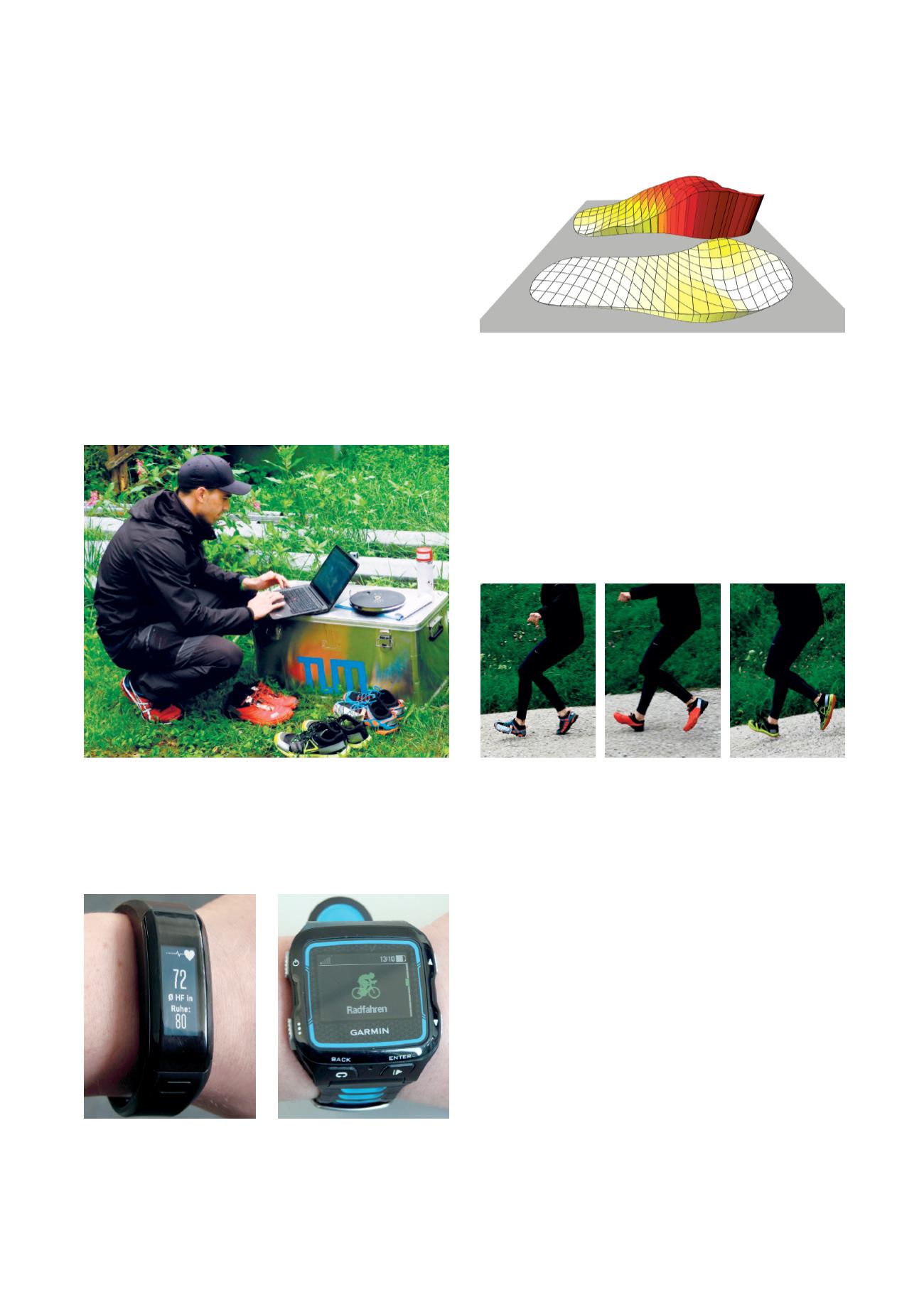
Performance tests with subjective ratings of discomfort of different trial
running shoes
Rather non-ergonomic data collection in the field
Plantar pressure measured with insoles
perfect boundary conditions to investigate this question.
Systematically different types and levels of perturbations
are imposed to runners (i.e. additional weight in the boots)
and their perceptions of perturbations are gathered.
Simultaneously objective variables such as center of
pressure, vertical force, joint kinematics and EMG are
measured. First observations indicate that the athlete
seems to maintain his/her running pattern even if major
equipment modifications have been made.
Health, Wellness and More Fun Through Technical Support
Sports and physical activity are often considered as
‘the preventive medicine not taken’. Clearly, this puts
emphasis on the so-called self-management of health
since people are individually responsible for their physi
cal activity and well-being. Today, the advancement
of sensing technologies, embedded systems, wireless
communication, nano-technologies and miniaturization
potentially makes it possible to develop smart systems for
monitoring activities and vital parameters. In the last few
years, a multitude of wearable devices, such as activity
trackers, smart watches or inertia sensors have come to
the market. They assist as a virtual coach, monitor physio
logical parameters or even serve as a feedback system.
The future of wearable devices with sensors close, on or
even in the body seems to be bright.
Multisport watch GARMIN
Forerunner® 920XT
Fitness Tracker GARMIN
vivosmart® HR