




 232 / 308

232
Thermodynamics
is slightly lower than the COP of the scroll compressor.
These promising first results lead to further investigations
comparing the dynamic operation of the two compressor
types.
4. Energy Efficient Heat Source Management During
the Initial Heat-up Period of Vehicle Cabin
Motivation and Objectives
Even in current, combustion-engine powered vehicles,
cabin-heating in winter conditions is mainly provided by
the heat rejection of the drivetrain. Consequently, develop-
ment goals to achieve higher effective efficiency and lower
fuel consumption entail decreasing waste heat production.
As a result, in particular diesel engine-powered vehicles
have to deal with insufficient heat supply to the vehicle
cabin under low ambient temperatures.
Approach to Solution
Present investigations are focused on the influence of
different engine operation modes of a state-of-the-art
automotive six-cylinder diesel engine on its energy
balance and its emissions especially under low-load con-
ditions. Primarily, the parameters affecting the combustion
process and the intake system are investigated. Addition-
ally, load point shifting due to electrical loads is examined.
As an evaluation criterion, a new kind of efficiency factor
is introduced.
Key Results
Cabin heating has a crucial influence on the thermal- and
emission behavior of the engine. Therefore, the amount
of heat or enthalpy transferred to the environment must
be reduced significantly. This can be achieved most
effectively by increasing the EGR rate and the charge
air temperature. Indirect charge air cooling systems, for
example, are advantageous for both measures.
5. Low Dimensional Modelling of Flow and Mixing in
Automotive HVAC Units Using Proper Orthogonal
Decomposition
Motivation and Objectives
Passenger comfort has become a major aspect in modern
vehicle air conditioning concepts. Therefore, the tem-
peratures at the outlets of the HVAC units are controlled
and measured using temperature sensors. These sensors
provide the most important value for the automatic climate
control (ACC). To predict the temperatures at the outlets
a novel proper orthogonal decomposition (POD) based
approach is investigated to avoid costly sensors and
enable model-based control of the HVAC unit.
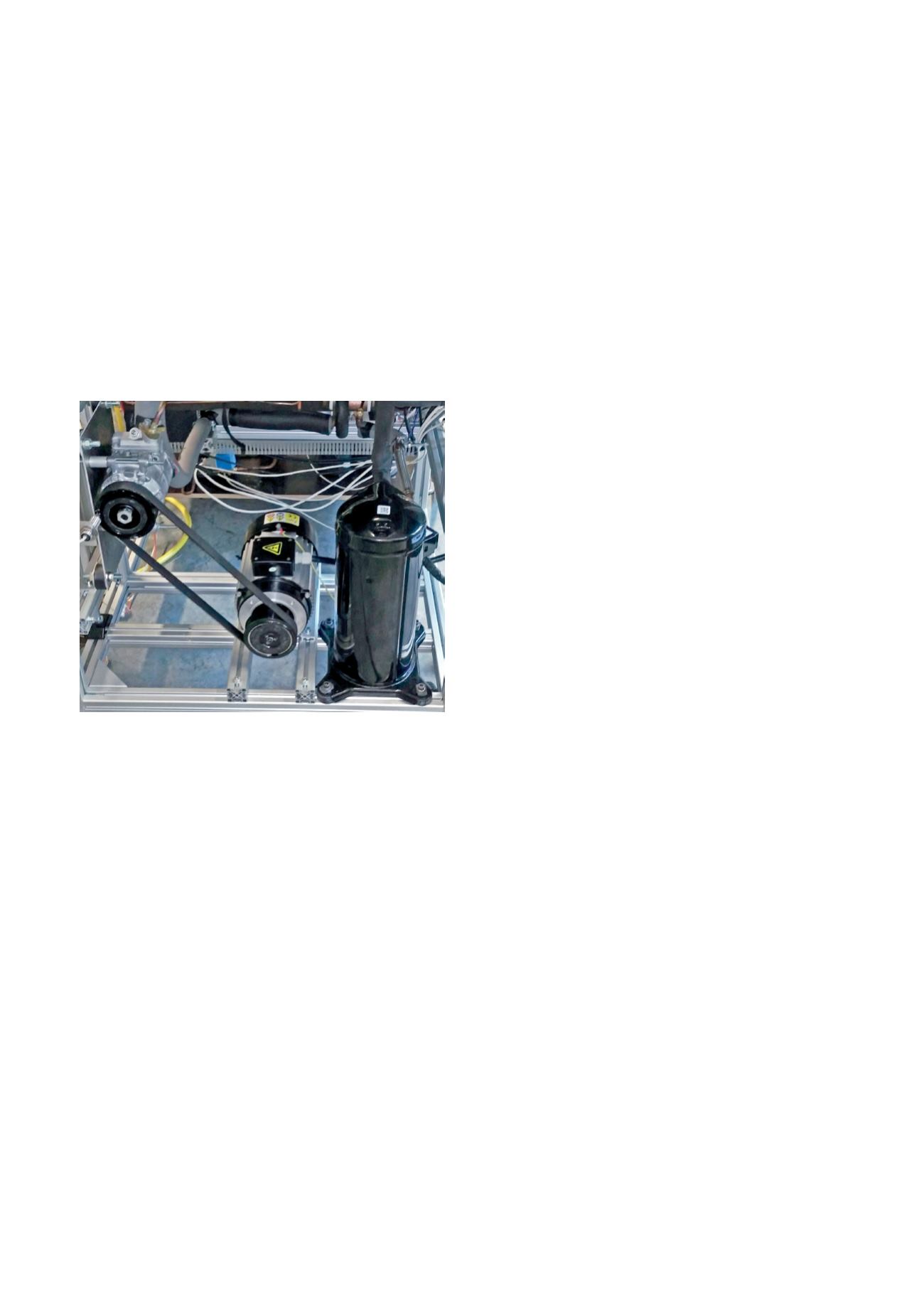
Compressor section of the test-rig with swash-plate compressor (left) and
scroll compressor (right)
3. Solar Cooling by Coupling of PV
and Compression Chillers
Motivation and Objectives
Thermal conditioning of residential buildings plays a major
role in the energy consumption of countries in a temperate
climate as well as in the hot and humid climate of coun-
tries in the Gulf region. The market share of HVAC devices
powered by renewable energy is low for both regions. This
issue is addressed in the PVCool project of the Institute
of Thermodynamics at TUM and the Hamad Bin Khalifa
University (HBKU) in Doha, Qatar, started in March 2017.
Approach to Solution
Compression chillers (CC) directly coupled with photo
voltaic (PV) systems (PV-CC) have gained increased
attention, mainly due to the decreasing costs of PV
systems and the low investment costs of conventional
compression chillers, which makes them more and more
economically feasible. However, one of the main chal-
lenges in PV-CC is their unsteady operation and need for
low part load capability under fluctuating solar irradiation.
Therefore, a swash-plate compressor is integrated into a
CC for residential buildings and tested under desert and
temperate climate boundary conditions.
Key Results
In a first step, experimental comparisons between
swash plate compressor and scroll compressor, that is
commonly used in HVAC applications, were executed
under steady state conditions. It could be shown, that
the part load capability of the swash-plate compressor
is substantially lower than for the scroll compressor. The
coefficient of performance of the swash plate compressor