




 236 / 308

236
Sport Equipment and Materials
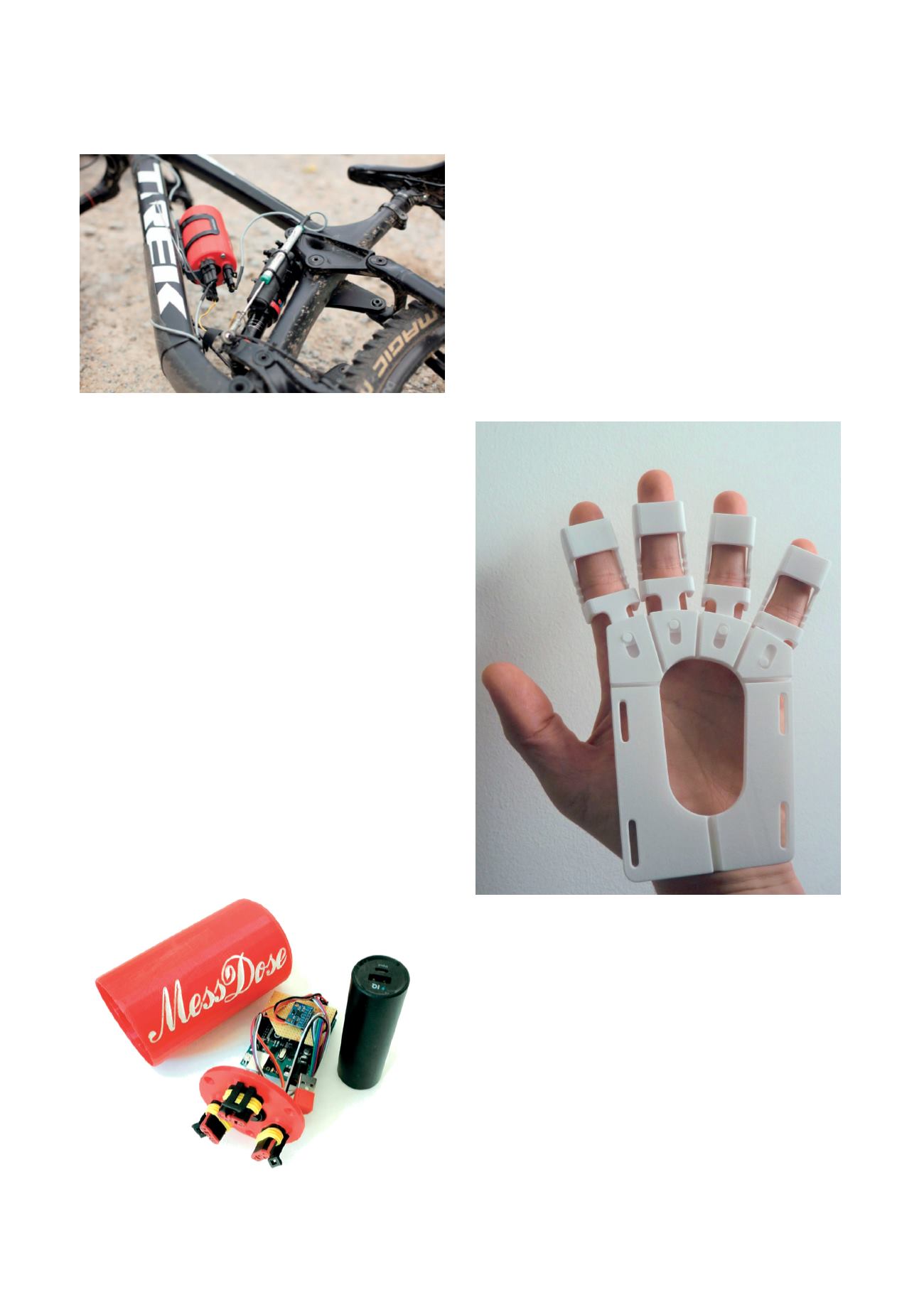
First steps towards an individual exoskeleton-glove which aims to activate
specific muscle groups to enhancing core stability
response characteristics such as ‘aggressive’, ‘efficient’,
‘balanced’ and ‘playful’.
All test bikes and their suspensions were equipped with
sensors – standardized measurements on a test bench
confirmed physically measurable spreads of the four
setups. To answer the above question on the relationship
between objective and subjective parameters a blind
test was performed. The selected ten subjects – all with
approximately the same body weight – had to rate the
performance of the bikes under widely standardized
field conditions and always against the same reference
bike. Variance analyses confirm significant differences in
perception and evaluation, thus paving the way for further
research on mechatronic suspension systems.
Improved Fitting Through Customized Sport Equipment
A good core stability has a high impact in different fields of
physical activity like rehabilitation, performance improvment
and injury prevention. Especially during fast distal segment
movements and initiation of force development, high activity and hence stability of the core muscles is essential.
Through a holistic activation of hand- and arm muscles we
want to achieve an equal activation of essential core mus-
cle groups and therefore improve athletic performance.
We aim to develop an individualized exoskeleton-glove
that activates the aforementioned muscles.
A high level of manufacturing quality for these gloves
is possible through our collaboration partner, the Chair
of Micro Technology and Medical Device Technology
(MiMed) of Professor Lüth. State-of-the art additive manu
facturing techniques will be used to create these gloves.
Using our expertise in scientific methodology, we will
validate their efficacy in performance during a subsequent
validation study.
Data logger and linear displacement measurement at rear suspension
(photo: Lars Scharl)
Custom built data logger to measure cycling speed, displacements and
velocities at the suspensions, three axis accelerations, angular displace-
ments and velocities
Future Aspects
Like the idea of ‘individualized medicine’ assistive devices
(e.g. ortheses) should also be adjustable to an individual’s
anthropometry. While ortheses and prostheses manufac-
turers already consider different segment circumferences
and lengths, they still neglect individual differences with
respect to the joint’s trajectory of its instantaneous centers
of rotation, leading to uneven pressure distribution of the
orthesis and consequently to high loads on soft tissues.
Through high-precision measurement of human surface
and joint properties, and additive manufacturing, we aim
for a real customization for everyone in the near future.