



 260 / 308

260
Internal Combustion Engines
Injection Systems – Spray Measurement – Optical Research
In the past decades the injection
pressure of modern diesel engines has
increased from 1000 bar up to 3000 bar.
Our research activities include all steps
of injection system development. Key
competences are various simulations
containing 1-D hydraulic, 3-D mul-
tiphase flow as well as spray simulation.
Furthermore, at several test benches
hydraulic and optical measurements of
injectors with various fuels are carried
out. A current project is focusing on the
hydraulic behavior of orifices in injection
systems to validate simulation results.
Part of the task is the development
of a hydraulic test bench including
measurement techniques to investigate
the high dynamic fluid flow properties in
combination with cavitation and thermal
effects. The main target is to analyze
hydraulic elements by using innovative
measurement techniques and gain
information about physical effects to
optimize the design of future injection
systems. Furthermore an open-loop
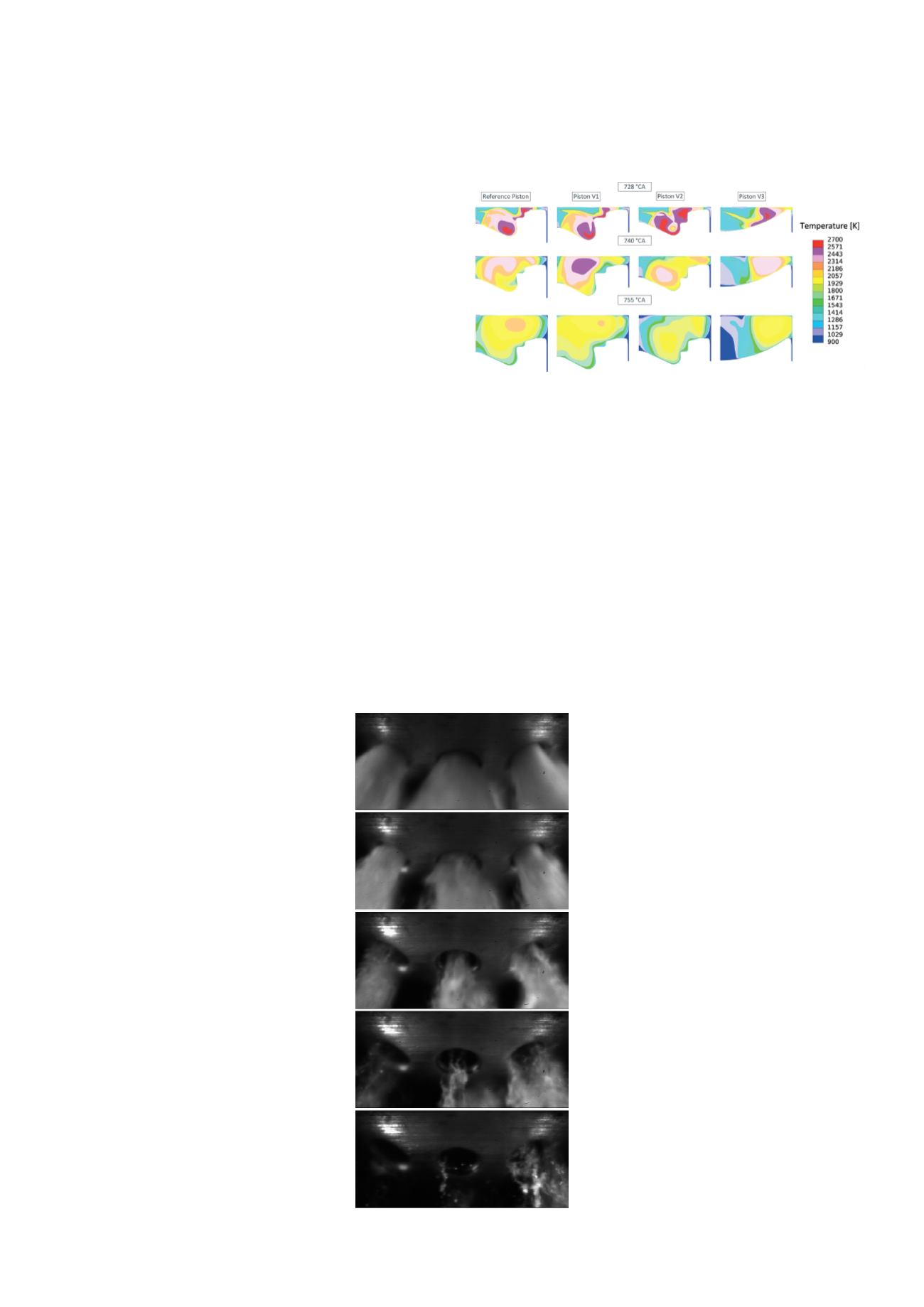
End of a gasoline injection event (from top to
bottom): poor atomization in the end bears the
risk of soot formation and injector coking.
control is under development in col-
laboration with the Institute of Applied
Mechanics whose aim is to maintain an
optimal injection rate throughout the
entire lifetime of a common-rail injector
subjected to coking, wear, etc. For this
purpose, different injector signals are
evaluated in order to determine the
injection rate by available signals in
engine operation.
Projects
■■
BFS project ‘Messung und Berech-
nung des Düsendurchflusses’
■■
DFG project ‘Optimierung des Ein-
spritzverhaltens von Dieselinjektoren
unter dem Einfluss von Alterungser-
scheinungen des Injektors’
■■
Several projects funded by industry
partners
Combustion Technologies – CFD Simulation – Emission Reduction
The reduction of engine emissions and fuel consumption
are drivers for the improvement of combustion technol-
ogy. Engines for gasoline, diesel, and natural gas are
developed and built at the institute and are available for
industrial or public-funded research projects. A key com-
petence for the realization of our engine concepts is the
application of professional CFD simulation software, which
is used to predict and optimize the gas exchange phase,
in-cylinder swirl, tumble or turbulence, and the phases of
fuel injection, mixture formation, and combustion. Simu-
lation results are used to design improved geometries of
the combustion chamber or injector nozzles and are then
validated on one of our 13 engine test benches. Engine
out emissions are measured by means of up-to-date FTIR
technology and a modern particle counting system. We
use component test benches to evaluate hydraulic behav-
ior and spray parameters of fuel injectors. Simulative and
experimental tools allow fast and effective optimization
of both emission behavior and engine efficiency. Test
runs on the research engines are planned and evaluated
with statistical methods (design of experiments, DOE) to
reduce time and costs for the testing procedure.
Half cross-section through the combustion chamber at three different
times (rows) and for four different piston shapes (columns): development
of a diesel combustion system and evaluation using CFD simulation.
Projects
■■
BStmW project ‘sim2gether – Kollaborationsplattform
zur interdisziplinären Simulation’
■■
Several projects funded by industry partners