



 262 / 308

262
Internal Combustion Engines
Natural Gas Engines – Combustion – Emissions – Simulation
Utilization of natural gas can be one step to cope with
future energy demand. Surplus energy from renewable
sources can be stored as hydrogen or methane. Further
development is needed to fulfill future emission legislation
with high efficiency combustion. Current research pro-
jects focus on emissions of unburned hydrocarbons like
methane or formaldehyde. The goal is to understand the
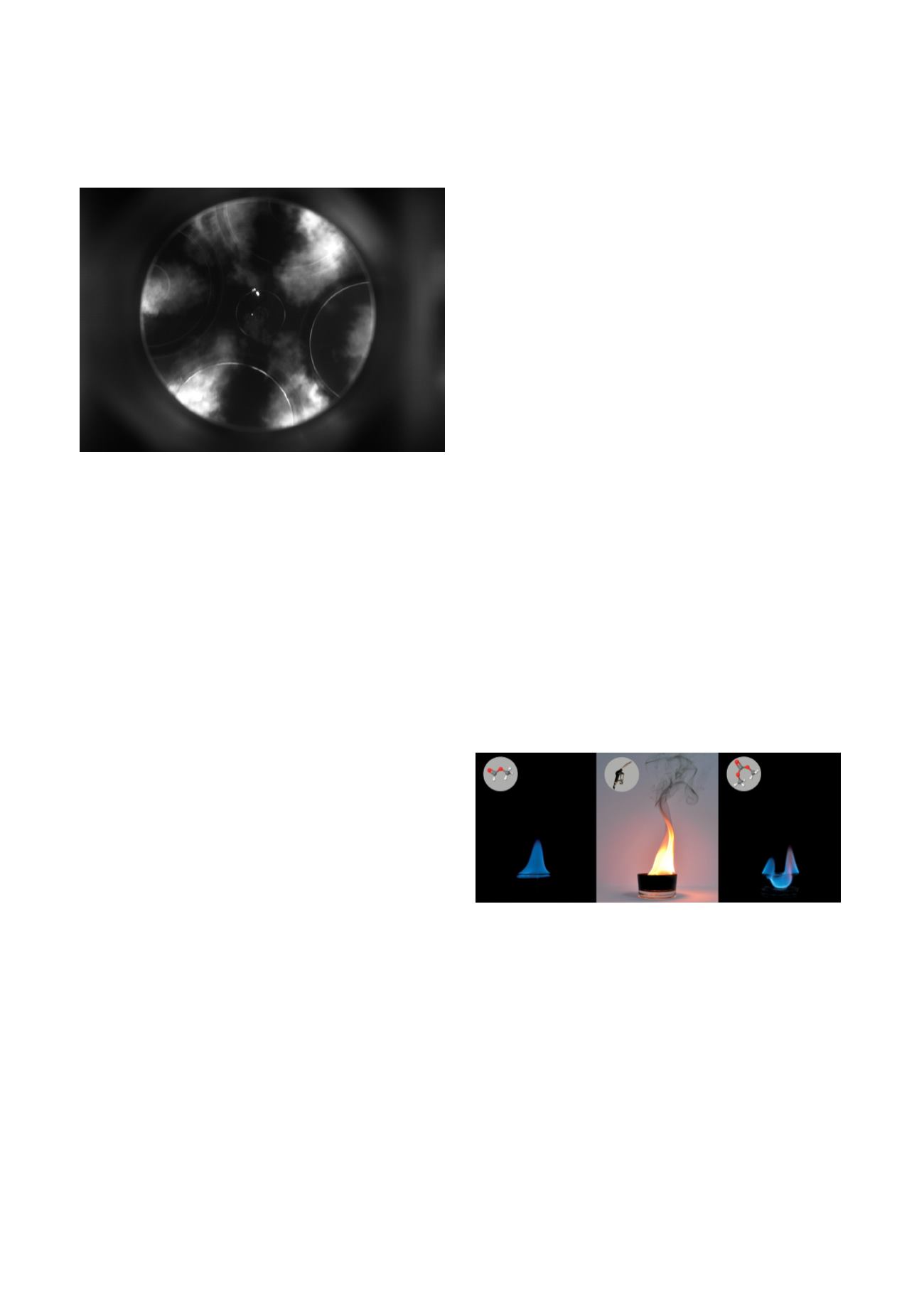
Combustion in a dual-fuel engine: a homogenous mixture of air and natural
gas is ignited by a small quantity of diesel fuel.
influence of engine parameters like valve timing, ignition,
equivalence ratio and gas quality. Alternative combustion
processes are another focus to overcome the trade-off
between emissions and efficiency. Stratified or diesel-like
combustion processes are promising techniques and
could allow highest loads without restrictions from knock-
ing while keeping lowest emission levels and highest
efficiency with highly volatile gas qualities. The 5 l single
cylinder research engine features an optically accessible
combustion chamber. Combined with CFD Simulations a
deep insight into the combustion process is now possible.
Projects
■■
FVV project ‘Formaldehyd’
■■
FVV project ‘Mitteldruck 30 bar bei Gasmotoren’
■■
BFS project ‘Effizienzsteigerung von Dual-Fuel Motoren
durch Optimierung der Zündung bei effektiven Mittel-
drücken über 24 bar’
■■
BMWi project ‘Flex DI: Flexible direkteinspritzende
Motoren für die Schifffahrt’
■■
BStmW project ‘Optimierter Verbrennungsmotor für
landwirtschaftliche Biogas Mini-BHKW’
■■
EU project ‘HERCULES 2’
■■
Several projects funded by industry partners
Alternative Fuels – Emission Measurement – Energy Management
Fossil fuels are becoming more and more scarce and
European CO
2
saving policies have been introduced to
fight global warming. Combustion engines can reduce
their output of GHG emissions and contribute to the
transition towards alternative energy by enhancing the
efficiency of energy conversion and by exploiting CO
2
neutral primary energies. Sustainable biofuels and syn-
thetic fuels can replace fossil fuels and offer the additional
benefit of clean combustion. With promising progress
in the field of clean burning diesel ongoing, in 2017 two
new fuels for spark ignited engines (‘Otto engines’) were
investigated at the Chair of Internal Combustion Engines.
Dimethylcarbonate (DMC) and methyl formate (MeFo)
were for the first time tested as pure substances in a
research engine, delivering substantially lower emissions
of particles, NO
x
and hydrocarbons compared to conven-
tional gasoline. Modern methods for the measurement of
ultra-low particle emissions are needed for this and other
advanced engine concepts. Cooperating closely with the
industry, we help to improve such measurement tech-
niques. Another field of our research is the utilization of
thermodynamic losses from coolant or exhaust. The ther-
modynamic Rankine cycle for instance allows harvesting
of enthalpy from hot exhaust gas and the production of
electric power by means of a steam turbine.
Projects
■■
BMWi project ‘XME Diesel – (Bio-)Methylether als
alternative Kraftstoffe in bivalenten Dieselmotoren’
■■
FNR project ‘OME – Umweltfreundliche Dieselkraftstof-
fadditive’
■■
BMWi project ‘TruckER – Rankine Kreislauf für Nutz-
fahrzeuge mit ganzheitlichem Energiemanagement’
■■
BFS project ‚Sub-Zero emission diesel engine’
■■
Several projects funded by industry partners
Flames of conventional gasoline (center) and low-particle fuels dimethylcar-
bonate (right) and methyl formate (left)