



 265 / 308

265
Computational Mechanics
Computational Solid, Structural and Fluid Dynamics
Computational structural and solid dynamics (CSD) is one
of the classical core disciplines within the fast-growing
field of computational mechanics. Our research activities
in computational structural and solid dynamics cover a
wide range of methods, from nonlinear solid (hybrid FE
meshes, isogeometric analysis) and structural models
(beams, shells) and corresponding finite element technol-
ogy (EAS, ANS, F-Bar) to material modeling (hyperelastic-
ity, viscoelasticity, elastoplasticity) at finite strains. Another
focus are complex material phenomena such as anisot-
ropy, fiber components, damage, fracture and multiscale
modeling of heterogeneous materials.
Computational contact dynamics represent a particularly
challenging class of structural mechanics problems due to
the non-smooth character of the underlying laws of phys-
ics (e.g. non-penetration) and the strong nonlinearities
introduced by the corresponding geometrical constraints.
In addition, complex interface phenomena (friction,
adhesion, etc.) need to be taken into account with
sophisticated computational models. Here, our research
emphasizes the development of robust and efficient
contact formulations and discretization methods in the
context of finite deformations and non-matching meshes/
non-conforming interfaces. Lately, this main focus has
been successfully extended towards contact with wear,
coupled thermo-mechanical contact and beam-to-beam
contact. Furthermore, strongly coupled fluid-structure
interaction (FSI) with contact is another current research
field.
Computational fluid dynamics (CFD) is the other core
discipline in computational mechanics. We are one of
the very few groups worldwide that do original research
in both CSD and CFD. Our focus in CFD is on incom-
pressible and weakly compressible flows. We develop
novel discretization methods for flow problems as well as
novel approaches for turbulent flows based on large eddy
simulation (LES) and detached eddy simulation (DES). Our
CFD application codes have been run on large supercom-
puters with more than 100,000 cores. Another focus is on
multiphase flows and flows coupled to other fields as in
fluid-structure interaction, electro-chemistry or reactive
transport problems.
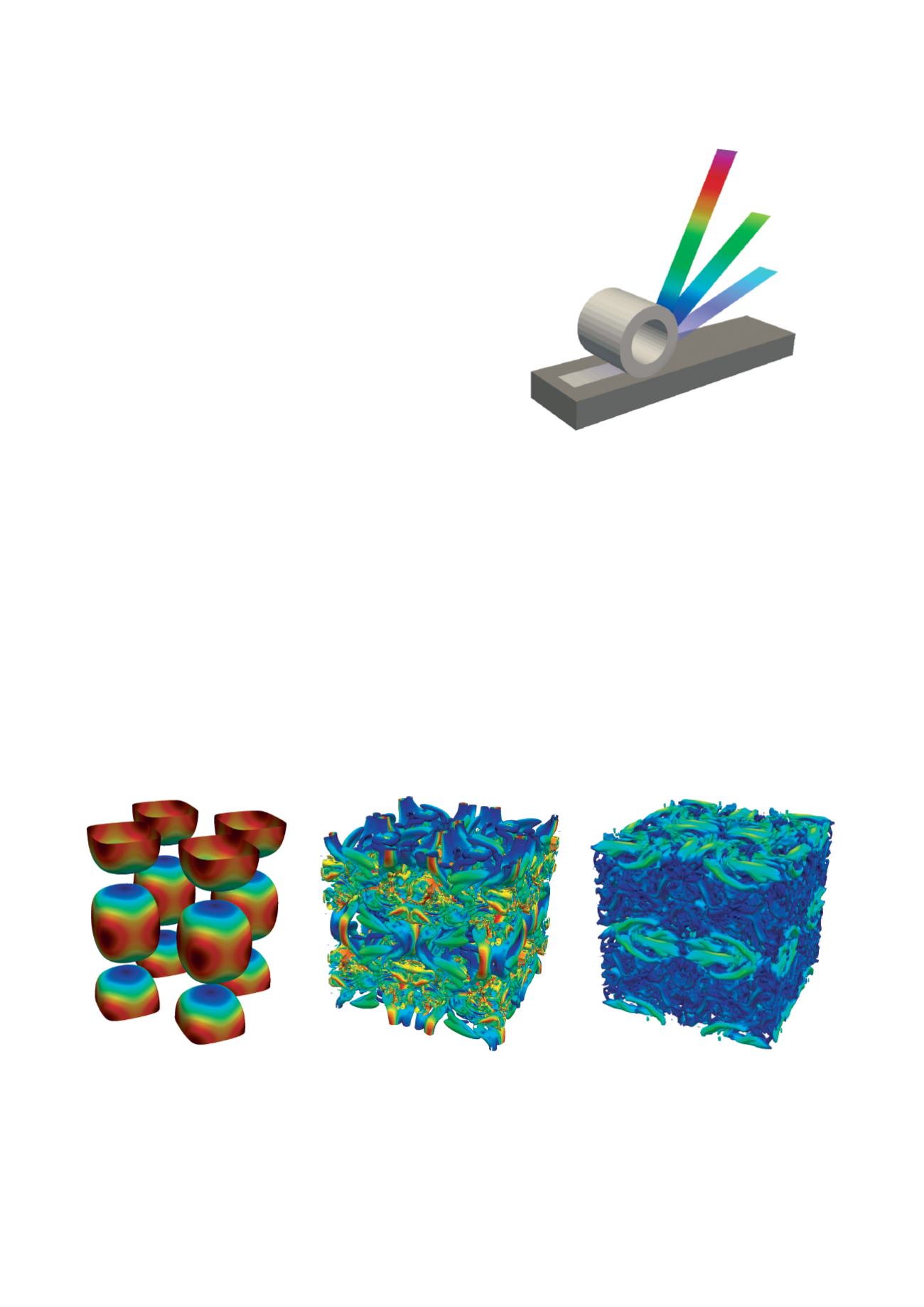
Highly efficient parallel (real time) simulation of turbulent flows (Taylor-Green vortex problem)
Contact simulation of automated fiber placement process for carbon
composites (collaboration with LCC)