



 266 / 308

266
Computational Mechanics
Computational Bioengineering and Biophysics
Our research in the biomedical engineering area includes
a variety of different fields. In all of them we collaborate
with experts from medicine, biology or biophysics.
Some activities are the development of a comprehensive
coupled multiscale model of the respiratory system, of
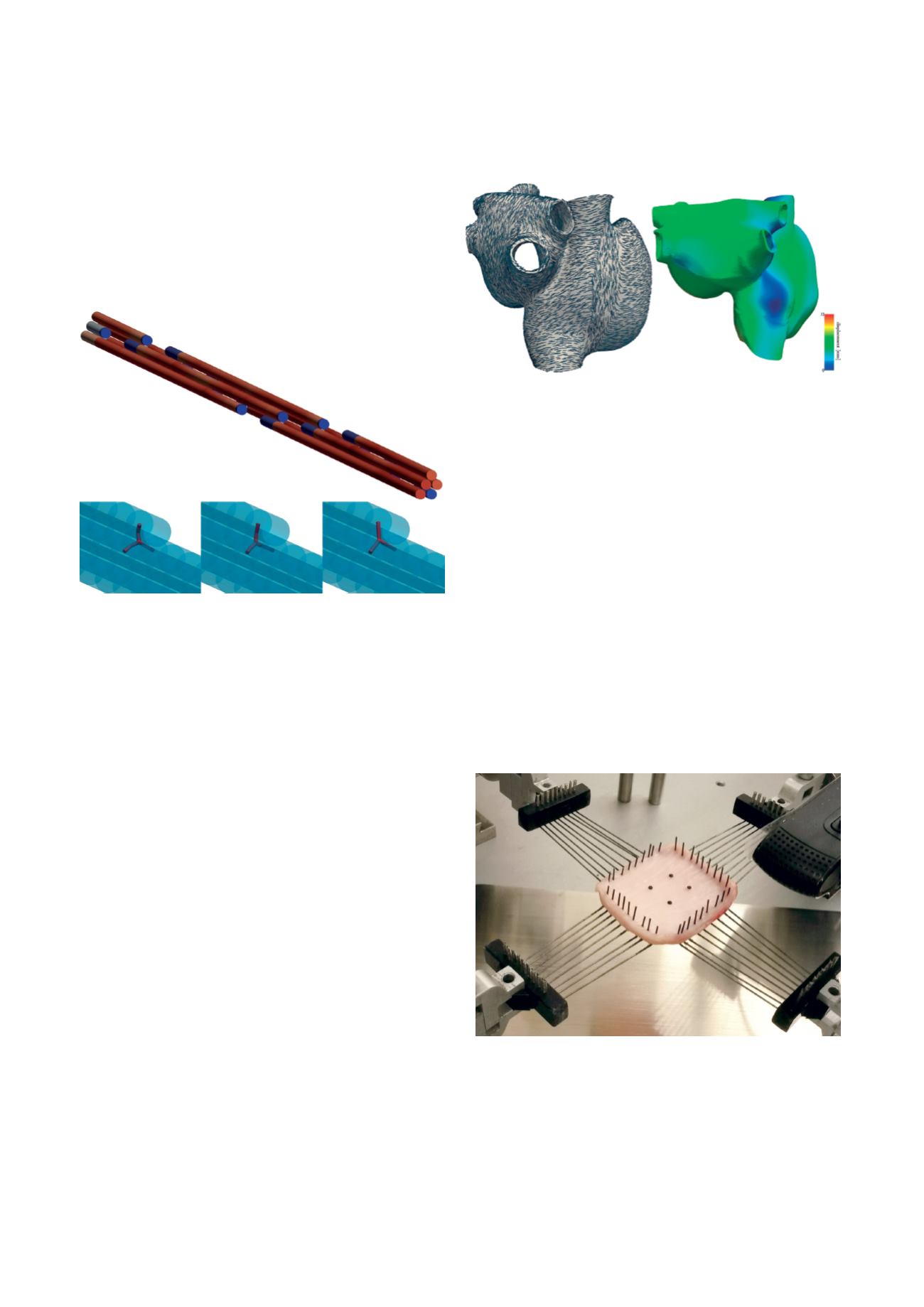
Automatic fiber generation for human atria for patient-specific electrome-
chanical simulations using image registration techniques. Mapped fibers
(left) and displacement during electromechanical simulation (right).
Tensile testing of a collagen microfibril in a numerical experiment: Studying
the effect of trivalent cross-links, hydrogen bonds and van der Waals
interactions.
a model for rupture risk prediction of abdominal aortic
aneurysms, comprehensive cardiac modeling, simulation
of surgical procedures or cellular modeling. In recent
years we have also successfully entered the area of bio-
physics, where we have developed a novel, theoretically
sound and highly efficient approach for the Brownian
dynamics of polymers. Based on this unique approach
we meanwhile are able to study and answer a number of
open questions in the biophysics community.
Vascular Growth and Remodeling in Aneurysms
(Emmy-Noether Group headed by Dr. C. Cyron)
Aneurysms are focal dilatations of blood vessels that often
grow over years and finally rupture. Rupturing aneurysms
are among the leading causes of mortality and morbidity
in industrialized countries. While over the last decades our
general understanding of the biomechanics of aneurysms
has advanced substantially, the factors governing their
growth – although the key to develop future therapies –
remain poorly understood. In February 2015, Dr. Christian
Cyron established the Emmy-Noether group for vascular
growth and remodeling in aneurysms at the Institute
for Computational Mechanics. It aims at exploring the
biomechanical and biochemical mechanisms governing
the growth of aneurysms, with the perspective of exploit-
ing these for the development of future therapies and
computer-aided diagnosis. To this end, the Emmy-Noether
group will combine advanced methods from computa-
tional mechanics with state-of-the-art medical imaging
technology and machine learning. The Emmy-Noether
program of the German Research Foundation (DFG) was
established in 1999 to support groundbreaking projects
Biaxial test of tissue sample for validation of constrained-mixture material
model
of young researchers. Since then the DFG has been
supporting only eight Emmy-Noether groups in the area of
mechanics and mechanical design.