



 34 / 308

34
The History of the Department
upturn in its fortunes. During the 13 years (four in industry,
nine at the TUM) in which Leinkamp has been working
on the topic, electromobility has been through some
difficult times. ‘Now, the subject has really taken off!’, he
says. However, unexpectedly, and contrary to what the
politicians have been saying, the level of state funding for
conducting research into the combustion engine has been
raised recently rather than decreased.
With regard to the issue of what mobility will look like
in the future, there is agreement in part between the
professorial chairs. For the years to come, they forecast
that both technologies will be used alongside each other.
The statement that the combustion engine has a future
(total energy balance, CO
2
-neutral fuels, the mathematical
impossibility of e-mobility that covers all requirements)
contrasts with the claim that the use of the combustion
engine will come to an end in the foreseeable future (total
energy balance, new battery technology, local emission
elimination, properly functioning infrastructure).
Perhaps here, politics will have the final word. However,
there is one further influential factor that cannot be calcu-
lated: the consumer. As was the case with digital cameras
or flat screens, things can change very quickly.
2018
Politics and the Future of Mobility
Science does not occur in a vacuum. Politics, which is
designed to define the guiderails of social activity, sets
the general direction. Here, higher education institutions
during the National Socialist period, with their inhumane
approach, are a negative example. Like the example of
aviation and astronautics described above, new fields of
research can be quickly established under the influence
of politics. Sometimes, however, politics reacts in unfore-
seeable ways. In 2007, for example, the professorial chair
for nuclear technology was established. At that time,
power generation through nuclear power stations was
still considered to be future-oriented technology, which
would make an important contribution to securing energy
supplies in Germany. In 2011, in the wake of the Fukush-
ima catastrophe, the German federal government decided
to phase out nuclear energy.
Currently, a question about the future is again under dis-
cussion: the issue of the future of mobility. Is the combus-
tion engine here to stay, or does the future belong to the
electric engine? In the view of Wachtmeister and Lien-
kamp, here, the influence of politics over the department
can be clearly felt. The chair for vehicle technology under
Lienkamp, with its focus on electromobility, is enjoying an
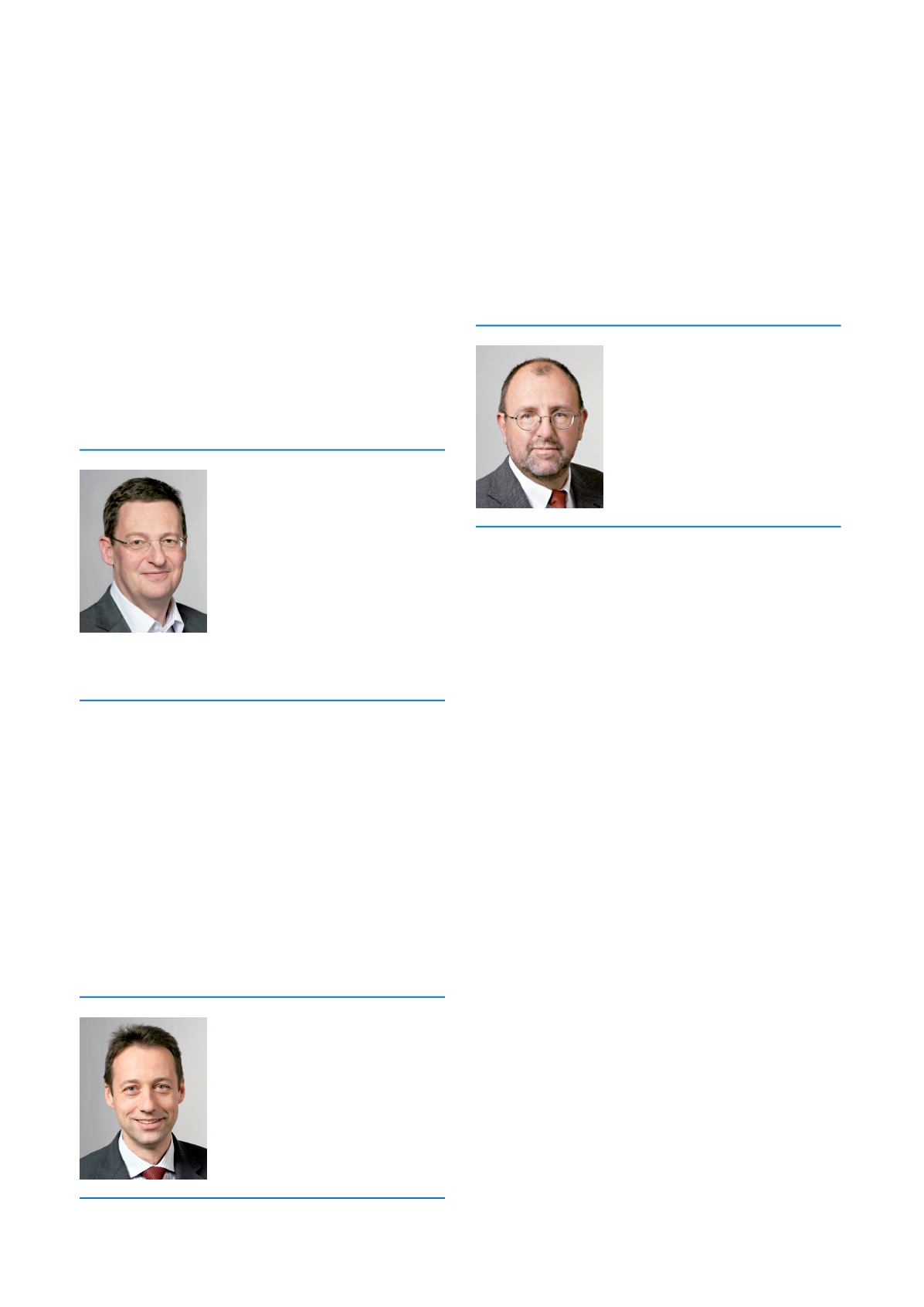
Colleagues may be asked for
political advice, but even so,
science doesn’t play a key
role, either in the decision
against the use of nuclear
energy or when it comes to
whether or not we should
only drive with batteries in
the future. We have to adjust
to that fact.
Prof. Adams
The subject of electromobil-
ity has now really taken off.
But we’ve also been through
difficult times with regard to
electromobility.
Prof. Lienkamp
The combustion engine
can be a component for
the mobility of the future.
With new fuels produced
from regenerative energy,
the combustion engine will
contribute to saving CO
2
.
Prof. Wachtmeister