



 31 / 308

31
The History of the Department
At the time of the dispute between theoreticians and
practitioners at the Technical University of Munich, the
teaching of mathematics was also adjusted to the needs
of the engineers. The university was therefore following a
path of beneficial compromise and was able to go some
way to meeting the demands of the ‘Aachen resolutions’.
In 1895, mechanical engineer Egbert von Hoyer was made
Director of the Technical University of Munich. While he
was not a radical defender of the rights of the practition-
ers, he did commit to increasing
the practical element in the teach-
ing programme in Munich. Walther
von Dyck, Professor of Mathemat-
ics at the Technical University of
Munich, was outraged: ‘The mere
suspicion that someone wishes
to teach more than simply pure
practical applications is sufficient
to severely impair our mission.’
Together with mathematicians from
other technical universities, as well
as mathematics-oriented engineers, he did all he could to
convince the ‘practitioners’ of the benefits of a basic edu-
cation in mathematics. He succeeded in retaining mathe-
matics as a basic science in mechanical engineering.
The dispute flared up again when during the 1898/1899
university year, technical physics was introduced as
a subject in the general department. Rudolf Diesel
expressed his admiration for the idea: ‘What a wonderful,
new field; that has attracted too little attention to date’.
The development was not met with much appreciation by
mechanical engineering professors Paul von Lossow and
Otto von Grove. In their view, the technical departments
alone should be responsible for educating engineers who
would later work in the industrial sector.
The dispute between theoreticians and practitioners
died down at the turn of the century. Both sides were
given the right to award doctorates. Also, after 1895, the
laboratories were made subordinate to the theoretical
mechanical engineering faculty. In this way, the position of
the theoreticians was strengthened instead of that of the
practitioners as had been expected.
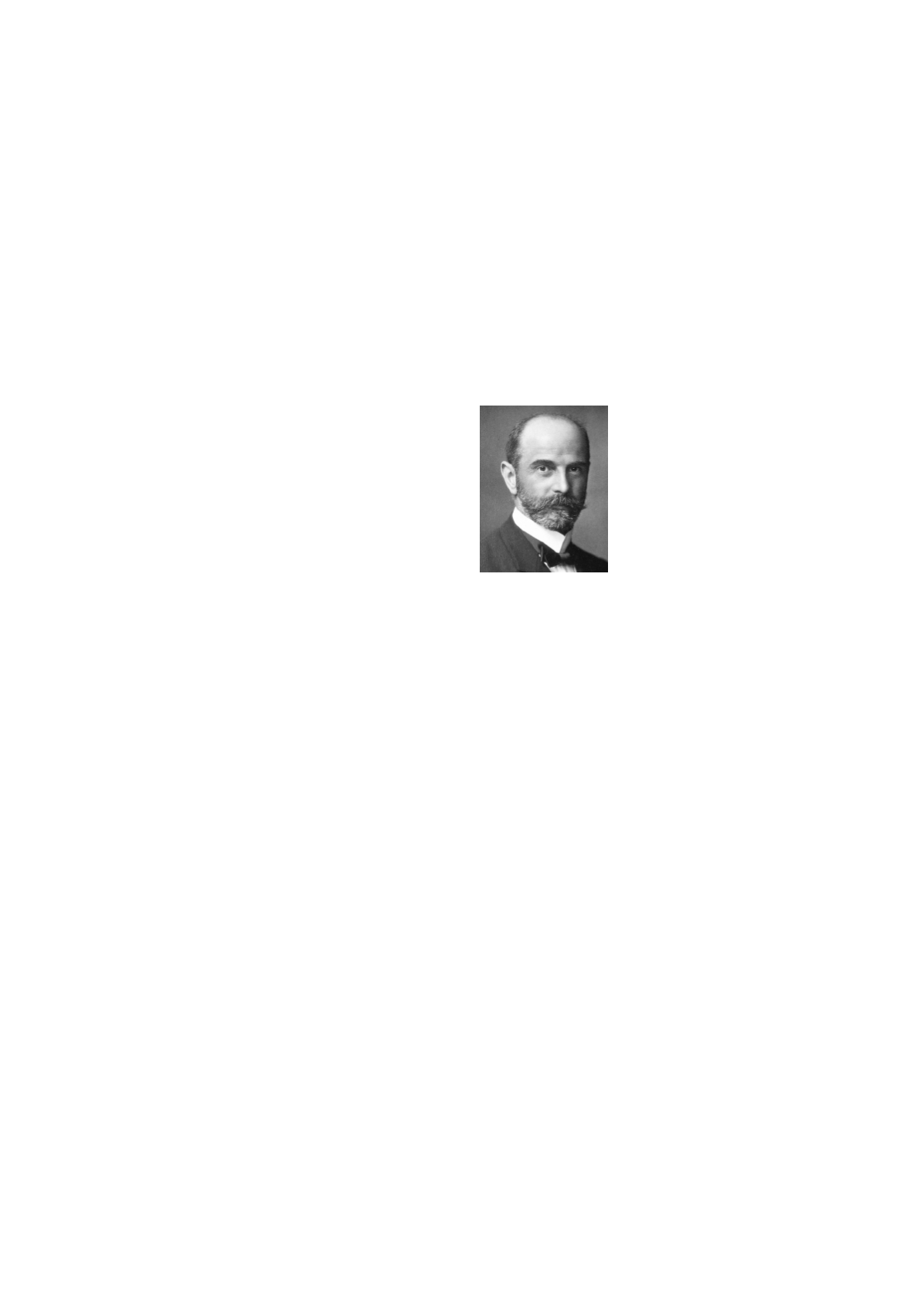
Walther von Dyck, 1899
1895
The Dispute Between
Theoreticians and Practitioners
When professors of German higher education institutions,
including the well-known cinematographer and mechan-
ical engineer Franz Reuleaux – the academic teacher of
Carl von Linde – visited the World Exhibition in Chicago in
1893, they were presented with the USA as a forerunner in
technical sciences. The German higher education teach-
ers visited the large machine and electrical technology
laboratories and sat in on teaching units with demon-
strations and experiments. They took these impressions
back to Germany with them, and in 1895, together with
the Association of German Engineers, (Verein Deutscher
Ingenieure, or VDI), they wrote the ‘Aachen resolutions’.
In these resolutions, the professors of mechanical
engineering demanded the construction of modern
laboratories and a practical orientation in teaching and
study. The basic subjects such as mathematics should
be downgraded to auxiliary sciences. According to the
authors of the resolutions, the teaching at the technical
universities was too theoretical. Young engineers received
extensive tuition in mathematics, while experiments and
practical tests were a rarity. The German mathematicians
resisted these demands. They stressed the importance
of mathematics as a basic science and warned against
making research and teaching too application-oriented
and superficial.
Members of the Munich Technical University also got
involved. At that time, the Department of Mechanical Engi-
neering has its own machine laboratory. Carl von Linde
had established the laboratory in 1875, around 20 years
earlier than at other technical universities in Germany.
Linde had taken on the idea from the ETH Zürich, separat-
ing the teaching of mechanical engineering from machine
construction and dividing the teaching into descriptive
and theoretical mechanical engineering. While descriptive
teaching overlapped with some areas of machine con-
struction, the theoretical teaching of mechanical engi-
neering comprised three focal content areas – kinematics,
engines and mechanical heat theory. With this approach,
Linde created the precursors of kinematics and hydraulics,
refrigeration technology and thermodynamics as subjects.
Fundamental Research vs. Applied Research