



 32 / 308

32
The History of the Department
who tend to prefer fundamental research is necessary, he
claims, in order to develop and realise new ideas – in the
ideal scenario in an interdisciplinary manner and beyond
department boundaries.
Lienkamp and Adams stress that the actual question
should be how the department or the university overall
should react to these new demands of increasing inter-
disciplinarity. Should it be left to the commitment of the
individual researcher and their networking skills, or should
new structures be created?
Not everyone can conduct
fundamental research. But
when the applied research-
ers collaborate with funda-
mental researchers, new
results emerge. That’s our
opportunity in mechanical
engineering, since we have
the people who understand
the application.
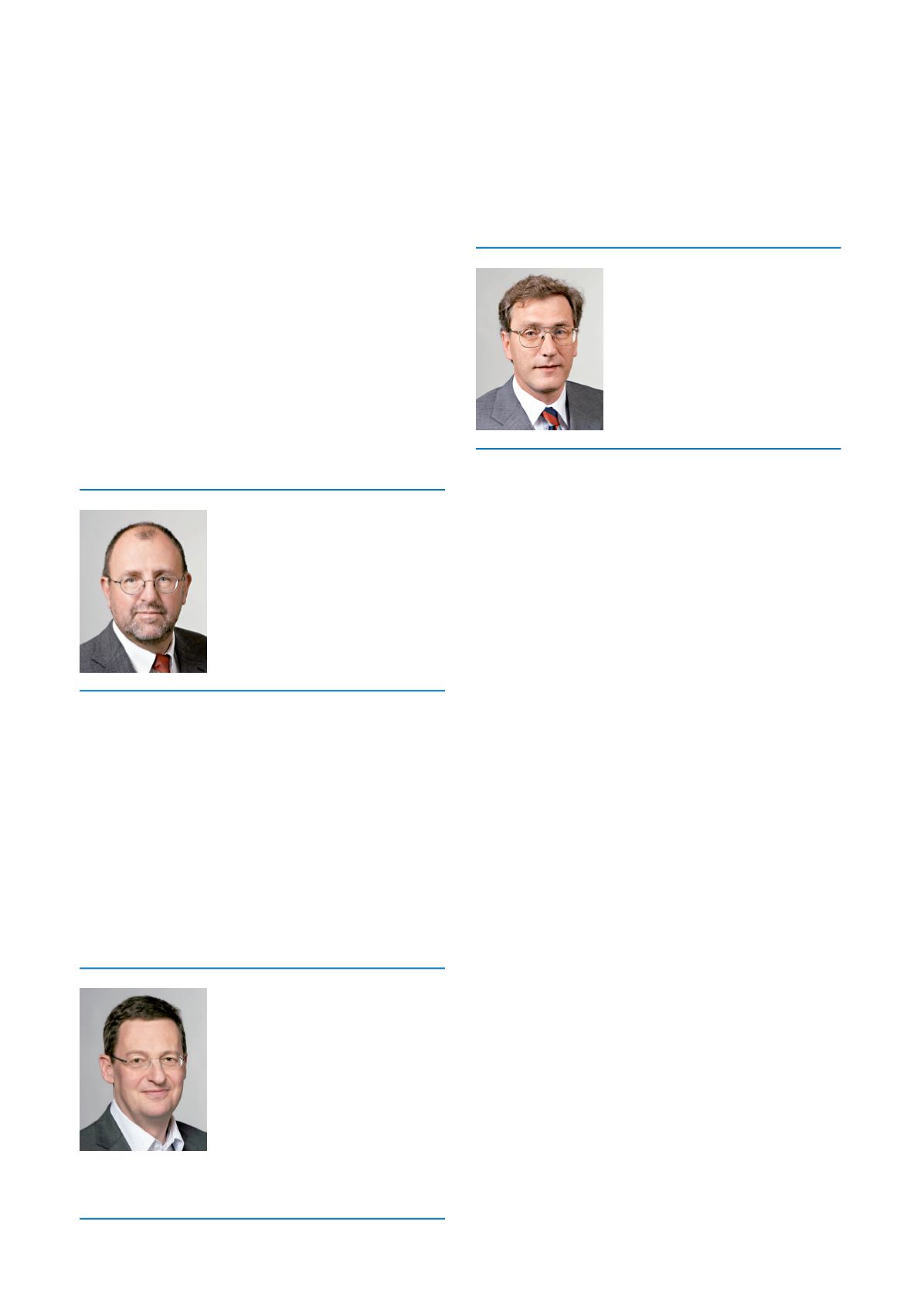
Prof. Adams
Currently, we are too strong
in the field of application
research. But this is subject
to cycles and it will change
again.
Prof. Werner
2018
Consolidation of Fundamental Research
In 2018, the subject is no longer disputed along such
fundamental lines. The practical element has been
established in teaching, although the question of how
much mathematics is necessary as a minimum has still
not been finally resolved today – particularly with a view
to the reduced teaching plans as part of the eight-year
grammar school syllabus. In research, the relationship
between fundamental research and applied research has
been subject to strong fluctuations over the decades. In
general – and here, the five professors interviewed agree
– the excellence initiative has led to a situation in which
the reputation of fundamental research has improved and
today, more research is being conducted on fundamental
topics.
However, what exactly is fundamental research? Adams
explains that fundamental research deals above all with
the development of mathematical and physical simula-
tion models, while applied research tends to focus on
experiments. Wachtmeister puts it in a similar, albeit less
abstract, way. In his sector, he says, fundamental research
tends to deal with mechanics, thermodynamics, etc.,
while applied research looks at gears, production technol-
ogy and engines, whereby the five professors regard the
polarising comparison as being problematic and possibly
no longer in keeping with the times. The collaboration
between application-oriented researchers and researchers
Research by our chair is
up to 90 percent applica-
tion-oriented. However, the
tendency is moving very
strongly towards funda-
mental research, including
for mechanical engineering.
Prof. Wachtmeister