



 30 / 308

30
The History of the Department
mercial businesses can make a considerable contribution
here. In most cases, it is not a question of being told what
to do by the industrial sector, but a case of constructive
collaboration (Wachtmeister). Werner emphasises that:
‘We are not obliged to take on all the requests made
by the industrial sector.’ Lienkamp regards it as being a
task of the TUM to be a thorn in the side of the industrial
sector. ‘We don’t get involved in the industrial sector’s
everyday business’ (Hajek). When approaching problems,
there are generally differences between the industrial sec-
tor research departments and the faculty. In the industrial
sector, experience plays a far greater role. At the univer-
sity, however, problems are considered at greater depth
and in a more analytical way. However, the independence
of their work is not just a result of the strength of their own
professorial chair and of the professor involved. Through-
out the university, contracts have been developed which
must be signed by the partners and external funders.
These contracts secure extensive freedoms for the higher
educational institution, the department and the research-
ers. These include the freedom to publish and freedom
regarding personnel.
With regard to the general development of the depart-
ment, there are clear differences of opinion among the
professors. The spectrum ranges from: proximity to the
industrial sector is increasing in the department, and the
industrial sector is attempting to increase its influence
over the department, in the view of Werner, to: independ-
ence is increasing and today’s department – unlike the
situation one to two generations of professors ago – is
no longer an extended workbench, as Adams described
it. The distance from the industrial sector is increasing,
possibly because an increasing number of professors are
from academic backgrounds and have not worked in the
industrial sector. The earnings from working in the private
sector are far higher than at the university. At the same
time, proximity to the industrial sector is increasing, since
more and more institutes are founding start-ups in order
to market their products themselves.
There is agreement when it comes to the sense and
purpose of their work. Without scientific work at the
department, the industrial sector would be lacking
important input; without the external funds provided by
the industrial sector, important means would be lacking
not just for research, but also for teaching. There is also
agreement with regard to the fact that the industrial sector
only provides a portion of external funds. One third comes
directly from the industrial sector, one third are public
funds intended to promote the teaching of mechanical
engineering, while one third comes from a combination of
public funding and industrial participation. Adams stresses
in this context that the Department of Mechanical Engi-
neering is the strongest department at TUM with regard to
DFG funding, and currently has two collaborative research
centres.
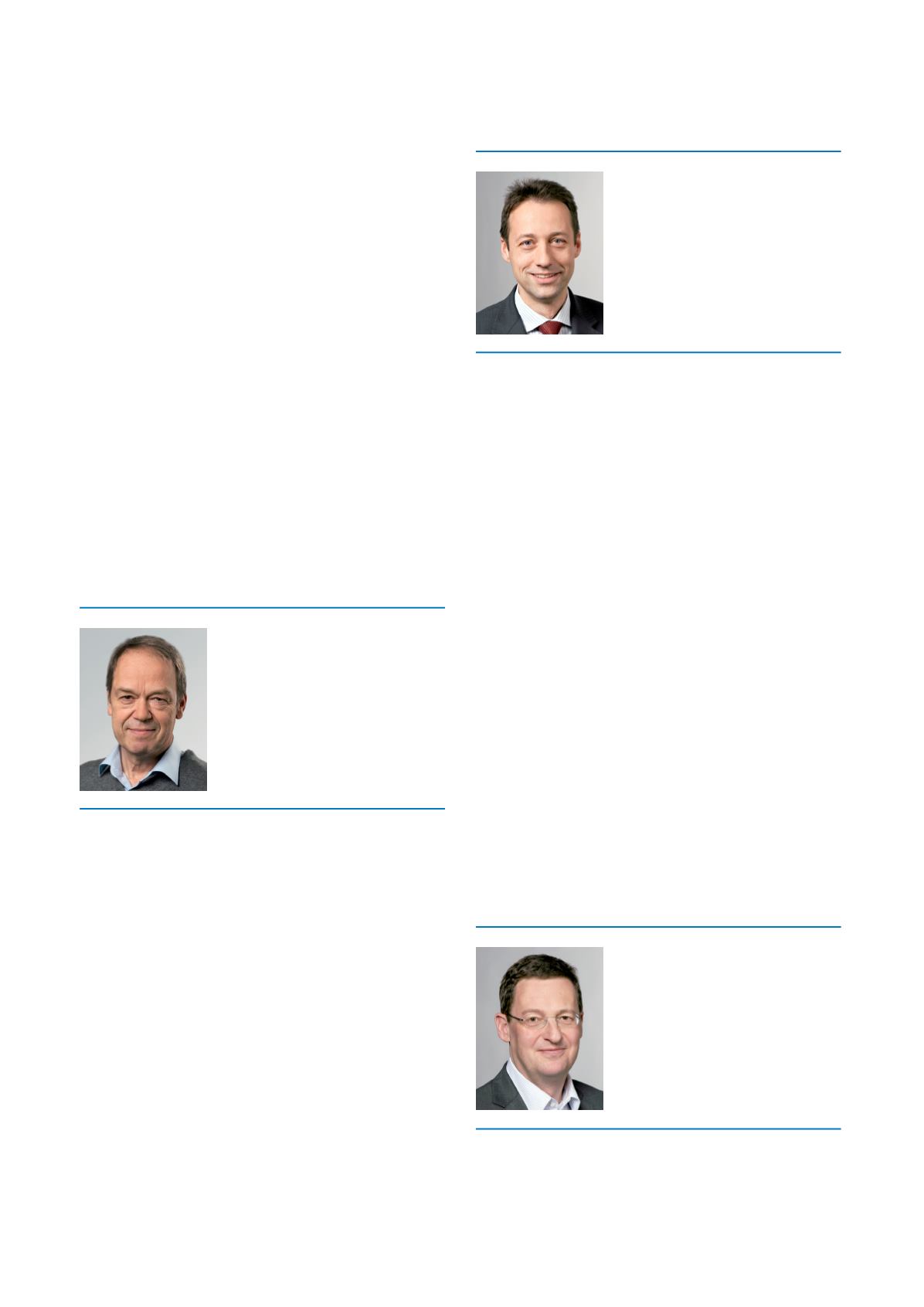
I found it strange how self
assured the TUM was in its
contracts with its industrial
partners. However, there’s
a benefit in that. We are not
an engineering office that
is being signed up. We are
scientists.
Prof. Hajek
If we only had money for
ourselves and could do
what we wanted with it,
then nothing much would
result from it. We need the
problems of the industrial
sector to develop further.
Prof. Lienkamp
We are not an extended
workbench.
Prof. Adams