




 106 / 308

106
Aerodynamics and Fluid Mechanics
Laminar-turbulent Transition with Chemical
(Non-)Equilibrium in Hypersonic Boundary-Layer Flows
Key Results
■■
A. Di Giovanni and C. Stemmer: Numerical Simulations
of the High-Enthalpy Boundary Layer on a Generic
Capsule Geometry with Roughness. New Results in
Numerical and Experimental Fluid Mechanics XI (Notes
on Numerical Fluid Mechanics and Multidisciplinary
Design 136), 2017. Contributions to the 20th STAB/
DGLR Symposium Braunschweig, Germany, 2016, pp.
189-199
■■
C. Stemmer, M. Birrer and N.A. Adams: Disturbance
Development in an Obstacle Wake in a Reacting
Hypersonic Boundary Layer. Journal of Spacecraft and
Rockets (54(4)), 2017, pp. 945-960 and pp. 899-915
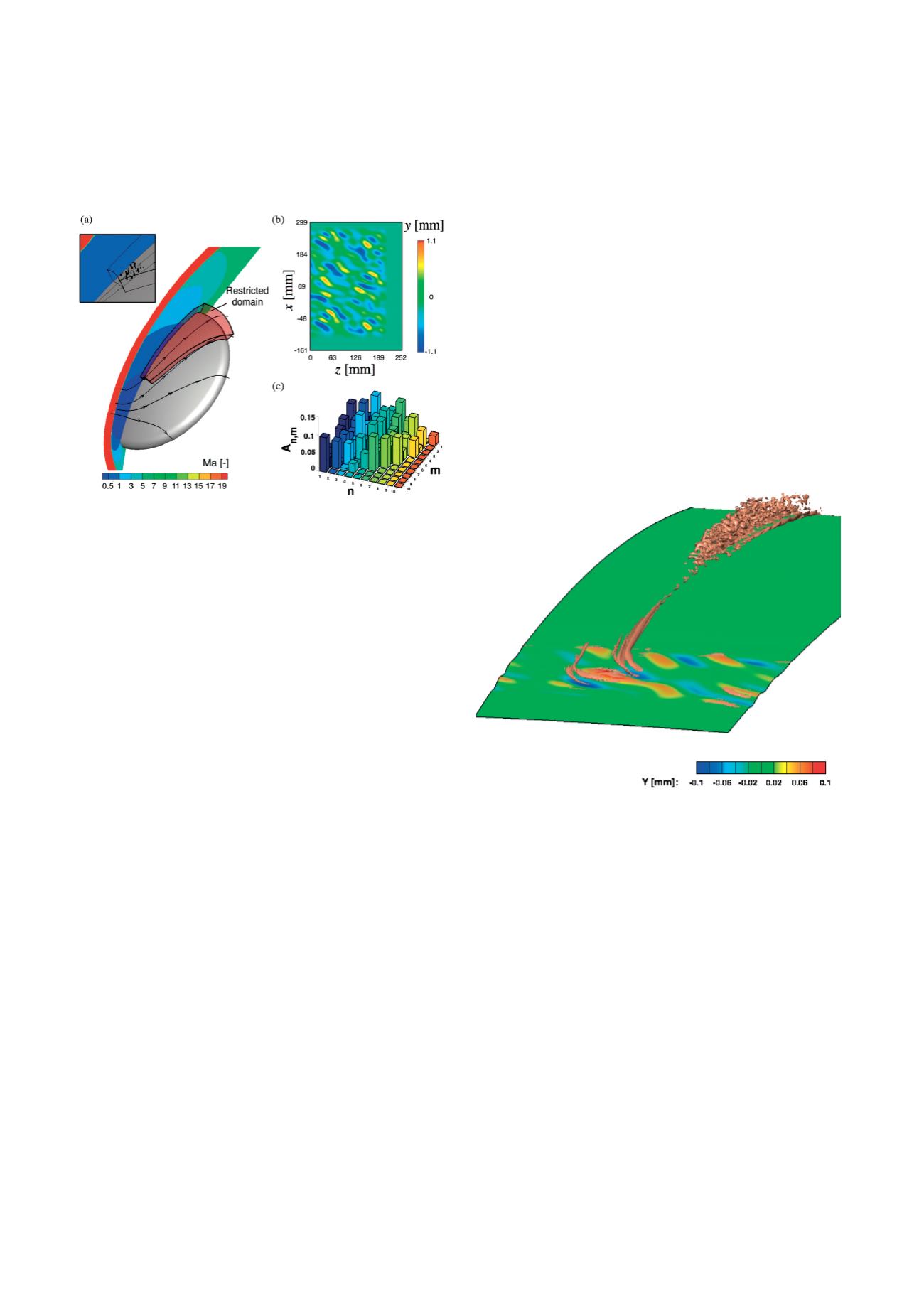
Computational setup for a roughness patch on a re-entry capsule
DNS results from vortical disturbances induced by surface roughness in
a reacting environment. The wake of the roughness elements becomes
unstable and laminar-turbulent transition takes place.
Motivation
Blunt bodies returning from space are subject to immense
heat loads leading to ablation. Roughnesses on these
ablating surfaces can induce laminar-turbulent tran-
sition in an otherwise laminar flow. Laminar-turbulent
transition increases the heat load on the surface. This
self-energizing effect can lead to a catastrophic failure
of the spacecraft. The role of the chemical modelling
in high-temperature boundary layers in equilibrium and
non-equilibrium is the main focus of the numerical work.
Approach to Solution
Direct numerical simulations (DNS) are conducted on
national HPC facilities such as SuperMUC and HLRS.
Results show that roughness wakes are subject to an
increased instability in the presence of chemical reactions
and non-equilibrium effects