




 105 / 308

105
Aerodynamics and Fluid Mechanics
Modal Decomposition for Vehicle Aerodynamics
A new modal decomposition approach is employed
for analyzing temporally resolved flow field data from
detached eddy simulation (DES) using the open source
CFD environment OpenFOAM®. Velocity components
are temporally filtered with moving average filter before
being interpolated to a coarser equidistant mapping mesh.
These filtering operations reduce the amount of spurious
numerical oscillations in the data to be analyzed and cut
off high frequency, low energy content. In order to extract
the most dominant flow structures for in-depth analysis,
an incremental variant of dynamic mode decomposition
(DMD) was found to be most useful. DMD generates
modes of distinct frequency that can be reconstructed
in time. Several modifications to an already existing
variant are implemented to increase the applicability for
large data sets, mainly reducing the required amount
of memory, which is the most limiting factor in modal
analysis for industrial applications with large data sets.
The modes represent flow structures of vortex shedding
and stationary recirculation processes. Reconstruction
enables tracking of structures to their respective excitation
mechanisms and allows for identification of geometrical
features that introduce strong perturbations to the flow.
Strong perturbations lead to an increase in potential for
viscous dissipation in the wake of bluff bodies and thus to
generally lower base pressure and increased drag.
The DrivAer reference model in notchback configuration
with structured underbody, engine bay flow, open wheel
houses and open rotating rims is simulated in wind tunnel
conditions with a rolling road system. The results from
CFD are processed using the DMD approach described
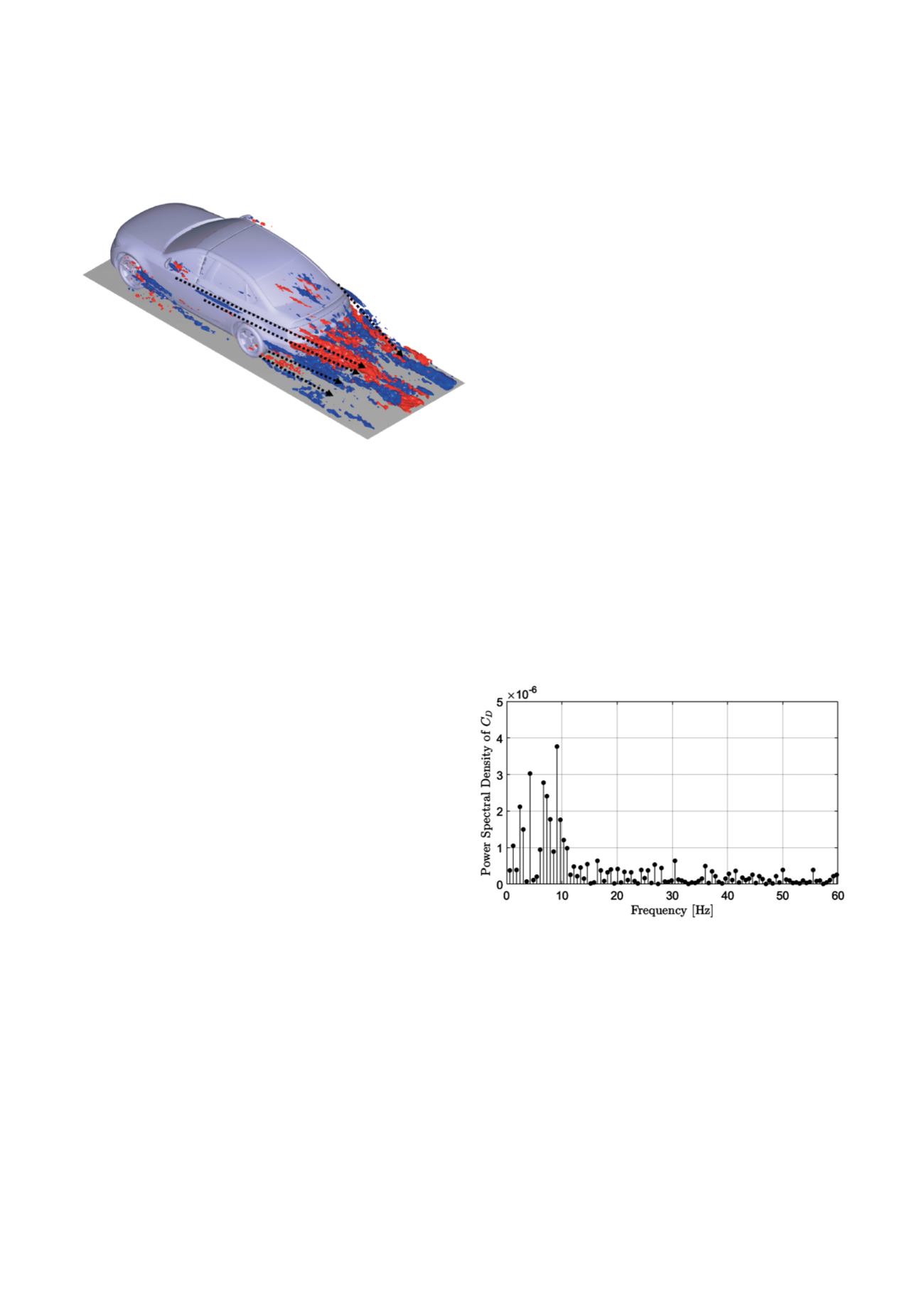
above and the most dominant flow structures are visu-
alized and discussed. Small scale detachments that are
generated far upstream of the mean detachment line
of the vehicle’s rear end travel downstream along the
surface, triggering large-scale structures in the wake.
The frequency of those structures is also dominant in the
frequency spectra of the integrated force coefficient.
Publications
■■
Kiewat, Haag, Indinger, Zander, ‘Low-Memory
Reduced-Order Modelling with Dynamic Mode Decom-
position Applied on Unsteady Wheel Aerodynamics’,
2017 ASME Fluids Engineering Division Summer
Meeting
■■
Kiewat, Haag, Matsumoto, Indinger, Zander, ‘Online
Dynamic Mode Decomposition for the Investigation of
Unsteady Vehicle Aerodynamics of the DrivAer Model:
Part 2. Application on Velocity Fields’, 2017 JSAE
Annual Congress (Spring)
Frequency spectrum of the integrated drag force coefficient
Iso-surfaces of the streamwise
velocity component of the most
dominant DMD mode at 9Hz