




 161 / 308

161
Aircraft Design
Fixed Wing VTOL UAS
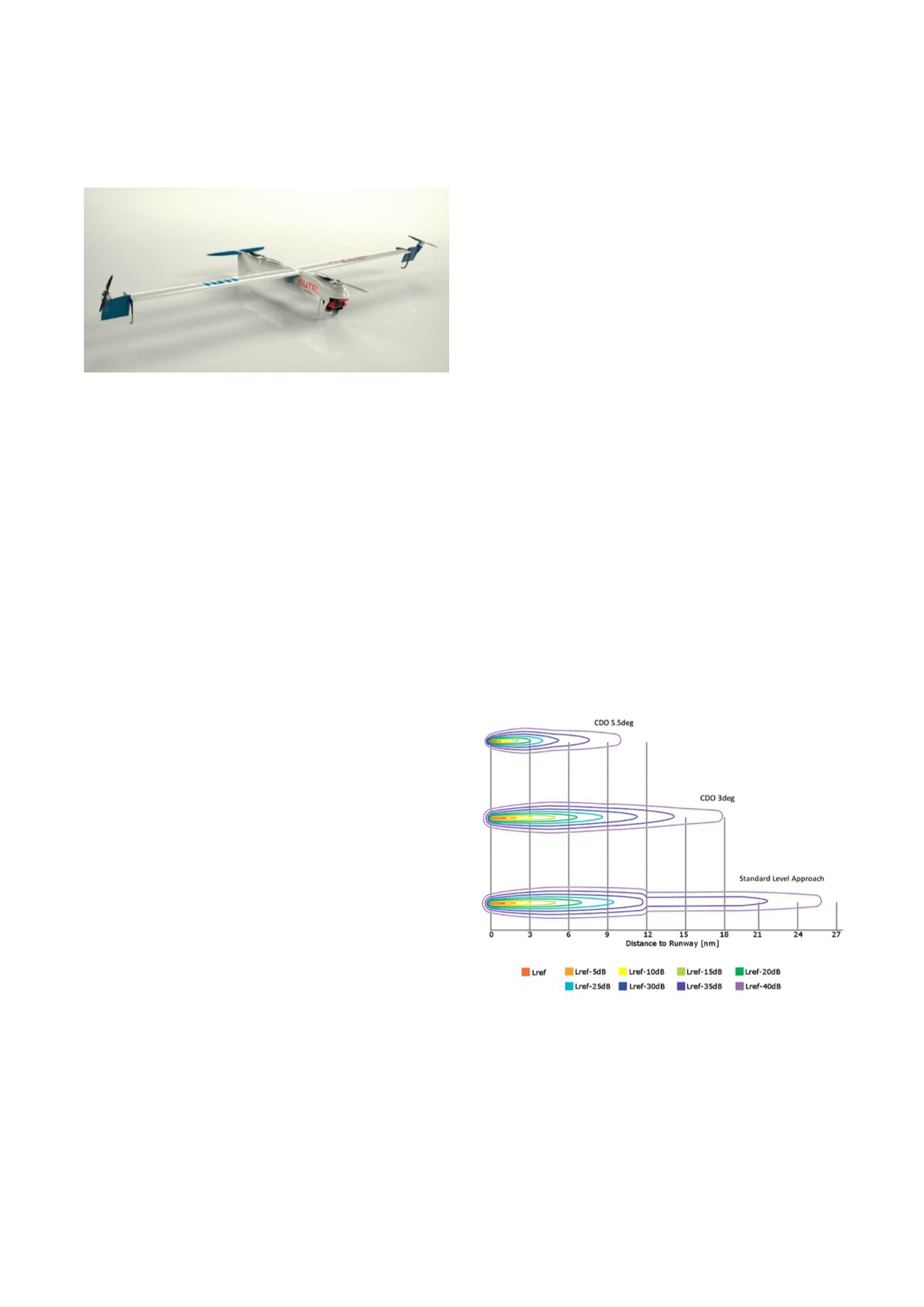
Rendering of Autel DRAGONFISH fixed-wing VTOL UAV
three more prototypes with modifications like full compos-
ite structure, improved wing tip tilt mechanism and new
internal fuselage layout were manufactured and test flown.
Along with the prototyping and test flight program, fixed-
wing VTOL research was continued on topics like
■■
the influence on propeller performance by blocking the
in- or outflow
■■
electromagnetic compatibility on electric VTOL UAV
■■
range and endurance extension with hybrid combus-
tion-electric powertrains or high energy batteries
■■
approaches to reduce the aerodynamic drag of inactive
rotors
■■
thermal management of electric powertrains
■■
redundant electric motor design
■■
fixed-wing VTOL UAV configuration studies
■■
conceptual design tool improvements
The realization of systems and components for the
demonstrators made massive use of rapid prototyping
processes, like 3D printing and hybrid structural concepts.
This allowed a radical reduction of the time from design to
test and thus faster concept maturation.
Combining the superior cruise performance of a fixed
wing aircraft with the vertical take-off capabilities of a
multicopter leads to so-called transition UAVs. Combining
both flight phases in one configuration is challenging. As
part of a joint research project with AUTEL Robotics, the
integration of a 5kg electric fixed-wing VTOL UAV demon-
strator took place, which was presented at the Consumer
Electronics Show 2017 in Las Vegas. The successful
maiden hover flight followed at the end of January, the
first transition to forward flight in March. Subsequently,
Noise and Fleet Assessment
Environmental effects of air transportation are a crucial
challenge for the aviation industry. Whereas on the global
level, gaseous emissions, such as CO
2
, represent the
major focus of environmental assessments, on a local
level, noise emissions in the vicinity of airports are the
main concern. The Institute for Aircraft Design thus under-
takes research in the area of aircraft noise emission and
noise exposure at the airport level. Following the expected
increase in air traffic and a continuing urbanization, noise
emissions at city airports become an increasingly relevant
research topic. The Institute for Aircraft Design supported
an interdisciplinary group design project at Bauhaus
Luftfahrt that developed a sophisticated concept for inner-
city airports, called ‘CentAir Station’. An aircraft, designed
to meet the special needs of inner-city operations, was
evaluated by the institute in terms of noise reduction by
comparing advanced, noise-mitigating aircraft operations.
Therein, significant potential for noise savings could be
shown, for instance of continuous descent operations
(CDOs), in particular in combination with increased glide
slope angles.
Further research at the institute focusses on the assess-
ment of future airport noise exposure and the evaluation
of corresponding impacts. Therein, methods and tools
Calculated noise contours of different approach procedures
are developed to model the impact of noise-reduced
aircraft types, of specific aircraft retirement behavior, or
of aircraft introduction strategies on future airport noise
exposure. The resulting methods may be used for tech-
nology assessment of new aircraft concepts at airport
level or for the prioritization of possible noise reduction
strategies.