




 163 / 308

163
Aircraft Design
Flexible Wing Demonstrator
As part of the European Commission funded FLEXOP
project, the Institute for Aircraft Design is responsible for
the design, manufacturing, integration and testing of the
unmanned demonstrator aircraft enabling in-flight investi-
gations on highly flexible wings. With flight tests planned
for mid 2018 the tasks during 2017 were focused on detail
design as well as manufacturing, integration and first
ground test of the FLEXOP demonstrator UAV.
Further subsystem tests with a mock-up of the airbrake,
as well as tests with the integrated modular propulsion
unit (engine, enginemount & ECU) were conducted. Since
no consumable off-the-shelf actuators fulfill the driving
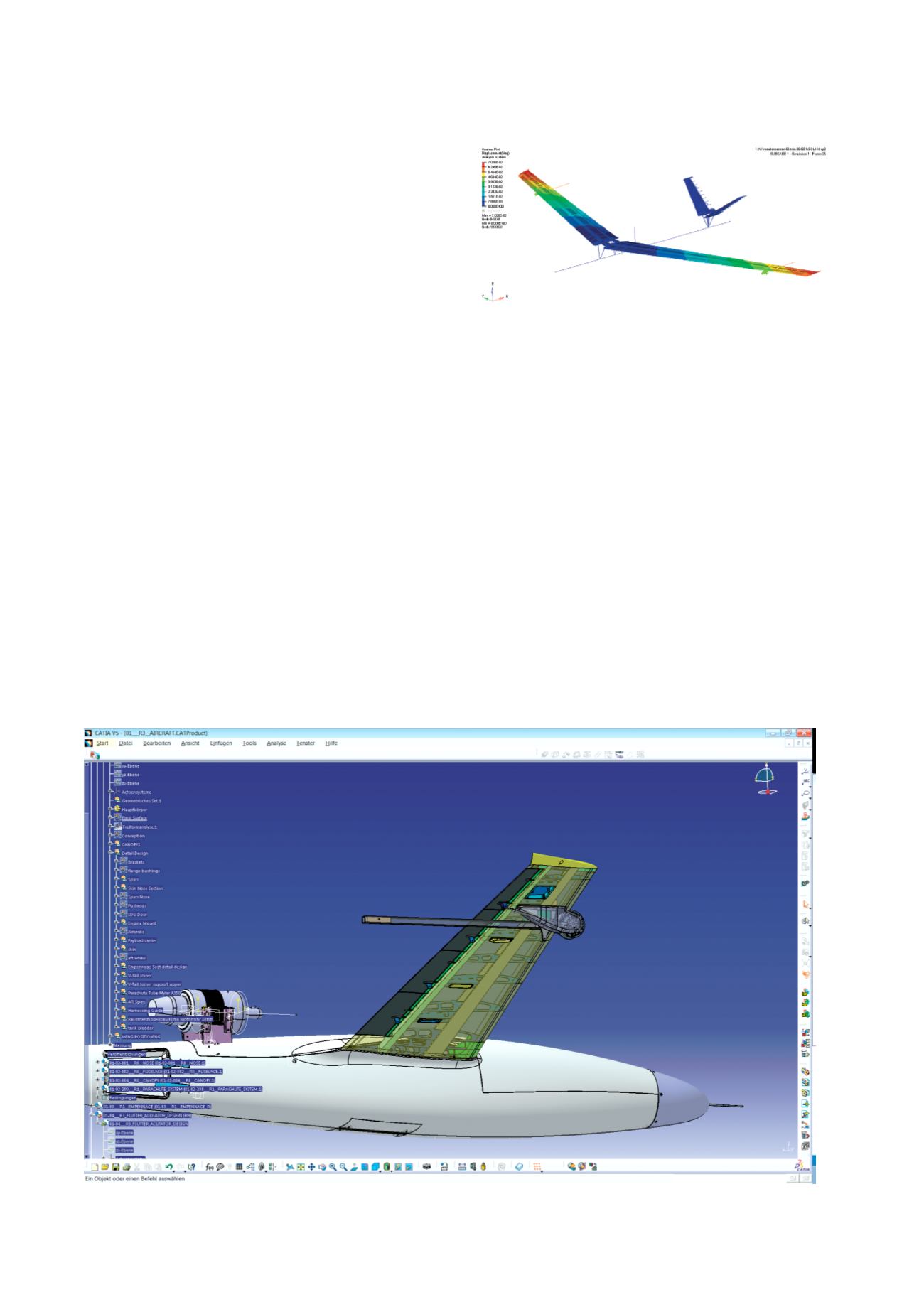
requirements of active flutter control, the design and
integration of a high frequency/high torque actuator for
flutter dampening into the most flexible wing set was a
major achievement. The electric and control engineering
was conducted by our Hungarian partners of MTA SZTAKI,
whereas the hardware and integrational design was con-
ducted by the Institute for Aircraft Design and the Institute
for Lighweight Structures. The assessment of minimum
implications on the aeroelastic characteristic of the aircraft
was ensured by full finite element models coupled with
aerodynamic simulations. The resulting design is currently
being manufactured and will be tested in a mock-up
configuration to verify the design strategy.
The idea of a virtual aircraft model, which allows virtual
External flutter control actuator integration with additional trim mass
flight tests to predict aircraft loads and performance is
part of the national LuFo funded research project VitAM.
The combination of structural and aerodynamic models
with an application aiming for highly flexible wing struc-
tures into a unified coupled aeroelastic aircraft model are
in the research focus of the project.
High fidelity coupled CSM-CFD methods are used for
highly accurate load and aerodynamic drag prediction.
Therefore, staggered fluid-structure interaction methods in
combination with a trim algorithm are developed. Fur-
thermore, dynamic flight maneuvers on a reduced order
model are performed to investigate the dynamic behavior.
Within the investigated methods, the number of degrees
of freedom are typically reduced from millions to some
hundreds, without loss of the most important dynamic
aircraft properties. The methods enable investigation of
wing instabilities due to gusts or flutter with high accuracy
at an early aircraft design stage.
Aeroelastic study with external actuator integration