




 167 / 308

167
Flow Control and Aeroacoustics
Numerical and Experimental
Modeling of the Influence of
Ground Roughness on the Wake
Evolution of Wind Turbines
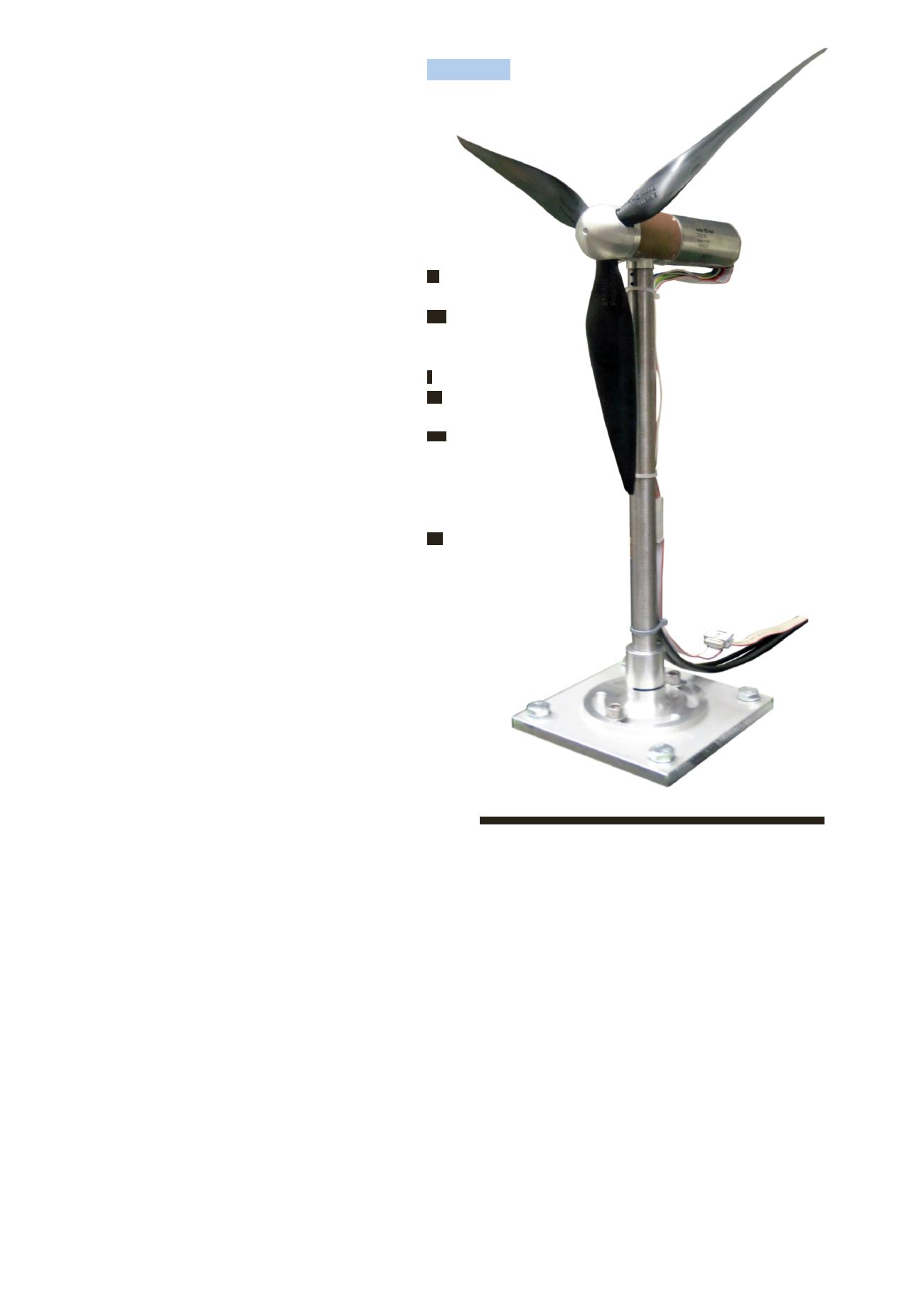
In order to identify the power produced by a model-scale
wind turbine (such as shown in Fig. 3) from the voltage
and current of the attached generator, the mechanical and
other losses of the drive train have to be known. Within
the Eurotech collaboration on wind energy (Greentech
project 03 Wind managed under the auspices of IGSSE)
our partners at EPFL (group of Prof. F. Porte-Agel) offered
us the possibility to calibrate the motors/generators for
two model-scale wind turbines in the facilities of the WIRE
lab at Lausanne which has recently acquired a suitable
miniature torque meter. In combination with our force
measurements these calibrations are mandatory for a
proper determination of the dependence of thrust and
power coefficients c
T
and c
P
as function of tip-speed ratio
and yaw angle under different roughness conditions.
Figure 3: Model-scale wind turbine for the experimental investigation of
the wake evolution over rough terrain in the atmospheric boundary layer
wind tunnel of the Chair of Aerodynamics and Fluid Mechanics. The rotor
diameter is abouit 450 mm.