




 170 / 308

170
Plant and Process Technology
Equipment Design Methods
In the chemical industry bubble col-
umns are used as multiphase reactors.
In the literature numerous experimental
studies investigate the regimes of
homogeneous and heterogeneous
bubble flow with low gas velocities up
to 0.4 m/s and propose correlations
for the prediction of the gas content.
At the Institute of Plant and Process
Technology a bubble column with a
diameter of 300 mm and a total height
of 5.5 m was operated at high gas
velocities up to 1.2 m/s. Different mix-
tures of water and 72.7% invert sugar
solution were used to selectively vary
the properties of the liquid, especially
the viscosity. The photograph shows
heterogeneous bubble flow in the blue-
colored solution in the column. A com-
parison of the measurement data with
different correlations for homogeneous
bubble flows shows clear deviations,
whereas some correlations show sim-
ilar tendencies for the heterogeneous
bubble flow. Based on a semi-empirical
approach, the measured gas content
for the heterogeneous flow of bubbles
Heterogeneous flow
of bubbles in a
bubble column
Simulation of irrigated structured packing
Modeling and Thermodynamic Property Data
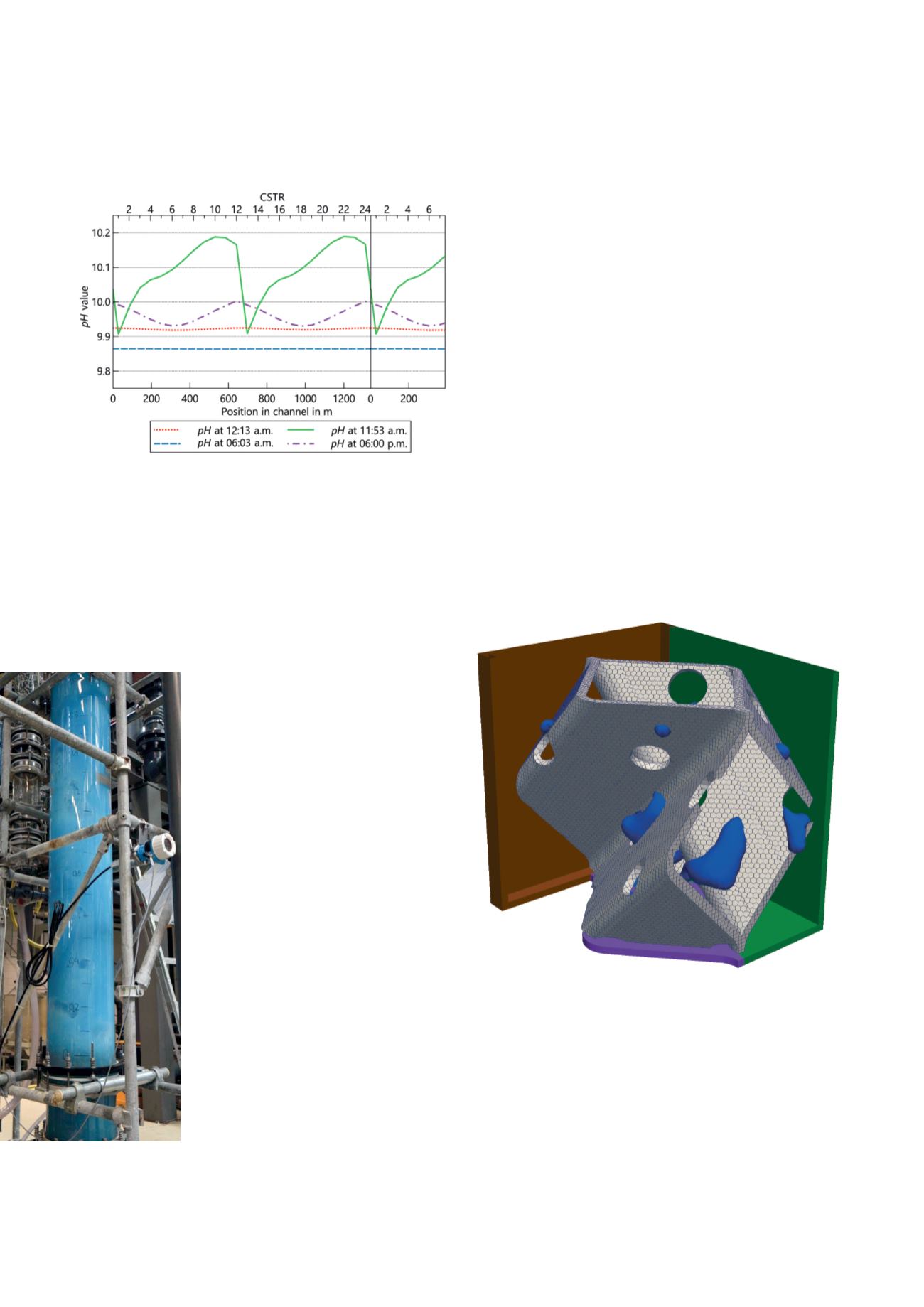
A dynamic model for open algae ponds was developed in
MATLAB at the Institute of Plant and Process Technology.
The model takes real weather data for selected locations
as input and enables the process engineer to optimize the
Typical dynamic behavior of pH value in open algae ponds
design of large raceway-type algae ponds. The developed
tool is essential since there is virtually no practical expe-
rience available on the behavior of these large ponds. A
possible CO
2
source is flue gas of power plants which can
either be used directly as feed for the algae pond or from
which the CO
2
can be captured and then used as a pure
CO
2
feed gas. Both options are covered in the MATLAB
model. Although growing algae in open ponds has been
done for decades, there is still a lot of research necessary
on how to efficiently grow algae in large systems with a
surface area per pond of 10 ha and greater and therefore
produce biofuels economically. At the Institute of Plant
and Process Technology a control scheme for CO
2
supply
has been developed with the fully dynamic MATLAB
model. It can be seen that for high yield algea a minimum
of three injection points are required for an algae pond
with a length of 1340 m and a width of 30 m. This ensures
that the pH-value stays within the range of 9.5 and 10.5.
The exemplary simulated location shown is Everglades,
Florida, taking a full year of available meteorological data.
can now be described for varying material properties with
a maximum deviation of ± 20%.
The model for dimensioning mass transfer columns based
on CAD data of packing elements, which was developed
at the institute, was successfully extended to structured
packings. The required coefficients were gained from
simulations with computational fluid dynamics. The picture
shows a representative element of structured packing
which is irrigated with liquid. The model can be used for a
more efficient design of distillation and absorption columns.