




 231 / 308

231
Thermodynamics
Double fiber probe inserted
into a two-phase flow
tions for validation of CFD-based critical heat flux mod-
eling. Special interest is placed on gathering data about
the morphology of the two-phase flow close to CHF in the
immediate vicinity of the heated wall. Measurements are
carried out using a variety of measurement techniques,
ranging from conventional thermocouples and pressure
sensors to high-speed videometry and optical micro-fiber
probes. The latter, shown in the figure representing a
double fiber probe, provide a way of measuring the local
void fraction, bubble velocity and bubble diameters inside
a flow channel.
research on the recovery of potable water from saline
water has therefore undergone a paradigm shift from a
product-centered activity to a comprehensive interdiscipli-
nary field.
Approach to Solution
Mainly two desalination techniques are currently investi-
gated at the Institute: reverse osmosis (RO) and vacuum
membrane distillation (VMD). The thermal driven process
of VMD can operate at salinities that go beyond the limits
of RO, which has to overcome the osmotic pressure of
saline solutions. This is a necessary feature especially
in brine treatment of desalination plants or waste water
treatment up to the so-called zero liquid discharge (ZLD).
Key Results
Similar to heat exchangers, in the RO process the
build-up of a concentration boundary layer decreases the
performance of the system. Experimental and numerical
studies on pulsatile flows showed that the water flux can
be significantly increased due to the distortion of the
boundary layer, depending on amplitude and frequency.
Furthermore, optical studies of pulsating flows in channels
including eddy promoters were performed to identify the
main fluid dynamic phenomena. During the experimental
investigations, a measurement technique was developed
to measure highly dynamic volume flow rates in hydraulic
systems.
Key Results
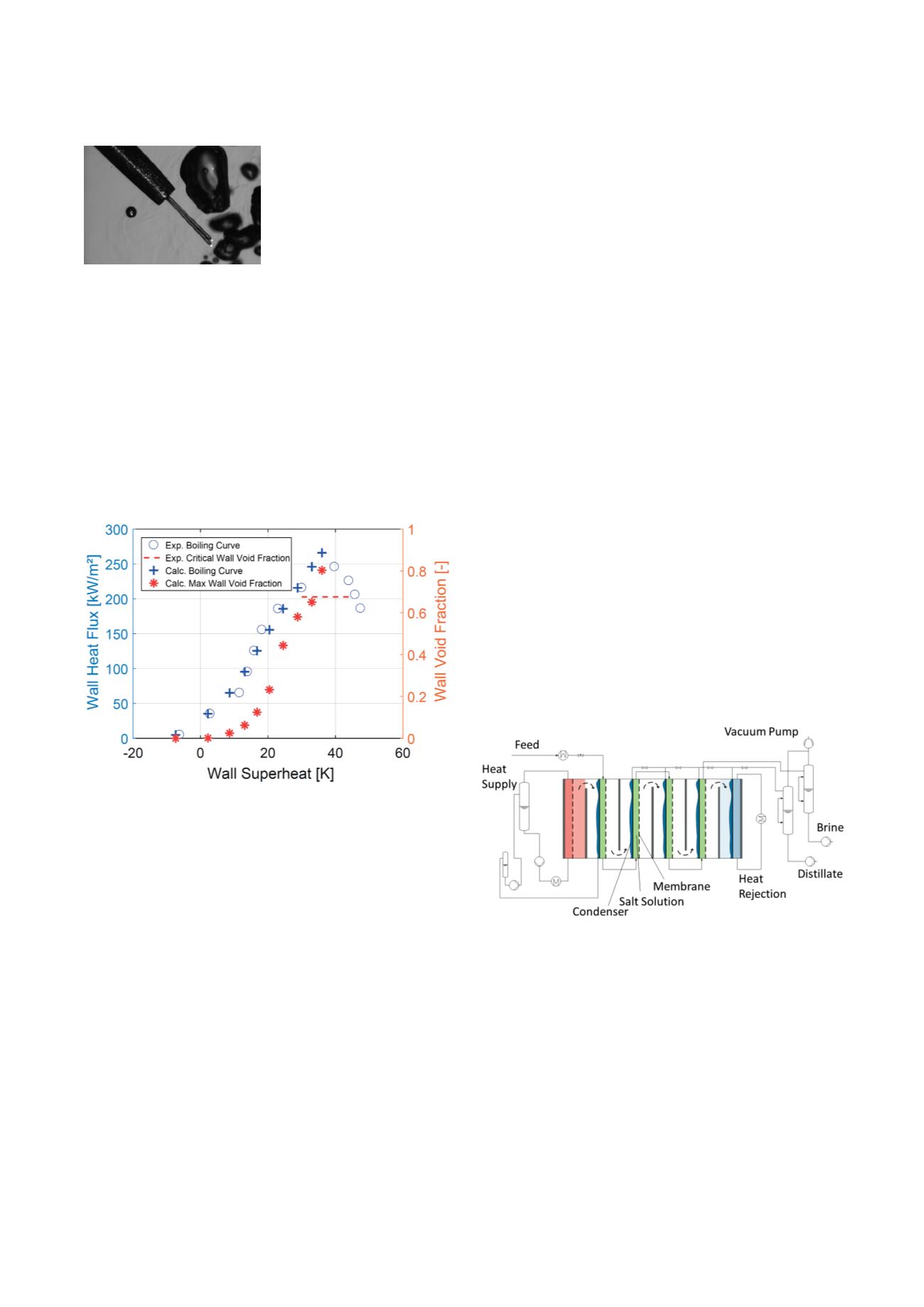
It was found that inlet subcooling is the main influence
parameter on void fraction. An analysis of the dynamic
behavior of the void along the entire boiling curve up to
fully developed film boiling revealed a sudden peak in
void fraction at the wall upon reaching critical heat flux in
conjunction with a significant increase in bubble velocity
close to the wall. The experimental data have been used
to develop a calibration procedure of the classical CFD
boiling model, as shown in the figure below.
2. Transport Phenomena in Desalination
Motivation and Objectives
Water processing and its related power consumption
within the constraints of an ecologically sustainable use of
globally essential resources has become one of the major
challenges of the 21st century. During the last decade
Left axis: Comparison of experimental with simulated boiling curve.
Right axis: Void fraction at the wall (dashed line: experimental result at CHF)
Sketch of the optimized VMD system design
Concerning VMD, during the last years the institute has
built up a research infrastructure to investigate the tech-
nology from multi-effect industrial systems down to heat
and mass transfer phenomena in the membrane channels
with respect to scaling behavior and membrane wetting.
Continuing the work of the last years a new model of a
multi-effect VMD system has been successfully com-
pleted. This tool developed can be used to optimize plant
design of multi-effect VMD systems and decrease the
energy consumption with respect to high concentrated
saline solutions and possible scaling effects.