



 281 / 308

281
Biochemical Engineering
Biocatalysis
Great demands are placed on the optical purity of build-
ing-blocks for the production of pharmaceuticals. Due to
the high natural selectivity of biocatalysts, biocatalysis
appears to be a favorable method for the purpose of chiral
syntheses. Major research interests are the development
of new reaction engineering methods and devices to
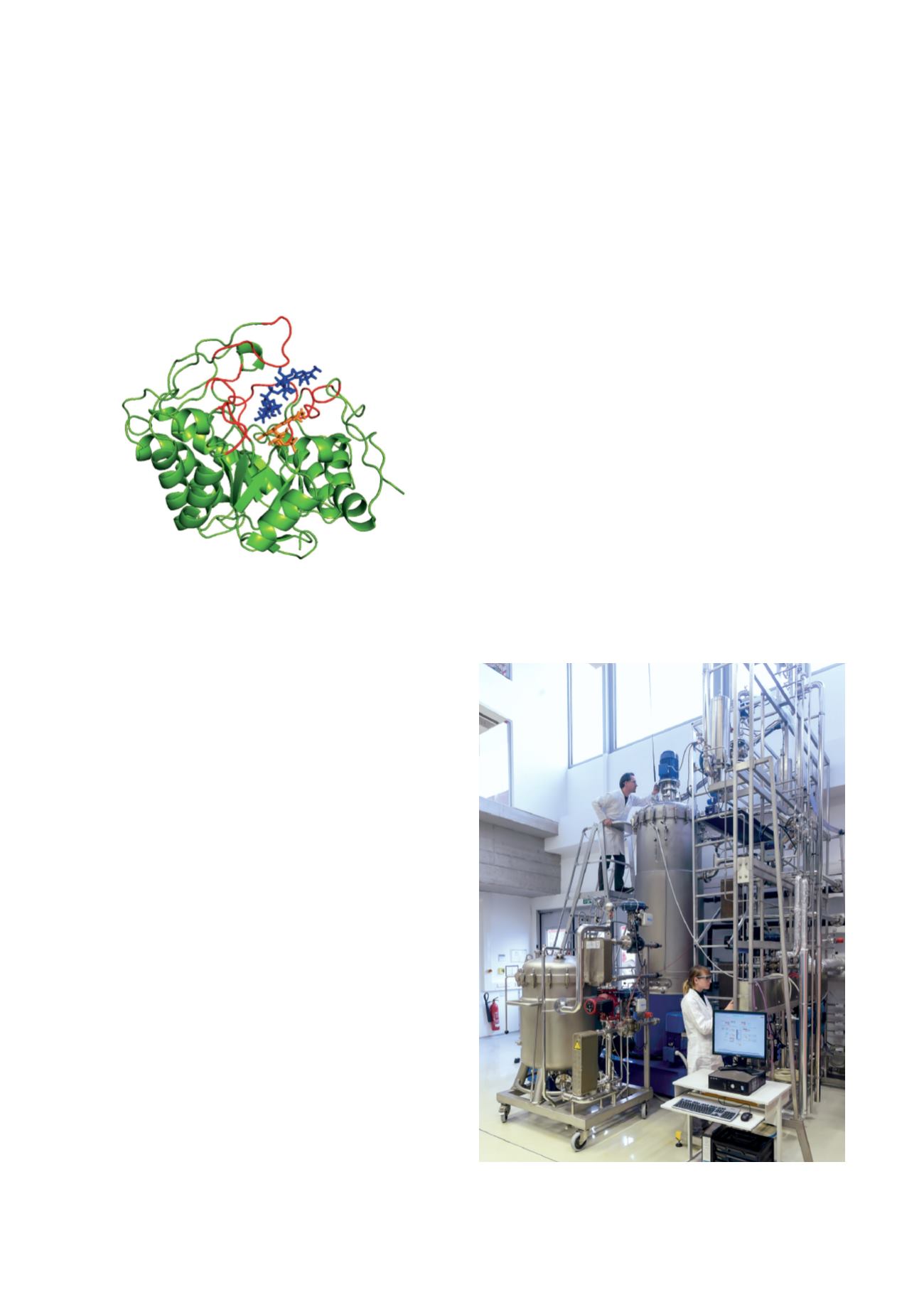
Model of an enzyme useful for the stereoselective reduction of alkenes
which was improved by rational exchange of loop regions (colored in red)
(copyright: Klermund, TUM)
intensify whole cell biotransformations of hydrophobic,
unstable and/or toxic substrates up to the technical scale.
Highlight
The activity of an industrially important enzyme isolated
from a cyanobacterium which catalyzes the stereo-selec-
tive reduction of alkenes was improved by a factor of 6 by
rational exchange of loop regions of the protein which are
supposed to interact with the electron transport metabo-
lite nicotinamide adenine dinucleotide (NADH).
Projects
■■
Polymeric nano-compartments for biocatalytic applica-
tions
■■
Membrane functionalization of nanoscale enzyme
membrane reactors
■■
Surface functionalization of nano-scale enzyme
membrane reactors
■■
Cellular envelopes for multi-enzyme synthesis
■■
Production of N-acetylneuraminic acid using epime-
rases from cyanobacteria
■■
Asymmetric syntheses with optimized ene-reductases
Fermentation
Making use of microorganisms for the production of
chemicals from renewable resources is the core of industrial
biotechnology. Reaction engineering analyses of metaboli-
cally optimized producer strains and metabolic analyses of
microorganisms in production processes are necessary for
efficient bio-production on an industrial scale.
Highlight
A new microbial production process was designed for
the efficient production of up to 225 g L
-1
L-erythrulose
(tanning agent used in cosmetics) from
meso
-erythritol
making use of a recombinant
Gluconobacter oxydans
provided by TUM Microbiology (Prof. Liebl).
Projects
■■
Population heterogeneity in industrial scale biopro-
cesses
■■
Metabolic analyses of recombinant microorganisms
from production processes
■■
Production of single-stranded DNA with
Escherichia
coli
■■
Production of terpenoid glycosides by recombinant
Escherichia coli
■■
Reaction engineering analysis of recombinant
Glucono-
bacter oxydans
Pilot-scale fermentations were performed at the TUM Research Center for
Industrial Biotechnology (photo: Tobias Hase, TUM)