



 277 / 308

277
Materials Science and Mechanics of Materials
Measurement, Redistribution and Relaxations of Residual Stress
Residual stresses, typically
acting on different length
scales depending on the
mechanisms they originate
from, can be beneficial or
detrimental for the material and
component performance. As a
consequence of compressive
macroscopic stresses near the
surface of a component, the
accumulation of micro-cracks
can be reduced and the life-
time of the component can be
extended. In contrast, tensile
macroscopic stresses can
lead to spontaneous cracking
which can reduce strength and
toughness.
A redistribution of residual
stress may result either from
the removal of portions of a
workpiece during machining
or from stress relaxation in
the material due to diffusion
processes and plays a central
role for most experimental
techniques applied for residual
stress analysis. Residual stress redistributions may lead
to undesired distortions of the whole component during
machining to its final shape or during the component’s
operating life. The macroscopic temperature-dependent
damping behavior of the material can provide important
information about the governing (microscopic) diffusion
processes, as it results from energy dissipation by internal
friction caused by (thermally activated) migration of crystal
lattice defects during loading/deformation.
In this context, research activities of WKM focus on
investigations of (residual) stress redistributions both on
macroscopic and microscopic scales as well as on the
identification of the underlying microscopic mechanisms.
This includes the application and further development
of experimental techniques involving diffraction and
mechanical methods. To investigate the diffusion pro-
cesses governing residual stress relaxation, the macro-
scopic damping behavior of the materials is investigated
by dynamic mechanical spectroscopy using an instru-
mented torsion pendulum and the impulse excitation
method.
Besides the semi-destructive hole drilling method, which
is an effective way of determining near-surface residual
stresses, dissection/slitting methods like boring of cylin-
ders are applied to analyze
axisymmetric residual stress
distributions in cylindrical
specimens. In most cases, an
accompanying residual stress
analysis via X-ray diffraction
on the specimen’s surface is
promising.
Neutron diffraction offers
the possibility of a spatially-
resolved, phase-specific and
non-destructive residual stress
analysis up to several centi
meters below the component’s
surface. In-situ neutron
diffraction experiments play
a central role within the
research activities of WKM
focusing on the evolution of
the intergranular and inter-
phase microstrains of different
nickel-base superalloys
(Inconel 718 and Haynes 282)
during loading and unloading
at room temperature and at elevated temperatures. Haynes
282, due to its good creep strength, thermal stability and
weldability, is developed for avian and land-based appli-
cations and exhibits a low diversity of precipitates and a
small lattice misfit, opening up the possibility of an in-depth
study on the micromechanics of the anomalous yielding
effect. A complementary rigorous characterization of both
microstructural aspects and their kinetics on different
length scales is accomplished by light- and electronmi-
croscopy (SEM/TEM), 3D-atomprobe tomography, small
angle neutron scattering, as well as X-ray diffraction. These
combined experimental techniques will help to identify the
mechanisms governing the different microstrain-accumula-
tion behavior of these alloys.
Project
■■
Entwicklung von Typ II Eigendehnungen in Abhängig-
keit der Mikrostruktur in Nickelbasislegierungen (DFG,
KR3687/3-1)
Partners
■■
Karlsruher Institut für Technologie, Institut für Ange-
wandte Materialien – Werkstoffkunde, Engelbert-
Arnold-Str. 4, 76131 Karlsruhe
■■
Forschungs-Neutronenquelle Heinz Maier-Leibnitz
(FRM II), Technische Universität München, Lichtenberg-
str. 1, 85748 Garching
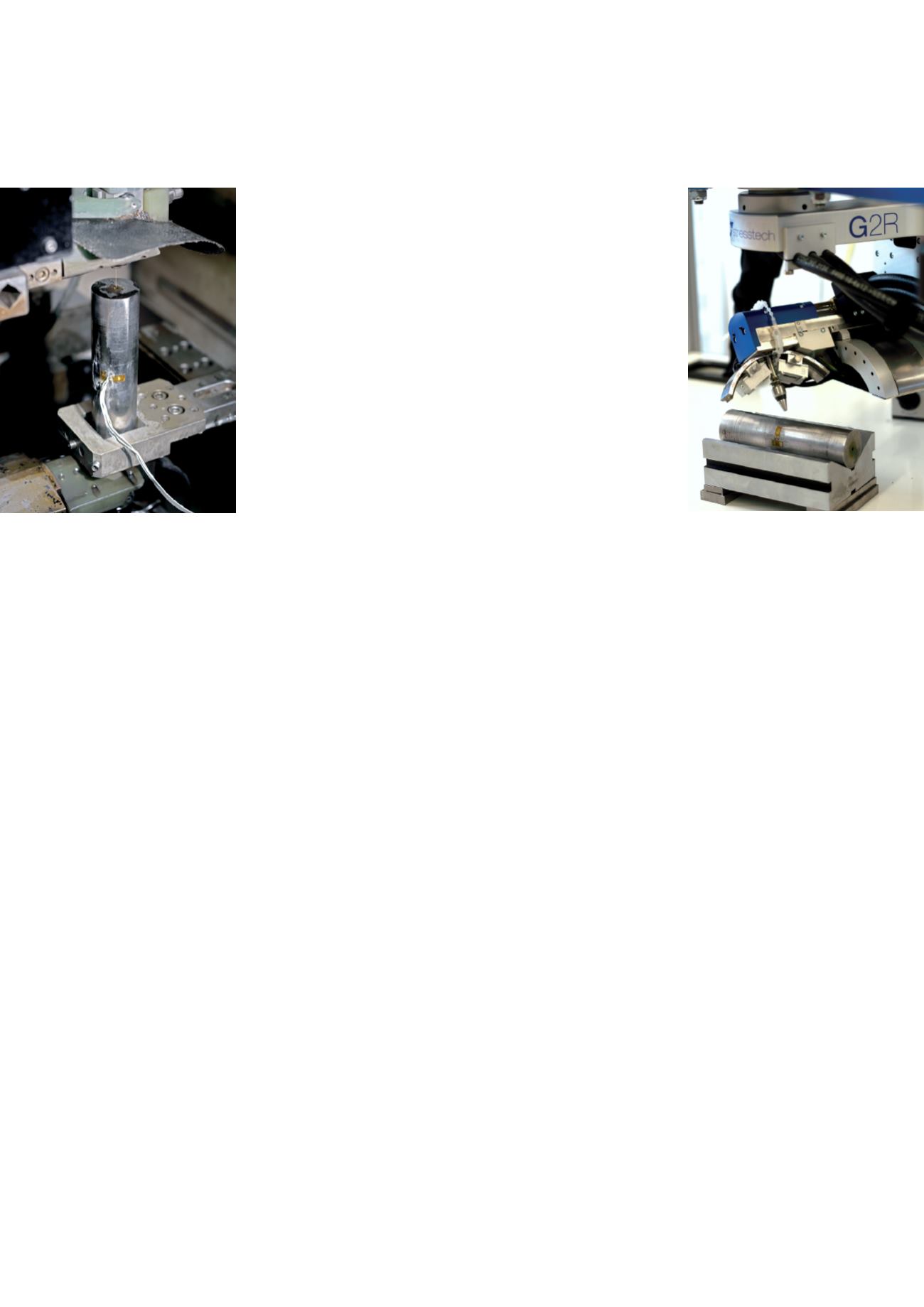
Characterization of the
axisymmetric residual stress
distribution in a cylindrical
specimen by WEDM (wire
electrical discharge machining)
assisted dissection. During
continuous material removal
on the inner cylindrical surface
via WEDM the strain relaxation
is simultaneously recorded by
strain gages mounted on the
lateral surface of the specimen.
(Source: WKM)
Semi-automatic residual
stress measurement via X-ray
diffraction (d-sin²x measure-
ment mode, two symmetrically
positioned linear detectors,
backscatter geometry) on
the surface of a cylindrical
specimen. (Source: WKM)