



 282 / 308

282
Biochemical Engineering
Gas Fermentation
Special microorganisms are able to produce chemicals
with carbon dioxide as sole carbon source. Electrons may
be supplied from sunlight or hydrogen gas. Bioprocess
engineering is the key to make use of these energy
sources for the microbial production of chemicals from
carbon dioxide on an industrial scale.
Highlight
New open thin-layer cascade photo-bioreactors made of
pond liner were designed and operated up to pilot scale
for the evaluation of new microalgae production pro-
cesses at physically simulated dynamic climate conditions
with respect to light (LED), temperature and air humidity
(e.g. Mediterranean summer in Spain) in the TUM Algae
TechCenter located at the Ludwig Bölkow Campus in
Ottobrunn.
Projects
■■
Modeling of microalgae cultivation in open photobio
reactors
■■
Characterization of new microalgae for open photobio-
reactors
■■
Mass production of microalgae in open photobioreactors
■■
Production of anti-oxidants with microalgae
New open thin-layer cascade photobioreactors operated in the TUM Algae
TechCenter, Ottobrunn (photo: Tobias Hase, TUM)
■■
Light-dependent growth kinetics in flat-plate photobio-
reactors
■■
Microalgae processes in open photobioreactors with
reduced water consumption
■■
Gas fermentation with
Clostridium carboxidivorans
■■
Gas fermentation with
Clostridium aceticum
■■
Multi-purpose reactor for gas fermentations
Bioprocess Integration
bioseparations are required yielding rather low product
yields. Therefore, existing bioseparation processes should
be improved and combined to reduce the number of
process steps. The focus is on bioprocess integration of
fermentation/biocatalysis and downstream processing.
Highlight
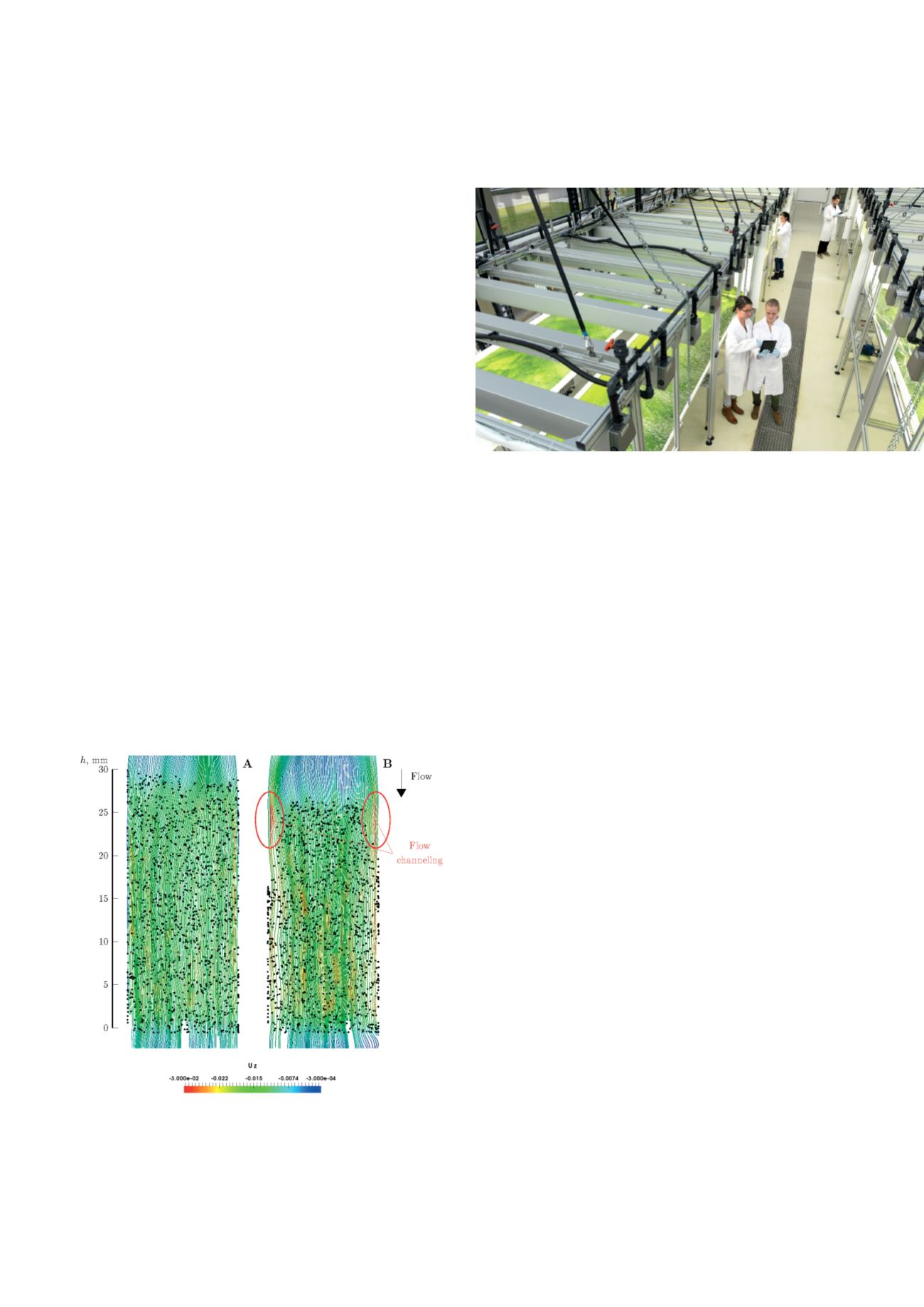
A three-dimensional deterministic model applying com-
putational fluid dynamics (CFD) coupled with the discrete
element method (DEM) was developed and validated
to simulate chromatographic column packing behavior
during either flow or mechanical compression.
Projects
■■
Non-stationary hydrodynamics of chromatography
columns
■■
Novel methods for packing of preparative chromatogra-
phy columns
■■
Preparative purification of proteins via extraction
■■
Engineering of proteins for the control of crystallization
processes
■■
Modeling and molecular dynamics simulation of protein
crystals
Simulated influence of particle migration on the fluid flow distribution in a
chromatography column (copyright: Dorn, TUM)
In many cases, downstream processing is by far the most
cost-intensive step of a bioprocess. Often, multiple-step