



 278 / 308

278
Materials Science and Mechanics of Materials
Plasticity and Failure of High-Strength Sheet Materials
for Automotive Applications
The desire to produce steel sheet material with a low
content of alloying elements but high strength and
excellent formability has led to the development of
microstructure-strengthened steels. Among these are the
ferritic-martensitic dual-phase (DP) steel grades. They
are produced from alloys containing mostly only iron and
carbon with the aid of a multi-step heat treatment. Their
microstructures consist of a soft matrix of ferrite, rein-
forced with dispersed, hard grains of martensite. Due to
their multi-phase nature, DP steels can be produced with
widely varying microstructural constitution.
Research activities at WKM related to DP steels focus on
the study of their heat treatment-induced microstructural
residual stresses and strains, their untypical plastic
deformation behavior and their damage behavior.
To attain an understanding of the complex mechanisms
which occur in DP-steel microstructures during pro-
cessing, forming, service or damage, it is necessary to
conduct systematic mechanical studies on the micro
and macro-levels. For this purpose, a simulation model
based on micro-continuum mechanics and tessellated (i.e.
computer generated) three-dimensional microstructures
was developed at WKM.
With the aid of this model, most currently the impact
of the heat treatment-induced microstructural residual
stresses and strains on the deformation behavior of
DP steels was demonstrated. Of particular importance in
this regard is the fact that this impact cannot be studied
correctly with the aid of simpler two-dimensional mod-
eling approaches, as were extensively used in the past.
Systematic variations in the simulations revealed which
processing-induced field quantity impacts the individual
peculiarities of the DP steels.
It could be shown, that regardless of the martensite
content, the heat treatment-induced residual stresses and
strains are qualitatively unaltered. Primary and secondary
causes for continuous yielding (a peculiar property of
the DP steels) could be identified. These are heat treat-
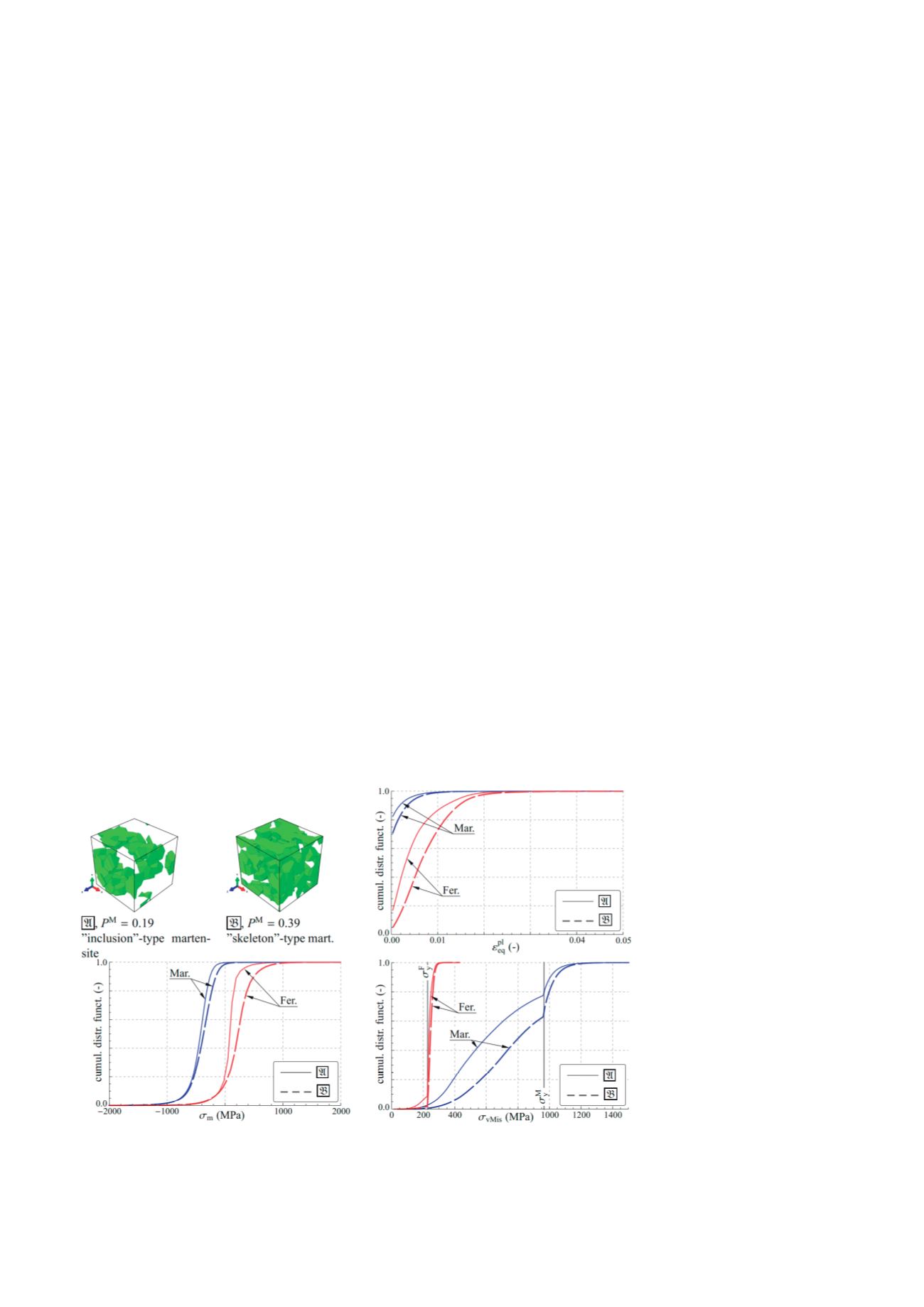
ment-induced plastic strains (figure, top right) and the
deviatoric component of the residual stresses (figure,
bottom right). The latter causes an unsymmetrical stress-
strain behavior of the material in tension and compression,
as well as a reduced Young’s modulus in the unaged
material state. Another important finding of this work is
that heat treatment-induced quantities impact the mac-
roscopic mechanical behavior of the DP steels only up to
roughly 1% of macroscopic strain.
Project
■■
Micromechanical modeling of the formability and failure
of DP steels
Partner
■■
voestalpine Stahl GmbH, voestalpine-Str. 3, 4020 Linz,
Austria
Two DP-steel model microstructures (top left; martensite: shaded, ferrite: transparent), differing only in martensite
phase fraction and their heat treatment-induced phase specific residual stresses and strain distributions. Top right:
plastic equivalent strain, the primary cause for continuous yielding; Bottom left: hydrostatic stress, the driving
quantity behind micro-damage; Bottom right: von Mises stress (the deviatoric stress component), the primary
cause for reduced Young’s modulus and yield-asymmetry in tension and compression. (Source: WKM)