



 276 / 308

276
Materials Science and Mechanics of Materials
Rubbing of Seal Systems in Gas Turbines
Achieving high aerodynamic efficiency in gas turbines
requires minimal clearance between the rotating and the
static components. This clearance can vary during opera-
tion, e.g. due to thermal expansion or dynamic loads. As
this clearance cannot be controlled sufficiently, rubbing
can occur locally, during which both the rotor and the
stator can be damaged critically. To ensure high reliability
and efficiency of the entire engine, seal systems that can
tolerate even extreme rubbing are necessary. Labyrinth
seals with special rubbing materials on the stator are able
to meet these requirements. However, rubbing processes
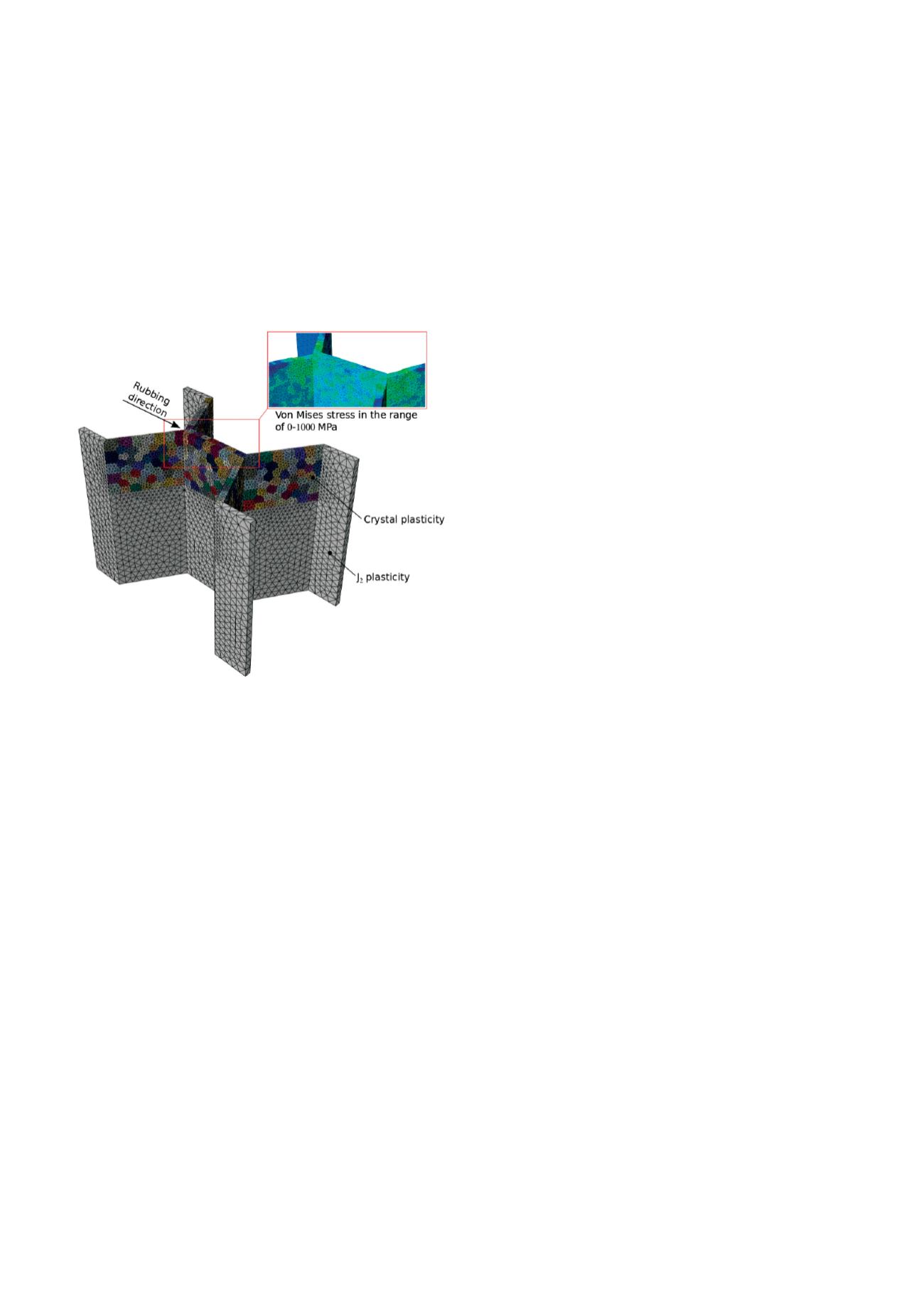
Three-dimensional finite element model of the periodic honeycomb unit
cell for simulating the rubbing process. In the detail the von Mises stress in
the rubbing area is shown. The structure contains roughly 300 grains with
an average grain size of 72 µm and random crystallographic orientation.
(Source: WKM)
in such seal systems are not yet completely understood.
The interactions of the numerous influencing parameters
as well as the extreme conditions during rubbing, such as
high temperatures and high rubbing velocities, complicate
the investigations. In collaboration with the Karlsruhe
Institute of Technology and the University of Bayreuth,
WKM contributes to a better understanding of the rubbing
process in labyrinth seals. It is the aim of the research
project to develop suitable models and tools that allow the
design of labyrinth seals of future gas turbines as well as
the reliable prediction of performance and lifetime of the
seals.
WKM conducts fully three-dimensional multiscale finite
element simulations with a microstructure-sensitive mode-
ling approach featuring attributes such as crystal orien-
tation, grain size and grain size distribution. The model is
also applicable for deformations at high temperatures and
high strain-rates. Various rubbing conditions are investi-
gated to find out possible drivers for crack formation that
can lead to failure of both rotor and stator.
Project
■■
Anstreifvorgänge in Turbinen – Experimentelle Untersu-
chung und Modellierung (DFG, WE2351/14-1)
Partners
■■
Universität Bayreuth, Lehrstuhl für Metallische Werk
stoffe, Ludwig-Thoma-Str. 36b, 95447 Bayreuth
■■
Karlsruher Institut für Technologie, Institut für Thermi
sche Strömungsmaschinen, Straße am Forum 6, 76131
Karlsruhe
■■
MTU Aero Engines AG, Dachauer Str. 665, 80995
München
characteristics are determined by hardness and compres-
sion testing. The resulting microstructure of the material in
dependence of the composition and process parameters
is another focus of the current investigation. Additionally,
expected phases are predicted via calculation of phase
diagrams (CALPHAD method) using a thermodynamic
database for HEA. Due to the sluggish diffusion reported,
mechanical alloying will be necessary in addition to heat
treatments to achieve a homogeneous distribution of the
alloying elements.